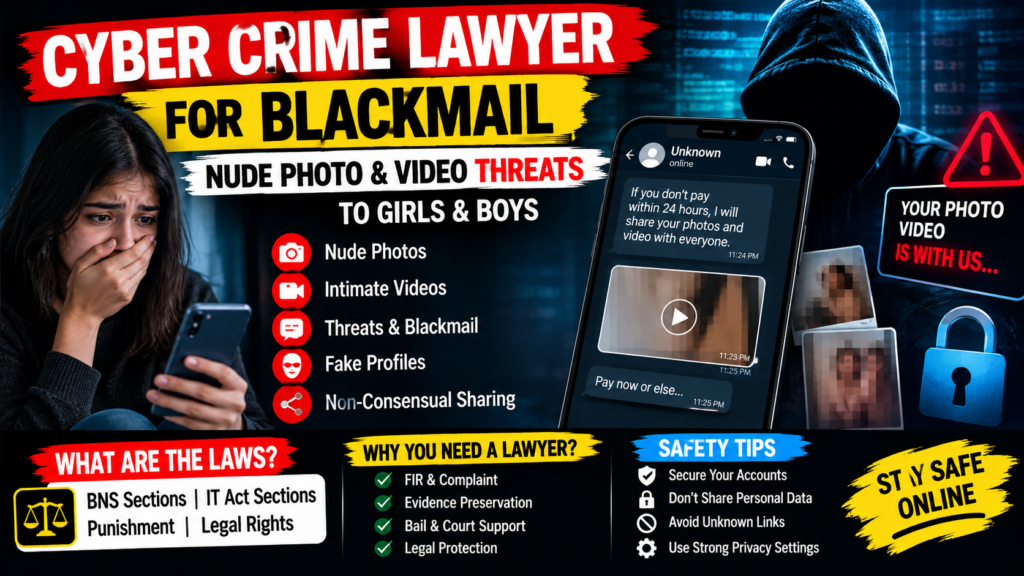
(IT & Cyber Lawyer) | Online Blackmailing by Nude Photo & Video
Cyber Crime Lawyer for Nude Photo & Video Blackmail in India – Online Blackmail, Sextortion, Intimate Image & Cyber Harassment Cases Online blackmail involving private photographs, intimate videos, nude images, manipulated photographs, fake profiles or threats to publish personal content can be extremely serious. Such incidents can affect women and men, girls and boys, individuals, students, professionals, married persons and people using social-media or dating platforms. A person may initially receive a message from an unknown social-media account, dating profile or online contact. After obtaining a private photograph or video, the offender may threaten to share it with family members, friends, colleagues, classmates or on social-media platforms unless the victim pays money or follows further demands. This type of conduct is commonly described as online blackmail, nude photo blackmail, intimate video blackmail, sextortion, cyber extortion, revenge-porn related abuse, non-consensual intimate image sharing or cyber harassment, depending on the facts. A cyber crime lawyer for blackmail cases can assist with complaint preparation, preservation of digital evidence, communication with investigating authorities, platform-related evidence, removal-related requests, criminal proceedings and other appropriate legal remedies. For incidents occurring under the current criminal-law framework, the Bharatiya Nyaya Sanhita, 2023 (BNS) applies from 1 July 2024, while the Information Technology Act, 2000 continues to contain important technology-specific offences. What Is Online Nude Photo or Video Blackmail? Online blackmail occurs when a person threatens another person with harm, exposure, humiliation, publication or disclosure of private information in order to obtain money, property, sexual acts, continued contact or some other benefit. Common examples include: Threatening to publish nude photographs Threatening to upload an intimate video Threatening to send private photographs to family members Threatening to expose private chats Demanding money to delete photographs Demanding cryptocurrency to stop publication Threatening to send videos to an employer Threatening to contact friends or relatives Creating fake social-media accounts using private photographs Editing photographs to create misleading or intimate images Repeatedly contacting the victim after being asked to stop Threatening to publish private material unless the victim meets the offender Demanding additional money after an earlier payment Threatening publication through Instagram, Facebook, Telegram, WhatsApp or other platforms The legal provisions depend on the exact conduct and evidence. Cyber Crime Lawyer for Blackmail Cases in India A cyber crime lawyer for blackmail deals with legal issues arising from threats, digital harassment, private-image misuse, online extortion, cyber stalking, impersonation and other technology-enabled offences. Legal assistance can be relevant for both: Victims A victim may require assistance to: Preserve evidence Prepare a detailed complaint Identify relevant offences Report the account or content Communicate with the appropriate authorities Address repeated threats Protect digital accounts Follow up on an investigation Seek appropriate court remedies Persons Accused A person facing allegations may require legal advice concerning: FIR or complaint Police notice Digital evidence Seizure of devices Arrest and bail Applicable statutory provisions Investigation Criminal proceedings Defence based on the actual evidence The legal position should always be assessed from the facts rather than simply from an accusation or social-media allegation. Nude Photo Blackmail and Intimate Video Blackmail Private photographs or videos do not become free for publication merely because they were voluntarily shared with another person. A person may have consented to: Taking a photograph; Sending a photograph privately; Recording a video; or Sharing material with one particular person, without consenting to its publication or transmission to third parties. This distinction can be legally important. For women, BNS Section 77 (Voyeurism) specifically addresses watching, capturing or disseminating images of a woman engaged in a private act in circumstances covered by the provision. The section provides imprisonment of one to three years and fine for a first conviction, and three to seven years and fine for a second or subsequent conviction. For victims of any gender, IT Act Section 66E may be relevant where its statutory requirements concerning non-consensual capture, publication or transmission of an image of a private area are satisfied. The punishment can extend to three years’ imprisonment, or fine up to ₹2 lakh, or both. Important Sections for Online Blackmail and Nude Photo Cases 1. BNS Section 351 – Criminal Intimidation Blackmail involving threats to a person’s reputation can potentially fall within criminal intimidation where the statutory ingredients are satisfied. BNS Section 351 covers threats involving injury to a person’s: Person Reputation Property Reputation of a person in whom they are interested where the required intention to cause alarm or compel conduct is present. The ordinary punishment under Section 351(2) is: Up to 2 years’ imprisonment, or fine, or both. For specified aggravated threats, including threats involving death or grievous hurt, destruction of property by fire, certain serious offences, or imputing unchastity to a woman, Section 351(3) provides punishment of: Up to 7 years’ imprisonment, or fine, or both. Anonymous intimidation is addressed separately under Section 351(4). A threat such as “Pay me or I will send your private video to your family and colleagues” should therefore be carefully documented and legally assessed. 2. BNS Section 308 – Extortion Online sextortion or intimate-photo blackmail may also involve extortion when a person intentionally puts another person in fear of injury and thereby dishonestly induces delivery of property or other covered items. BNS Section 308 expressly gives an illustration involving a threat to publish defamatory material unless money is given. Under Section 308(2), ordinary extortion is punishable with: Up to 7 years’ imprisonment, or fine, or both. More serious forms of extortion involving threats of death or grievous hurt can attract higher punishment, including up to 10 years and fine under Section 308(5). Therefore, when an offender says: “Pay money or I will publish your private photographs.” the matter may require examination under extortion provisions if the statutory ingredients are present. 3. IT Act Section 66E – Violation of Privacy Section 66E of the Information Technology Act deals with intentionally or knowingly capturing, publishing or transmitting the image of a person’s private area without consent in circumstances violating privacy. Punishment: Up to 3 years’ imprisonment, or fine up
(IT & Cyber Lawyer) | Online Blackmailing by Nude Photo & Video Read More »


