
Cyber Crime Lawyer for Nude Photo & Video Blackmail in India – Online Blackmail, Sextortion, Intimate Image & Cyber Harassment Cases
Online blackmail involving private photographs, intimate videos, nude images, manipulated photographs, fake profiles or threats to publish personal content can be extremely serious. Such incidents can affect women and men, girls and boys, individuals, students, professionals, married persons and people using social-media or dating platforms.
A person may initially receive a message from an unknown social-media account, dating profile or online contact. After obtaining a private photograph or video, the offender may threaten to share it with family members, friends, colleagues, classmates or on social-media platforms unless the victim pays money or follows further demands.
This type of conduct is commonly described as online blackmail, nude photo blackmail, intimate video blackmail, sextortion, cyber extortion, revenge-porn related abuse, non-consensual intimate image sharing or cyber harassment, depending on the facts.
A cyber crime lawyer for blackmail cases can assist with complaint preparation, preservation of digital evidence, communication with investigating authorities, platform-related evidence, removal-related requests, criminal proceedings and other appropriate legal remedies.
For incidents occurring under the current criminal-law framework, the Bharatiya Nyaya Sanhita, 2023 (BNS) applies from 1 July 2024, while the Information Technology Act, 2000 continues to contain important technology-specific offences.
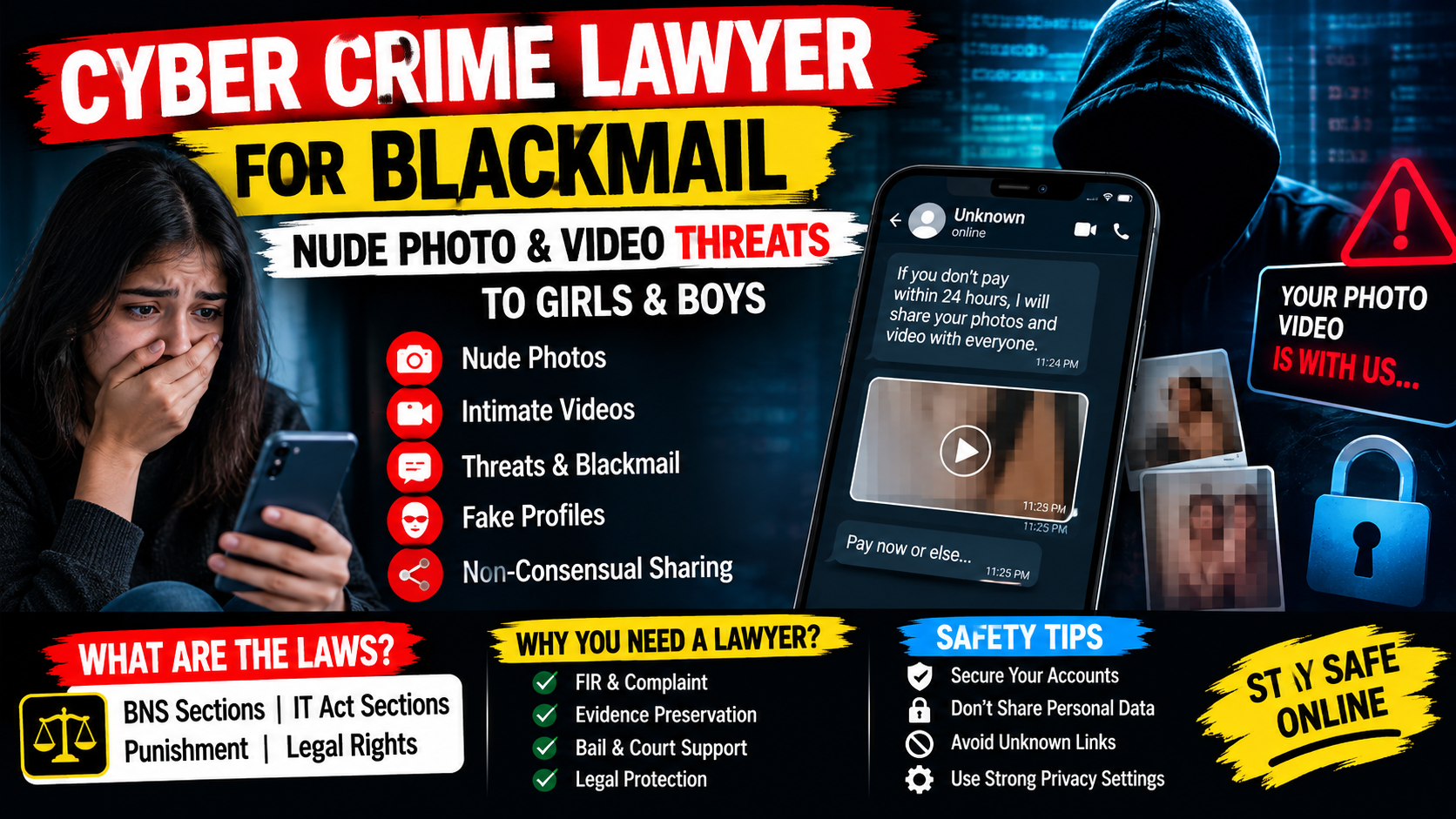
What Is Online Nude Photo or Video Blackmail?
Online blackmail occurs when a person threatens another person with harm, exposure, humiliation, publication or disclosure of private information in order to obtain money, property, sexual acts, continued contact or some other benefit.
Common examples include:
- Threatening to publish nude photographs
- Threatening to upload an intimate video
- Threatening to send private photographs to family members
- Threatening to expose private chats
- Demanding money to delete photographs
- Demanding cryptocurrency to stop publication
- Threatening to send videos to an employer
- Threatening to contact friends or relatives
- Creating fake social-media accounts using private photographs
- Editing photographs to create misleading or intimate images
- Repeatedly contacting the victim after being asked to stop
- Threatening to publish private material unless the victim meets the offender
- Demanding additional money after an earlier payment
- Threatening publication through Instagram, Facebook, Telegram, WhatsApp or other platforms
The legal provisions depend on the exact conduct and evidence.
Cyber Crime Lawyer for Blackmail Cases in India
A cyber crime lawyer for blackmail deals with legal issues arising from threats, digital harassment, private-image misuse, online extortion, cyber stalking, impersonation and other technology-enabled offences.
Legal assistance can be relevant for both:
Victims
A victim may require assistance to:
- Preserve evidence
- Prepare a detailed complaint
- Identify relevant offences
- Report the account or content
- Communicate with the appropriate authorities
- Address repeated threats
- Protect digital accounts
- Follow up on an investigation
- Seek appropriate court remedies
Persons Accused
A person facing allegations may require legal advice concerning:
- FIR or complaint
- Police notice
- Digital evidence
- Seizure of devices
- Arrest and bail
- Applicable statutory provisions
- Investigation
- Criminal proceedings
- Defence based on the actual evidence
The legal position should always be assessed from the facts rather than simply from an accusation or social-media allegation.
Nude Photo Blackmail and Intimate Video Blackmail
Private photographs or videos do not become free for publication merely because they were voluntarily shared with another person.
A person may have consented to:
- Taking a photograph;
- Sending a photograph privately;
- Recording a video; or
- Sharing material with one particular person,
without consenting to its publication or transmission to third parties.
This distinction can be legally important.
For women, BNS Section 77 (Voyeurism) specifically addresses watching, capturing or disseminating images of a woman engaged in a private act in circumstances covered by the provision. The section provides imprisonment of one to three years and fine for a first conviction, and three to seven years and fine for a second or subsequent conviction.
For victims of any gender, IT Act Section 66E may be relevant where its statutory requirements concerning non-consensual capture, publication or transmission of an image of a private area are satisfied. The punishment can extend to three years’ imprisonment, or fine up to ₹2 lakh, or both.
Important Sections for Online Blackmail and Nude Photo Cases
1. BNS Section 351 – Criminal Intimidation
Blackmail involving threats to a person’s reputation can potentially fall within criminal intimidation where the statutory ingredients are satisfied.
BNS Section 351 covers threats involving injury to a person’s:
- Person
- Reputation
- Property
- Reputation of a person in whom they are interested
where the required intention to cause alarm or compel conduct is present.
The ordinary punishment under Section 351(2) is:
Up to 2 years’ imprisonment, or fine, or both.
For specified aggravated threats, including threats involving death or grievous hurt, destruction of property by fire, certain serious offences, or imputing unchastity to a woman, Section 351(3) provides punishment of:
Up to 7 years’ imprisonment, or fine, or both.
Anonymous intimidation is addressed separately under Section 351(4).
A threat such as “Pay me or I will send your private video to your family and colleagues” should therefore be carefully documented and legally assessed.
2. BNS Section 308 – Extortion
Online sextortion or intimate-photo blackmail may also involve extortion when a person intentionally puts another person in fear of injury and thereby dishonestly induces delivery of property or other covered items.
BNS Section 308 expressly gives an illustration involving a threat to publish defamatory material unless money is given.
Under Section 308(2), ordinary extortion is punishable with:
Up to 7 years’ imprisonment, or fine, or both.
More serious forms of extortion involving threats of death or grievous hurt can attract higher punishment, including up to 10 years and fine under Section 308(5).
Therefore, when an offender says:
“Pay money or I will publish your private photographs.”
the matter may require examination under extortion provisions if the statutory ingredients are present.
3. IT Act Section 66E – Violation of Privacy
Section 66E of the Information Technology Act deals with intentionally or knowingly capturing, publishing or transmitting the image of a person’s private area without consent in circumstances violating privacy.
Punishment:
Up to 3 years’ imprisonment, or fine up to ₹2 lakh, or both.
This provision is gender-neutral, which is important because private-image abuse can affect both men and women.
4. IT Act Section 67 – Obscene Material
Section 67 deals with publishing or transmitting obscene material in electronic form where its statutory requirements are satisfied.
Punishment for a first conviction can extend to:
3 years’ imprisonment and fine up to ₹5 lakh.
For a second or subsequent conviction:
Up to 5 years’ imprisonment and fine up to ₹10 lakh.
The exact application of Section 67 depends upon the nature of the material and the statutory ingredients.
5. IT Act Section 67A – Sexually Explicit Material
Section 67A addresses publication or transmission of material containing sexually explicit acts or conduct in electronic form.
For a first conviction:
Up to 5 years’ imprisonment and fine up to ₹10 lakh.
For a second or subsequent conviction:
Up to 7 years’ imprisonment and fine up to ₹10 lakh.
Accordingly, online publication or transmission of sexually explicit material can create significant criminal liability where the provision applies.
6. IT Act Section 67B – Material Involving Children
Where a person below 18 is involved, the legal position becomes particularly serious.
Section 67B covers specified conduct involving electronic material depicting children in sexually explicit acts or conduct, including publishing, transmitting, collecting, seeking, browsing, downloading, advertising, promoting, exchanging or distributing such material, subject to the statutory language.
Punishment for a first conviction can extend to:
5 years’ imprisonment and fine up to ₹10 lakh.
For a second or subsequent conviction:
Up to 7 years’ imprisonment and fine up to ₹10 lakh.
Where a minor is involved, additional provisions under child-protection laws may also become relevant depending on the facts.
Never forward, download, store or circulate suspected child sexual-abuse material. Preserve only the information necessary to report the incident and follow official instructions.
7. BNS Section 78 – Cyber Stalking
Repeated unwanted online contact or monitoring may constitute stalking where the statutory ingredients are met.
BNS Section 78 includes repeatedly contacting a woman despite a clear indication of disinterest and monitoring her use of the internet, email or other electronic communication.
Punishment for a first conviction can extend to:
3 years’ imprisonment and fine.
For a second or subsequent conviction:
Up to 5 years’ imprisonment and fine.
This provision can become relevant where blackmail is accompanied by persistent online monitoring or repeated unwanted contact.
8. BNS Section 79 – Intrusion Into Privacy / Insulting Modesty of a Woman
BNS Section 79 covers specified words, sounds, gestures, objects or acts intended to insult the modesty of a woman, including intrusion upon her privacy.
Punishment:
Simple imprisonment up to 3 years and fine.
Whether Section 79 applies to a particular online incident depends on the exact conduct and statutory ingredients.
Old IPC Provisions and New BNS Provisions
For older incidents, the IPC framework may remain relevant. For offences committed after the new criminal laws came into force, the BNS framework generally applies subject to the statutory transition provisions.
Some relevant comparisons include:
| Earlier IPC | Current BNS | Subject |
|---|---|---|
| IPC 503 | BNS 351 | Criminal intimidation |
| IPC 506 | BNS 351 | Punishment for criminal intimidation |
| IPC 507 | BNS 351(4) | Anonymous criminal intimidation |
| IPC 383–389 | BNS 308 | Extortion |
| IPC 354C | BNS 77 | Voyeurism |
| IPC 354D | BNS 78 | Stalking |
| IPC 509 | BNS 79 | Insulting modesty/privacy of a woman |
The IT Act provisions such as Sections 66E, 67, 67A and 67B continue to operate as technology-specific provisions.
Blackmail Using Nude Photos – What Evidence Should You Preserve?
Evidence can be extremely important in a cyber blackmail case.
Preserve:
Screenshots
Take screenshots showing:
- Threatening messages
- Profile name
- Username
- Phone number
- Date and time
- Payment demands
- Threats to publish content
Chat Records
Preserve relevant:
- WhatsApp chats
- Telegram chats
- Instagram messages
- Facebook messages
- Email communications
- SMS
Financial Evidence
If money was demanded or transferred, preserve:
- Bank statements
- UPI transaction IDs
- UTR numbers
- Wallet addresses
- Cryptocurrency transaction hashes
- Payment receipts
- Beneficiary details
Account Information
Record:
- Username
- Profile URL
- Phone number
- Email address
- Website URL
- UPI ID
- Cryptocurrency wallet address
Do not delete the original conversation merely because you have taken screenshots.
What to Do If Someone Is Blackmailing You With Nude Photos or Videos
Step 1 – Do Not Panic
Blackmailers often attempt to create fear and urgency.
Take a moment to document the incident.
Step 2 – Do Not Keep Negotiating
Repeatedly communicating with the offender can sometimes make the situation worse.
Do not voluntarily provide additional photographs, videos, passwords or OTPs.
Step 3 – Do Not Pay Automatically
Payment does not necessarily end blackmail.
An offender may demand additional money after receiving the first payment.
Step 4 – Preserve Evidence
Save relevant messages, profile information, transaction records and other evidence.
Step 5 – Secure Your Accounts
Change passwords and enable appropriate two-factor authentication.
Check:
- Email accounts
- Telegram
- Cloud storage
- Google/Apple accounts
Step 6 – Report the Account
Use the relevant platform’s reporting mechanism for non-consensual intimate imagery, harassment, impersonation or blackmail.
Step 7 – Make a Cybercrime Complaint
Report the incident through the appropriate official cybercrime and law-enforcement channels.
Step 8 – Consult a Cyber Crime Lawyer
A cyber blackmail lawyer can review the evidence and advise on the appropriate legal route.
Why You Should Not Delete the Blackmail Messages
Victims sometimes immediately delete the entire conversation because they are embarrassed or frightened.
This can remove useful evidence.
Before deleting anything, preserve:
- Complete chats
- Usernames
- Profile URLs
- Phone numbers
- Email addresses
- Payment requests
- Threats
- Screenshots
- Transaction records
- Relevant files
Where technically possible, preserve the original device and relevant electronic records rather than relying exclusively on edited screenshots.
What If the Blackmailer Has Already Uploaded the Photo or Video?
If private material has already been uploaded:
- Record the exact URL.
- Capture relevant screenshots.
- Record the username/account details.
- Report the content to the platform.
- Preserve the complaint/report reference.
- Make the appropriate cybercrime complaint.
- Avoid forwarding the material to friends or relatives.
- Consult a cybercrime lawyer regarding available legal remedies.
Do not unnecessarily circulate the content while attempting to prove that it exists.
What If the Blackmailer Is Demanding Money?
A demand for money connected with threats can potentially raise extortion issues where the statutory requirements are satisfied.
BNS Section 308 defines extortion as intentionally putting a person in fear of injury and thereby dishonestly inducing delivery of property or other specified things. Ordinary extortion under Section 308(2) can carry up to 7 years’ imprisonment, or fine, or both.
A victim should preserve:
- Amount demanded
- Payment instructions
- UPI ID
- Bank account
- Wallet address
- QR code
- Cryptocurrency address
- Screenshots
- Threatening messages
These details can help establish the financial trail.
What If the Victim Is a Boy or Man?
Cyber blackmail is not limited to women.
Men and boys can also face:
- Nude-photo blackmail
- Intimate-video threats
- Fake dating scams
- Video-call recording scams
- Social-media blackmail
- Fake-profile extortion
- Cryptocurrency sextortion
- Threats to contact family or employer
The IT Act Section 66E is gender-neutral where its requirements concerning private-area images are met. Criminal intimidation and extortion provisions can also apply based on the facts.
Therefore, a male victim should not hesitate to seek legal assistance simply because the victim is a man.
What If the Victim Is a Girl or Woman?
Women may face:
- Nude photo blackmail
- Intimate video threats
- Cyber stalking
- Fake profiles
- Social-media harassment
- Revenge-image threats
- Sexual harassment
- Privacy violations
- Extortion
Depending on the facts, provisions such as BNS Sections 77, 78 and 79, IT Act Section 66E and other applicable laws may be considered.
What If the Photograph Was Originally Sent Voluntarily?
Voluntary sharing of an intimate photograph with one person does not automatically mean consent to publish or distribute it to other people.
The legal assessment depends on:
- What consent was given
- To whom the photograph was sent
- Whether publication was authorised
- How the material was obtained
- Whether it was subsequently transmitted
- Whether threats were made
- Whether money was demanded
A private image shared privately is not automatically permission for public distribution.
Fake Nude Photos and AI-Generated Images
Modern cyber blackmail may also involve manipulated or artificially generated images.
An offender may threaten a victim with a fabricated intimate photograph even though the victim never created such an image.
Potential legal issues may involve:
- Impersonation
- Defamation
- Criminal intimidation
- Extortion
- Privacy violations
- Identity misuse
- Online harassment
- Forgery or electronic-record related offences
The precise provisions depend upon how the image was created, used and distributed.
A deepfake blackmail lawyer or cybercrime advocate can examine the underlying evidence and identify the applicable legal provisions.
Why Do You Need a Cyber Crime Lawyer for Blackmail?
A blackmail case can involve multiple legal and technical issues simultaneously.
1. Identifying Applicable Sections
The same incident may involve:
- Extortion
- Criminal intimidation
- Privacy violation
- Voyeurism
- Stalking
- Identity misuse
- Obscene or sexually explicit electronic material
- Other criminal offences
2. Preserving Digital Evidence
A lawyer can help identify which records may be important.
3. Complaint Preparation
A properly structured complaint can explain:
- Who contacted the victim
- How contact started
- What material was obtained
- What threats were made
- What money was demanded
- Which accounts were used
- Where the content was uploaded
- What evidence is available
4. Investigation Support
Legal assistance can be relevant when dealing with investigative communications and evidence.
5. Bank and Payment Trail
Where money has been transferred, the transaction trail can be important to the investigation.
6. Court Proceedings
If the matter proceeds to court, appropriate representation and procedural advice may be required.
Cyber Blackmail Case – Common Mistakes to Avoid
Avoid these mistakes:
Do not pay repeatedly.
Do not send additional intimate photographs.
Do not threaten the blackmailer with illegal retaliation.
Do not hack the blackmailer’s account.
Do not publicly post the blackmailer’s alleged private information.
Do not forward intimate material to prove the allegation to friends.
Do not delete all evidence.
Do not give your OTP, password or banking credentials.
Do not install unknown remote-access applications.
Do not assume that paying the offender guarantees deletion.
Safety Tips to Prevent Online Blackmail
Use Strong Passwords
Use unique passwords for important accounts.
Enable Two-Factor Authentication
Activate 2FA wherever available.
Review Privacy Settings
Restrict who can:
- Message you
- View your stories
- See your friends/followers
- Download or reuse profile information
Be Careful With Video Calls
Do not assume that a private video call cannot be recorded.
Avoid Sending Highly Sensitive Material to Unknown or Newly Met People
Online identities can be fabricated.
Verify Dating and Social-Media Profiles
Do not rely solely on photographs or profile information.
Never Share OTPs
Banks and legitimate service providers should not require you to disclose authentication credentials in response to unsolicited calls or messages.
Protect Cloud Accounts
A compromised cloud account can expose old photographs and videos.
Review Logged-In Devices
Periodically review active sessions on email and social-media accounts.
Cyber Crime Lawyer for Sextortion and Online Blackmail
Sextortion is a commonly used term for situations where someone threatens to expose sexual or intimate material unless the victim complies with a demand.
The demand may involve:
- Money
- Cryptocurrency
- Additional photographs
- Additional videos
- Sexual activity
- Continued communication
- Meeting the offender
- Personal information
A sextortion lawyer in India can review the threats, payment demands, digital evidence and applicable criminal provisions.
Cyber Crime Lawyer for Revenge Image Threats
Threats to publish private photographs after the end of a relationship can create serious legal issues.
Common allegations may involve:
- Criminal intimidation
- Extortion
- Privacy violations
- Voyeurism where applicable
- Online harassment
- Stalking
- IT Act offences
The fact that the parties were previously in a relationship does not by itself establish consent to subsequent publication.
Cyber Blackmail and Social Media
Blackmailers may use:
- Telegram
- Snapchat
- Dating applications
- Video-chat applications
- Fake websites
A victim should preserve the account’s username, profile URL and relevant messages before blocking the account, wherever practical.
Advocate Deepak – Cyber Crime Lawyer for Online Blackmail Cases
Advocate Deepak (IT & Cyber Lawyer) provides legal assistance in cybercrime and technology-related criminal matters, including online blackmail, nude photo and intimate video threats, cyber extortion, sextortion, cyber stalking, privacy violations, digital evidence and online harassment.
Legal assistance may include:
- Cybercrime complaint preparation
- Online blackmail matters
- Intimate-image misuse cases
- Nude photo/video blackmail
- Cyber extortion
- Sextortion cases
- Social-media harassment
- Cyber stalking
- Digital evidence
- Online impersonation
- Identity theft
- Bank and payment-related cyber fraud
- Investigation-related legal assistance
- Bail and criminal proceedings where applicable
One-line profile:
Advocate Deepak (IT & Cyber Lawyer) assists victims and accused persons in online blackmail, intimate photo/video misuse, cyber extortion, sextortion, cyber harassment and related cybercrime matters, with a focus on digital evidence and applicable criminal and technology laws.
When Should You Contact a Cyber Crime Lawyer?
Consider obtaining legal advice promptly when:
- Someone threatens to publish your nude photograph.
- Someone threatens to upload your intimate video.
- Someone demands money for deleting private material.
- Someone threatens to send your photograph to your family.
- Someone has already uploaded private content.
- A fake profile has been created using your photographs.
- Someone is repeatedly contacting or stalking you online.
- You have transferred money to a blackmailer.
- Your social-media account has been compromised.
- You have received a police/cybercrime notice.
- You have been accused of online blackmail.
- Your electronic device has been seized in an investigation.
Important Punishment Table
| Provision | Conduct | Maximum / prescribed punishment |
|---|---|---|
| BNS 308(2) | Extortion | Up to 7 years, or fine, or both |
| BNS 308(5) | Extortion involving fear of death/grievous hurt | Up to 10 years + fine |
| BNS 351(2) | Criminal intimidation | Up to 2 years, or fine, or both |
| BNS 351(3) | Specified aggravated threats | Up to 7 years, or fine, or both |
| BNS 77 | Voyeurism involving a woman | 1–3 years + fine first conviction; 3–7 years + fine subsequent conviction |
| BNS 78 | Stalking | Up to 3 years + fine first conviction; up to 5 years + fine subsequent conviction |
| BNS 79 | Specified insult to modesty/privacy of a woman | Up to 3 years + fine |
| IT Act 66E | Violation of privacy involving private-area images | Up to 3 years or ₹2 lakh fine or both |
| IT Act 67 | Publishing/transmitting obscene electronic material | Up to 3 years + ₹5 lakh first conviction; higher punishment for subsequent conviction |
| IT Act 67A | Publishing/transmitting sexually explicit electronic material | Up to 5 years + ₹10 lakh first conviction; up to 7 years + ₹10 lakh subsequent conviction |
| IT Act 67B | Specified electronic material involving children | Up to 5 years + ₹10 lakh first conviction; up to 7 years + ₹10 lakh subsequent conviction |
These provisions are fact-specific; not every blackmail case automatically attracts every section listed above.
Frequently Asked Questions
What should I do if someone is blackmailing me with nude photos?
Preserve the messages and account details, avoid sending additional intimate material, consider not making further payments, secure your accounts, report the content/account through the appropriate channels and make a cybercrime complaint. Legal advice can help determine the appropriate criminal and procedural remedies.
Can I file a cybercrime complaint for intimate video blackmail?
Yes. Where the facts disclose a cyber offence or other criminal offence, the matter can be reported to the appropriate cybercrime or law-enforcement authority.
What if the blackmailer has my private video but has not uploaded it?
Do not wait for publication before preserving evidence. Threatening messages, payment demands and account information can themselves be important evidence.
What if I already paid the blackmailer?
Preserve the payment records. Do not assume that paying more will solve the problem. Bank statements, UPI records, UTR numbers, wallet addresses and transaction hashes can be relevant.
Can boys also file complaints for nude-photo blackmail?
Yes. Men and boys can also be victims of online blackmail, intimate-image abuse and cyber extortion. Gender-neutral provisions such as IT Act Section 66E may be relevant where their requirements are satisfied.
What if a fake nude photo has been created using my face?
Preserve the fake image only as necessary for reporting and evidence, record the account/URL, report the content and seek legal assistance. Depending on the facts, different criminal and technology-law provisions may apply.
What if the victim is below 18?
Cases involving persons under 18 require particularly careful handling. Do not circulate or forward the material. IT Act Section 67B contains specific offences concerning electronic material depicting children in sexually explicit acts or conduct, with severe penalties.
Can a lawyer guarantee that the blackmailer will be arrested?
No. A lawyer cannot guarantee arrest, conviction, removal of content or recovery of money. Investigation and court outcomes depend on evidence, jurisdiction and the actions of the competent authorities.
SEO Keyword Variations for This Topic
Primary keyword:
Cyber Crime Lawyer for Blackmail
Related keywords:
- Cyber blackmail lawyer in India
- Online blackmail lawyer
- Nude photo blackmail lawyer
- Nude video blackmail lawyer
- Intimate photo blackmail lawyer
- Intimate video blackmail advocate
- Sextortion lawyer in India
- Sextortion advocate
- Cyber extortion lawyer
- Online sextortion lawyer
- Private photo blackmail lawyer
- Private video blackmail lawyer
- Revenge photo lawyer
- Revenge image case lawyer
- Non-consensual intimate image lawyer
- Private image misuse lawyer
- Cyber harassment lawyer
- Cyber stalking lawyer
- Online harassment advocate
- Social media blackmail lawyer
- Instagram blackmail lawyer
- WhatsApp blackmail lawyer
- Telegram blackmail lawyer
- Facebook blackmail lawyer
- Nude photo threat lawyer
- Intimate video threat lawyer
- Online photo blackmail advocate
- Online video blackmail advocate
- Cybercrime lawyer for sextortion
- Cyber crime advocate for blackmail
- IT Act lawyer for privacy violation
- Cyber lawyer for intimate image abuse
- Digital blackmail lawyer
- Cyber extortion advocate
- Online reputation threat lawyer
- Private content blackmail lawyer
- Deepfake blackmail lawyer
- AI image blackmail lawyer
- Fake nude photo lawyer
- Cyber crime lawyer for women
- Cyber crime lawyer for men
- Online blackmail lawyer near me
- Cyber crime advocate in Noida
- Cyber crime lawyer in Delhi NCR
- Blackmail case lawyer in Noida
- Sextortion lawyer in Noida
Online blackmail involving nude photographs, intimate videos, private images or threats of publication is a serious legal matter. The victim does not have to handle the situation alone or continue negotiating with the blackmailer.
Depending on the facts, the conduct may involve extortion under BNS Section 308, criminal intimidation under BNS Section 351, voyeurism under BNS Section 77, stalking under BNS Section 78, and technology-specific offences under Sections 66E, 67, 67A or 67B of the IT Act.
The most important practical steps are to preserve evidence, avoid sending additional private material, secure online accounts, report the incident through appropriate channels and obtain timely legal advice.
Advocate Deepak (IT & Cyber Lawyer) handles legal matters relating to cyber blackmail, online sextortion, intimate photo/video misuse, cyber extortion, cyber stalking, privacy-related offences, digital evidence and other cybercrime matters.
Legal Disclaimer: This article is for general legal information and educational purposes only. The applicable offence, section, punishment, procedure and legal remedy depend on the facts, date of the alleged conduct, evidence and applicable law. No particular result, arrest, content removal or recovery is guaranteed.


