The Best Cyber Crime Lawyer Online 

How to Check Who Filed a Complaint on the NCRP Portal

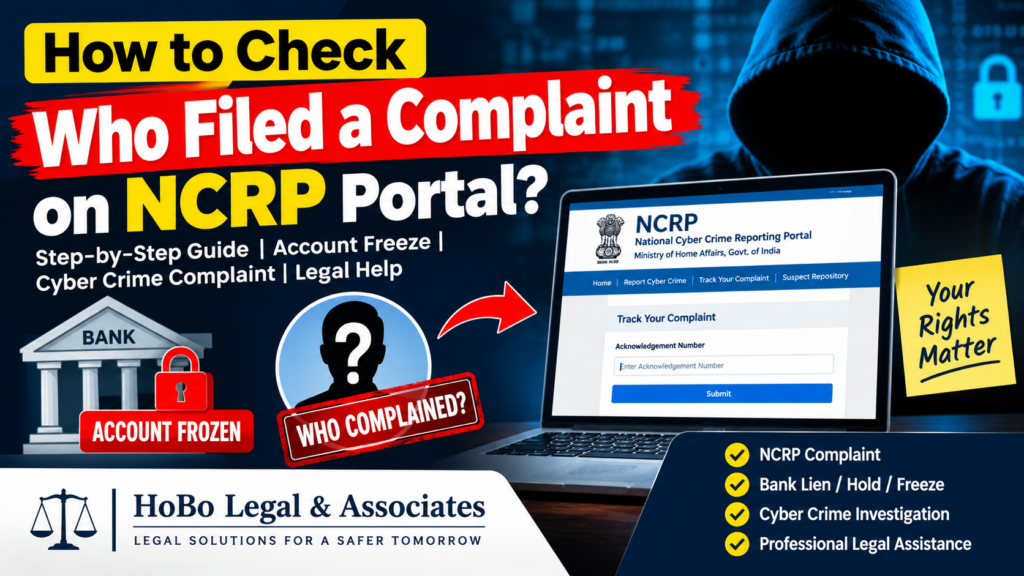
How to Check Who Filed a Complaint on the NCRP Portal in India If your bank account has been frozen, lien marked, put on hold, or debit restricted because of a cyber crime complaint, one of the first questions you may have is: “Who filed the NCRP complaint against me?” This question is particularly common when a person receives a message from the bank stating that the account is restricted due to a cyber crime complaint, NCRP complaint, CFCFRMS complaint, police instruction, or disputed transaction. However, checking the identity of the person who filed a cybercrime complaint is not the same as checking the status of your own complaint. The National Cyber Crime Reporting Portal (NCRP) allows complainants to register and track their own complaints. The official portal provides a facility to track a complaint using its acknowledgement number and OTP. It does not provide a general public search facility where an account holder can enter their bank account number and obtain the identity of every person who complained against them. Therefore, if your account has been frozen because of an NCRP-related cyber-fraud complaint, the practical route is generally to identify the concerned investigating authority, police station, transaction and complaint reference, and then seek the relevant information through the appropriate legal or administrative process. What Is an NCRP Complaint? The National Cyber Crime Reporting Portal is the Government of India’s online platform for reporting cybercrime. It covers categories including: Online financial fraud UPI fraud Banking fraud Cryptocurrency-related cybercrime Hacking Identity theft Social-media crimes Mobile-related cybercrime Ransomware Other cyber offences The official NCRP website states that complaints are handled by the concerned State/UT law-enforcement agencies, rather than NCRP itself acting as the investigating police agency. Can I Directly Check Who Filed an NCRP Complaint Against Me? Generally, there is no public NCRP search option that allows an accused or affected account holder to enter their account number and see the complainant’s name and complete complaint details. The portal’s complaint-status facility is designed for tracking a complaint using its acknowledgement number and OTP. This is different from asking: “Who complained against my bank account?” That information may be held by the concerned State/UT law-enforcement agency or another authorized agency handling the matter. The Ministry of Home Affairs has also clarified that I4C manages the technical infrastructure of NCRP, while complaints are investigated by the concerned State/UT law-enforcement agencies. Why Does the Bank Say “NCRP Complaint”? When a bank account is connected with a reported financial cyber fraud, the bank may receive information or instructions relating to the disputed transaction. The account holder may then receive a message such as: “Your account has been lien marked due to a cyber crime complaint.” or: “Debit freeze has been placed pursuant to NCRP/CFCFRMS.” or: “Account restricted based on instructions from cyber crime police.” This does not necessarily mean that the bank itself knows every detail that the account holder wants to know. The bank may have only received a particular instruction or transaction-related reference. Important: NCRP Is Not the Same as an FIR An NCRP acknowledgement or complaint reference is not automatically an FIR number. The official Citizen Manual explains that the complaint ID generated after reporting a cybercrime is a confirmation of registration on the portal and is not an FIR number. Therefore: NCRP Complaint ≠ Automatically FIR A complaint can be reported online and subsequently handled by the jurisdictional State/UT law-enforcement agency. Whether an FIR has been registered is a separate question that may need to be confirmed from the concerned police authority. How to Find Which Cyber Crime Police Station Is Handling the Matter If your account is frozen, start by asking your bank for available information concerning the restriction. Ask for: ☞ Name of the concerned authority ☞ Cyber Crime Police Station name ☞ State and district ☞ Investigating Officer details, if available ☞ Police reference number ☞ NCRP/CFCFRMS reference, if available ☞ Transaction ID/UTR ☞ Date of disputed transaction ☞ Amount under lien ☞ Date of lien/freeze ☞ Nature of restriction ☞ Any available communication reference The bank may not be able to disclose every investigation detail, but requesting the available information in writing is useful. Step 1 – Ask the Bank for the Reason for the Freeze Submit a written request to the bank. Your request can state that your account has been restricted and that you require clarification regarding: The nature of the restriction Amount under lien Transaction concerned Authority requesting the restriction Police station/cyber cell, where available Reference number Date of communication Procedure for submitting your explanation Do not rely solely on a telephone conversation. A written request creates a record. Step 2 – Ask for the Disputed Transaction If the account has been frozen because of an alleged financial cyber fraud, ask which transaction caused the restriction. For example: Account holder: XYZ Disputed amount: ₹35,000 Transaction date: 12 September UTR: XXXXXXXX Restriction: Lien/debit freeze Once the transaction is identified, you can determine whether the payment was: A genuine sale Business payment Refund Loan Salary Investment Personal transfer UPI payment Cryptocurrency transaction Gaming-related payment Other legitimate transaction The explanation must be based on actual facts. Step 3 – Identify the Transaction Layer Cyber financial fraud investigations may trace money through multiple accounts. For example: Victim → Account A → Account B → Account C → Account D If your account is Account B, you may want to know: Why did the money come to my account? and: Who reported the original transaction? The investigating authority may have information regarding the original complaint and transaction chain. The account holder can provide their explanation and supporting documents to help establish their role. Step 4 – Contact the Concerned Cyber Crime Police Station Once the police station or investigating authority is identified, submit a written representation. The representation can request: ☞ Confirmation that the account has been identified in a cyber-fraud investigation ☞ Relevant transaction details to the extent legally permissible ☞ Identification of the case/complaint reference ☞ Clarification

How to Check Who Filed a Complaint on the NCRP Portal Read More »

Cyber Crime Lawyer in Supreme Court of India

Cyber Crime Lawyer in Supreme Court of India – Cybercrime, Digital Fraud, Bail, Appeals & Digital Evidence Cybercrime cases in India are increasingly involving complex online transactions, digital evidence, electronic communications, cryptocurrency, banking fraud, hacking, identity theft, cyber blackmail and other technology-related offences. When a cybercrime matter reaches the Supreme Court of India, the legal issues may involve appeals, special leave petitions, bail, constitutional remedies, interpretation of criminal law, electronic evidence and questions concerning the investigation or trial. A Cyber Crime Lawyer in Supreme Court of India may assist in matters involving cybercrime, online financial fraud, digital evidence, cyber fraud investigations, hacking, cryptocurrency disputes, bank account freezes, cyber blackmail, identity theft and other technology-related criminal proceedings. The Supreme Court has appellate and constitutional jurisdiction, including jurisdiction under Article 32 for enforcement of Fundamental Rights and powers concerning transfer of criminal cases in appropriate circumstances. Therefore, a matter reaching the Supreme Court requires careful examination of the procedural history, orders passed by lower courts and the legal questions involved. Cyber Crime Lawyer in Supreme Court of India A Cyber Crime Lawyer in Supreme Court handles or advises on legal proceedings involving cybercrime and technology-related criminal matters that reach the apex court. Cybercrime cases may involve: Online financial fraud UPI fraud Internet banking fraud Cryptocurrency fraud Investment fraud Trading fraud Hacking Identity theft Cyber blackmail Online harassment Cyber stalking Data theft Electronic evidence Digital evidence Social-media offences Online cheating Business email compromise Bank account freeze Bank account lien Cybercrime investigation Criminal appeals Special Leave Petitions Bail matters Anticipatory bail-related proceedings Quashing-related proceedings Transfer petitions Constitutional remedies The Supreme Court does not function as an ordinary trial court for every cybercrime matter. The availability of a Supreme Court remedy depends upon the nature and procedural stage of the case. What Does a Cyber Crime Lawyer in Supreme Court Do? A Supreme Court Cyber Crime Lawyer may be involved when a cybercrime dispute reaches the apex court through an appropriate legal proceeding. Depending upon the case, legal work may include: Examining the judgment or order challenged before the Supreme Court. Reviewing the FIR, complaint, charge-sheet and investigation record. Examining digital and electronic evidence. Advising regarding bail proceedings. Preparing or assisting with Special Leave Petition proceedings. Advising on criminal appeals. Examining constitutional or jurisdictional issues. Reviewing questions concerning electronic evidence. Advising regarding bank account restrictions connected with cyber investigations. Representing a client in appropriate Supreme Court proceedings. The exact procedure depends upon the facts, applicable law and procedural history. Cyber Crime Cases That Can Reach the Supreme Court Cybercrime cases can reach the Supreme Court through different legal routes. Examples may include: Criminal Appeals An accused person or prosecution may challenge an order or judgment before the Supreme Court where the law permits such an appeal. Special Leave Petition In appropriate cases, a party may approach the Supreme Court through a Special Leave Petition challenging a judgment, decree, determination, sentence or order. Bail Proceedings Cybercrime-related bail matters can reach the Supreme Court in appropriate circumstances. The Supreme Court has dealt with criminal matters arising from Cyber Crime Police Station investigations, including orders concerning bail. Constitutional Remedies The Supreme Court has original jurisdiction under Article 32 for enforcement of Fundamental Rights. The availability of such a remedy depends on the nature of the grievance and the constitutional issue involved. Transfer Matters The Supreme Court has power to transfer certain civil or criminal proceedings from one High Court to another High Court or from a subordinate court to another High Court, subject to the applicable legal requirements. Cyber Crime Bail Lawyer in Supreme Court Bail is an important issue in many cybercrime investigations. Cybercrime allegations may involve: Online cheating Financial fraud Cryptocurrency transactions Hacking Identity theft Cyber extortion Data theft Electronic-document offences Social-media offences Financial transaction investigations A Cyber Crime Bail Lawyer in Supreme Court can examine the procedural history of the case and determine what Supreme Court remedy may be available. The Supreme Court has passed orders granting bail in matters arising from cybercrime investigations, while making the relief subject to case-specific terms and conditions. Bail is always dependent on the facts and circumstances of the particular case. Anticipatory Bail and Cybercrime Cases Anticipatory bail is generally sought before arrest, subject to the applicable criminal procedure and jurisdiction. A cybercrime matter may involve questions such as: Whether an FIR has been registered Which offences have been invoked Whether a person has received an investigation notice Whether the accused has joined the investigation Whether custodial interrogation is being sought Whether digital devices are involved Whether financial transactions are being investigated Whether a lower court or High Court has already considered bail A Cyber Crime Advocate in Supreme Court can examine the procedural history and advise whether a Supreme Court proceeding is legally maintainable and appropriate. Regular Bail in Cybercrime Cases Where an accused has already been arrested, regular bail proceedings may arise. The case may involve: FIR Arrest Remand Investigation Charge-sheet Trial Bail applications Orders of subordinate courts High Court proceedings Supreme Court proceedings A Supreme Court Cyber Crime Lawyer can examine the orders already passed and determine the appropriate legal course based on the procedural stage. Digital Evidence in Supreme Court Cybercrime Cases Digital evidence is often one of the most important components of a cybercrime case. It may include: Emails WhatsApp conversations SMS messages Social-media records Mobile phone data Computer files CCTV footage Bank transaction records UPI transaction records Electronic documents Website records Server records Call-related records Cryptocurrency transaction records Digital photographs Videos Cloud data The Supreme Court has addressed issues concerning electronic records and the legal requirements applicable to their evidentiary use. Its judgments have discussed the statutory framework governing electronic records and admissibility requirements. Therefore, a Cyber Crime Lawyer in Supreme Court of India needs to examine not only what a digital record says but also the applicable evidentiary and procedural requirements. Electronic Evidence and Cybercrime Litigation Electronic evidence can become important in both prosecution and defence. A cybercrime case may rely

Cyber Crime Lawyer in Supreme Court of India Read More »

(IT & Cyber Lawyer) | Online Blackmailing by Nude Photo & Video

Cyber Crime Lawyer for Nude Photo & Video Blackmail in India – Online Blackmail, Sextortion, Intimate Image & Cyber Harassment Cases Online blackmail involving private photographs, intimate videos, nude images, manipulated photographs, fake profiles or threats to publish personal content can be extremely serious. Such incidents can affect women and men, girls and boys, individuals, students, professionals, married persons and people using social-media or dating platforms. A person may initially receive a message from an unknown social-media account, dating profile or online contact. After obtaining a private photograph or video, the offender may threaten to share it with family members, friends, colleagues, classmates or on social-media platforms unless the victim pays money or follows further demands. This type of conduct is commonly described as online blackmail, nude photo blackmail, intimate video blackmail, sextortion, cyber extortion, revenge-porn related abuse, non-consensual intimate image sharing or cyber harassment, depending on the facts. A cyber crime lawyer for blackmail cases can assist with complaint preparation, preservation of digital evidence, communication with investigating authorities, platform-related evidence, removal-related requests, criminal proceedings and other appropriate legal remedies. For incidents occurring under the current criminal-law framework, the Bharatiya Nyaya Sanhita, 2023 (BNS) applies from 1 July 2024, while the Information Technology Act, 2000 continues to contain important technology-specific offences. What Is Online Nude Photo or Video Blackmail? Online blackmail occurs when a person threatens another person with harm, exposure, humiliation, publication or disclosure of private information in order to obtain money, property, sexual acts, continued contact or some other benefit. Common examples include: Threatening to publish nude photographs Threatening to upload an intimate video Threatening to send private photographs to family members Threatening to expose private chats Demanding money to delete photographs Demanding cryptocurrency to stop publication Threatening to send videos to an employer Threatening to contact friends or relatives Creating fake social-media accounts using private photographs Editing photographs to create misleading or intimate images Repeatedly contacting the victim after being asked to stop Threatening to publish private material unless the victim meets the offender Demanding additional money after an earlier payment Threatening publication through Instagram, Facebook, Telegram, WhatsApp or other platforms The legal provisions depend on the exact conduct and evidence. Cyber Crime Lawyer for Blackmail Cases in India A cyber crime lawyer for blackmail deals with legal issues arising from threats, digital harassment, private-image misuse, online extortion, cyber stalking, impersonation and other technology-enabled offences. Legal assistance can be relevant for both: Victims A victim may require assistance to: Preserve evidence Prepare a detailed complaint Identify relevant offences Report the account or content Communicate with the appropriate authorities Address repeated threats Protect digital accounts Follow up on an investigation Seek appropriate court remedies Persons Accused A person facing allegations may require legal advice concerning: FIR or complaint Police notice Digital evidence Seizure of devices Arrest and bail Applicable statutory provisions Investigation Criminal proceedings Defence based on the actual evidence The legal position should always be assessed from the facts rather than simply from an accusation or social-media allegation. Nude Photo Blackmail and Intimate Video Blackmail Private photographs or videos do not become free for publication merely because they were voluntarily shared with another person. A person may have consented to: Taking a photograph; Sending a photograph privately; Recording a video; or Sharing material with one particular person, without consenting to its publication or transmission to third parties. This distinction can be legally important. For women, BNS Section 77 (Voyeurism) specifically addresses watching, capturing or disseminating images of a woman engaged in a private act in circumstances covered by the provision. The section provides imprisonment of one to three years and fine for a first conviction, and three to seven years and fine for a second or subsequent conviction. For victims of any gender, IT Act Section 66E may be relevant where its statutory requirements concerning non-consensual capture, publication or transmission of an image of a private area are satisfied. The punishment can extend to three years’ imprisonment, or fine up to ₹2 lakh, or both. Important Sections for Online Blackmail and Nude Photo Cases 1. BNS Section 351 – Criminal Intimidation Blackmail involving threats to a person’s reputation can potentially fall within criminal intimidation where the statutory ingredients are satisfied. BNS Section 351 covers threats involving injury to a person’s: Person Reputation Property Reputation of a person in whom they are interested where the required intention to cause alarm or compel conduct is present. The ordinary punishment under Section 351(2) is: Up to 2 years’ imprisonment, or fine, or both. For specified aggravated threats, including threats involving death or grievous hurt, destruction of property by fire, certain serious offences, or imputing unchastity to a woman, Section 351(3) provides punishment of: Up to 7 years’ imprisonment, or fine, or both. Anonymous intimidation is addressed separately under Section 351(4). A threat such as “Pay me or I will send your private video to your family and colleagues” should therefore be carefully documented and legally assessed. 2. BNS Section 308 – Extortion Online sextortion or intimate-photo blackmail may also involve extortion when a person intentionally puts another person in fear of injury and thereby dishonestly induces delivery of property or other covered items. BNS Section 308 expressly gives an illustration involving a threat to publish defamatory material unless money is given. Under Section 308(2), ordinary extortion is punishable with: Up to 7 years’ imprisonment, or fine, or both. More serious forms of extortion involving threats of death or grievous hurt can attract higher punishment, including up to 10 years and fine under Section 308(5). Therefore, when an offender says: “Pay money or I will publish your private photographs.” the matter may require examination under extortion provisions if the statutory ingredients are present. 3. IT Act Section 66E – Violation of Privacy Section 66E of the Information Technology Act deals with intentionally or knowingly capturing, publishing or transmitting the image of a person’s private area without consent in circumstances violating privacy. Punishment: Up to 3 years’ imprisonment, or fine up

(IT & Cyber Lawyer) | Online Blackmailing by Nude Photo & Video Read More »

Lawyer for online Cheating Case in Noida | (IT & Cyber Lawyer)

Online Cheating Case Lawyer in Noida – Sections, Punishment, Cyber Fraud & Legal Assistance Online cheating has become a major form of financial and cyber-enabled crime. A person may be deceived through a fake investment platform, fraudulent online seller, UPI transaction, social-media account, fake customer-care number, cryptocurrency scheme, matrimonial profile, job offer, loan application or impersonation. When money, property, credentials or valuable information is obtained through deception, the matter may involve cheating under the Bharatiya Nyaya Sanhita (BNS), 2023, along with provisions of the Information Technology Act, 2000 and other applicable laws. For incidents covered by the new criminal-law framework, the Bharatiya Nyaya Sanhita, 2023 is the principal replacement for the Indian Penal Code. The IT Act continues to contain specific offences involving computers, communication devices, identity theft and online personation. A person looking for an online cheating case lawyer in Noida, online fraud advocate in Noida, cyber cheating lawyer in Noida, or cyber crime advocate for online fraud may need legal assistance at the complaint, investigation, notice, bail or court stage. What Is Online Cheating? Online cheating generally involves deception carried out through digital or electronic means with the intention of obtaining money, property, information or some other benefit. Examples include: Fake online shopping websites UPI fraud Online banking fraud Fake investment schemes Stock-market trading scams Cryptocurrency scams Fake loan applications Fake job offers Matrimonial fraud Romance scams Fake customer-care scams Phishing OTP fraud QR-code fraud Social-media impersonation Fake government-officer scams Fake police or CBI/ED officer impersonation Business email fraud Payment-gateway fraud Digital-wallet fraud Fake refund scams Online marketplace fraud Fake property or rental advertisements Insurance scams Fake KYC scams Cryptocurrency investment fraud Online trading fraud The exact legal section depends on what was represented, how the victim was deceived, what was delivered, the intention at the time of the transaction, the electronic evidence and the date of the alleged offence. Online Cheating Case Lawyer in Noida An online cheating case lawyer in Noida can assist in matters involving digital financial fraud and technology-enabled cheating. Depending on the circumstances, legal assistance may include: Examining the transaction history Reviewing WhatsApp and Telegram conversations Examining emails and screenshots Analysing UPI and bank transactions Reviewing website and application information Preparing a cybercrime complaint Assisting with police complaints Responding to notices Advising on FIR-related proceedings Assisting in bank-account freeze or lien matters Advising accused persons regarding criminal proceedings Bail-related proceedings where applicable Court representation Assistance concerning electronic evidence Online Cheating Under the New BNS One of the most important provisions for cheating is Section 318 of the Bharatiya Nyaya Sanhita, 2023. BNS Section 318 defines cheating and provides different punishments depending upon the circumstances. BNS Section 318(2) – Cheating A person who commits cheating can be punished with: Imprisonment up to 3 years, or fine, or both. This provision can apply to qualifying cheating conduct where the more aggravated circumstances in the subsequent subsections are not established. BNS Section 318(3) – Cheating Causing Wrongful Loss in Certain Relationships Section 318(3) addresses cheating where the person committing the cheating knew that the conduct was likely to cause wrongful loss to a person whose interests in the transaction the accused was legally or contractually bound to protect. The punishment can extend to: 5 years’ imprisonment, or fine, or both. Whether this subsection applies depends upon the relationship between the parties and the statutory requirements. BNS Section 318(4) – Cheating and Dishonestly Inducing Delivery of Property This is particularly important in many online financial cheating cases. Where a person cheats and thereby dishonestly induces the deceived person to: Deliver property; Make, alter or destroy a valuable security; or Make, alter or destroy something signed or sealed that can be converted into a valuable security, the punishment can extend to: 7 years’ imprisonment and fine. This provision is particularly relevant to allegations involving money or property obtained through deception. Old IPC Section 420 vs New BNS Section 318 Before the new criminal-law framework, IPC Section 420 was commonly invoked in cases involving cheating and dishonestly inducing delivery of property. Under the BNS framework, the corresponding cheating offence is addressed primarily through Section 318, with subsection 318(4) covering aggravated cheating involving dishonest inducement to deliver property or certain valuable instruments. Simplified comparison Earlier framework Current framework Subject IPC Section 415 BNS Section 318 Definition of cheating IPC Section 417 BNS Section 318(2) General punishment for cheating IPC Section 420 BNS Section 318(4) Cheating involving dishonest inducement to deliver property IPC Sections 416/419 BNS Section 319 Cheating by personation The precise provision depends on the facts and date of the alleged offence. Important Difference Between Cheating and Breach of Contract Not every failed transaction is automatically cheating. This distinction can be extremely important. For example, if a person enters into a genuine transaction intending to perform it but subsequently fails to perform the contractual obligation, the facts may constitute a civil dispute or breach of contract rather than criminal cheating. The BNS itself illustrates this principle: where a person initially intends to perform a promise but subsequently fails to perform it, the circumstances may amount to a civil breach rather than cheating. However, if the evidence shows that the person had a dishonest intention from the relevant beginning and used deception to induce the victim to part with money or property, the legal position can be different. Therefore, an online cheating case advocate should examine the complete transaction rather than relying solely on the fact that money was not returned. Cheating by Personation – BNS Section 319 Online fraud frequently involves impersonation. Examples include pretending to be: A bank employee A police officer A government officer A company director A relative A lawyer A customer-care executive An investment adviser A cryptocurrency exchange employee BNS Section 319 deals with cheating by personation. The provision covers pretending to be another person or knowingly substituting one person for another, including personation of a real or imaginary person. Punishment can extend to: 5 years’ imprisonment, or fine, or both. IT Act Section

Lawyer for online Cheating Case in Noida | (IT & Cyber Lawyer) Read More »

Crypto Fraud, Investment Scam & Digital Asset Fraud Legal Assistance 

Best Cryptocurrency Scam Cyber Lawyer in India – Crypto Fraud, Investment Scam & Digital Asset Fraud Legal Assistance  Cryptocurrency and Virtual Digital Assets (VDAs) have created new opportunities for investment, trading and digital transactions, but they have also become a target for sophisticated online fraudsters. Cryptocurrency scams can involve fake investment platforms, fraudulent crypto exchanges, impersonation, phishing, wallet theft, fake trading applications, Ponzi schemes, USDT scams, Bitcoin fraud, NFT scams, crypto romance scams and unauthorized transfers of digital assets. When a person loses money or cryptocurrency through an online scam, obtaining legal assistance quickly can be important because the investigation may involve blockchain transactions, crypto wallets, exchanges, bank accounts, UPI transactions, mobile numbers, IP addresses, emails, digital devices and other electronic evidence. A cryptocurrency scam cyber lawyer in India can assist with the legal strategy surrounding a suspected crypto fraud, including complaint preparation, preservation of digital evidence, coordination with investigating authorities, tracing-related legal proceedings, freezing or securing associated funds where legally possible, and court proceedings. What Is a Cryptocurrency Scam? A cryptocurrency scam is a fraudulent scheme in which criminals use cryptocurrency, blockchain technology, digital wallets, exchanges or online investment platforms to deceive victims and obtain money or virtual digital assets. Common examples include: Fake cryptocurrency investment platforms Bitcoin investment scams USDT and stablecoin fraud Fake crypto trading applications Cryptocurrency Ponzi schemes Fake mining investment schemes Crypto wallet hacking Private-key or seed-phrase theft Phishing attacks targeting crypto wallets Fake cryptocurrency exchanges Fraudulent DeFi investment schemes NFT investment scams Crypto romance and relationship investment scams Fake cryptocurrency recovery services Telegram and WhatsApp crypto investment scams Impersonation of crypto exchange representatives Cryptocurrency giveaway scams Fake ICO/token schemes Crypto arbitrage scams Online trading and cryptocurrency investment fraud The method may vary, but many cases involve a combination of cybercrime, financial fraud, digital evidence and cryptocurrency transactions. Why Cryptocurrency Fraud Cases Are Legally Complex Cryptocurrency fraud cases can be more complicated than conventional financial fraud because the movement of digital assets may cross multiple platforms and jurisdictions. A typical transaction may involve: Victim → Bank/UPI → Crypto Exchange → Wallet → Multiple Wallets → Overseas Exchange or Service In some cases, cryptocurrency may subsequently be transferred through several wallet addresses or other services. This means that a crypto fraud lawyer in India may need to examine not only the original payment but also the surrounding digital and financial evidence. Important evidence can include: Blockchain transaction hashes Wallet addresses Exchange account information Bank statements UPI transaction details Transaction IDs Screenshots Telegram or WhatsApp conversations Emails Website information Mobile numbers Cryptocurrency deposit and withdrawal records KYC information available from relevant service providers Device information Login records IP-related information where available Smart-contract details Trading records Cryptocurrency purchase records How a Cryptocurrency Scam Cyber Lawyer Can Help A cryptocurrency scam lawyer can examine the facts of the matter and determine the appropriate legal route. Depending on the circumstances, legal assistance may include: 1. Analysis of the Crypto Fraud The first step is understanding exactly how the fraud occurred. A lawyer may examine: How the victim was contacted Which platform was used Where the payment was made Which cryptocurrency was transferred Which wallet received the cryptocurrency Whether a bank account was also involved Whether an exchange was used Whether the accused made false representations Whether there are identifiable suspects Whether the transaction can be documented on the blockchain This initial analysis can help in preparing a structured complaint and evidence package. 2. Cyber Crime Complaint Assistance Cryptocurrency fraud can involve cybercrime and financial fraud elements. A cyber crime lawyer for cryptocurrency fraud can assist in preparing a detailed complaint containing relevant transaction information, wallet addresses, payment records and supporting electronic evidence. A properly documented complaint can make it easier for investigators to understand the transaction flow. 3. Blockchain Transaction Analysis Blockchain records can provide important information about the movement of cryptocurrency. For example, a transaction hash can help establish: Sending wallet Receiving wallet Transaction amount Date and time of transaction Blockchain network Subsequent wallet movements Blockchain evidence does not automatically identify the real-world person behind every wallet. Identification may require additional information from exchanges, service providers, devices, communications or other investigative sources. Therefore, a blockchain fraud lawyer may work with relevant technical evidence while developing the legal strategy. 4. Crypto Wallet Fraud Cases Crypto wallet fraud can involve unauthorized access, phishing, malicious applications, stolen credentials or disclosure of private keys and seed phrases. A crypto wallet fraud lawyer can help organize evidence relating to: Wallet addresses Unauthorized transfers Login activity Device access Phishing links Fake applications Emails and messages Transaction hashes Exchange records Immediate preservation of evidence can be particularly important because digital information can become difficult to obtain later. 5. Fake Crypto Investment Platform Cases Many victims are approached through social media, messaging applications or online advertisements promising unusually high cryptocurrency returns. The victim may initially see profits displayed on a fake dashboard. Later, the fraudster may demand additional money in the name of: Tax Withdrawal charges Processing fees Security deposits Verification charges Account activation Government fees Blockchain charges A crypto investment scam lawyer can examine the entire communication and transaction chain rather than treating each payment as an isolated transaction. Cryptocurrency Investment Scam Lawyer in India Cryptocurrency investment fraud can take many forms. Fraudsters may claim to be: Professional crypto traders Investment advisors Cryptocurrency exchange employees Portfolio managers Blockchain experts Mining companies International investment firms Crypto fund managers Victims may be encouraged to transfer increasing amounts of money or cryptocurrency. A cryptocurrency investment fraud lawyer can help assess the available evidence and determine appropriate legal steps based on the specific facts. Bitcoin Scam Lawyer and USDT Fraud Lawyer Bitcoin and USDT are frequently mentioned in cryptocurrency-related fraud complaints because they are widely used digital assets. A Bitcoin scam lawyer may handle matters involving unauthorized Bitcoin transfers, fake Bitcoin investment schemes, wallet fraud and fraudulent trading platforms. Similarly, a USDT fraud lawyer in India may assist with cases involving unauthorized USDT transfers, fake USDT investment schemes, wallet

Crypto Fraud, Investment Scam & Digital Asset Fraud Legal Assistance  Read More »

Economic Offence & Cyber Crime Lawyer | Advocate Deepak

Economic Offence & Cyber Crime Lawyer: Complete Guide to Financial Fraud, Cyber Fraud and Economic Offences Economic offences and cyber crimes are increasingly interconnected. A financial fraud that once required forged documents, physical meetings or conventional banking transactions can now be carried out through websites, mobile applications, UPI, internet banking, social media, cryptocurrency platforms, email, messaging applications and other digital systems. As a result, cases involving economic offences, cyber crime, online financial fraud, bank fraud, investment fraud, money laundering allegations and digital transactions can require both financial investigation knowledge and technology-law understanding. An Economic Offence and Cyber Crime Lawyer can assist individuals, companies, investors, business owners, complainants and accused persons in understanding the legal issues arising from complex financial and technology-related offences. Economic Offences Wings are specialized police units dealing with serious financial and economic crimes. For example, Delhi Police’s Economic Offences Wing states that it investigates large-scale economic crimes involving substantial financial amounts and complex investigations involving banks, government departments, companies and regulatory institutions. What Is an Economic Offence? An economic offence generally involves unlawful activity connected with money, property, financial transactions, commercial activity, cheating, breach of trust, fraudulent investment schemes or other financial misconduct. Depending on the facts, economic offences can include: Large-scale financial fraud Bank fraud Investment fraud Ponzi schemes Multi-level marketing fraud Business fraud Cheating Criminal breach of trust Forgery-related financial fraud Property-related financial fraud Loan fraud Corporate fraud Fake investment schemes Fund diversion Misappropriation Fraudulent transactions Money-mule activity Digital payment fraud The precise offence and applicable law depend on the facts and evidence of each case. Delhi Police’s EOW specifically identifies financial and economic frauds, bank frauds, land and building rackets, multi-level marketing fraud and intellectual-property-related matters among the categories it investigates. What Is Cyber Crime? Cyber crime involves unlawful conduct in which computers, mobile devices, networks, digital accounts, electronic communications or digital platforms are involved. Examples include: Online financial fraud UPI fraud Internet banking fraud Phishing Hacking Identity theft Email fraud Social-media fraud Account takeover Online investment scams Cryptocurrency fraud Digital impersonation Data theft Cyber harassment Online blackmail Ransomware Business email compromise The Information Technology Act, 2000 and other applicable criminal and regulatory laws may become relevant depending on the conduct involved. The Bharatiya Nyaya Sanhita, 2023 is also part of India’s current criminal-law framework and has applied from 1 July 2024, subject to the statutory provisions concerning commencement. How Economic Offences and Cyber Crime Are Connected Modern economic crimes frequently use digital technology. For example: Fake Investment Advertisement ↓ WhatsApp / Telegram Contact ↓ Fake Trading Platform ↓ UPI / Bank Transfer ↓ Multiple Bank Accounts ↓ Digital Money Trail ↓ Cyber Crime Complaint ↓ Economic Investigation ↓ Bank Account Freeze / Lien ↓ Police Investigation This is why a case that initially appears to be a simple cyber fraud can develop into a broader financial investigation. Economic Offence and Cyber Crime Lawyer An Economic Offence and Cyber Crime Lawyer deals with legal matters where financial transactions and digital technology overlap. Legal assistance may be relevant in cases involving: Economic offences Cyber financial fraud Bank fraud Online investment fraud Cryptocurrency fraud UPI fraud Corporate financial fraud Digital payment fraud Loan fraud Business fraud Ponzi schemes Fake trading applications Money-mule allegations Bank account freeze Bank lien Digital evidence Cyber crime notices Police investigation Bail proceedings Criminal complaints Court proceedings Economic Offence Lawyer for Financial Fraud Cases Financial fraud cases can involve large volumes of documents and transactions. A single investigation may involve: Bank statements Company records Agreements Invoices Emails Payment records GST documents Accounting records Digital communications Mobile phones Computers Investment records Property documents The lawyer may need to understand both the legal allegations and the financial transaction trail. Cyber Financial Fraud Lawyer Cyber financial fraud has become one of the most common areas where economic offences and cyber crime overlap. Fraudsters may use: Fake investment applications Fake stock-trading platforms Fake cryptocurrency exchanges Phishing websites Fake customer-care numbers QR-code scams UPI payment requests Remote-access applications Social-media advertisements WhatsApp groups Telegram channels Fake loan applications Fake employment offers The resulting investigation can involve multiple bank accounts and digital platforms. Online Investment Fraud and Economic Offences Investment fraud can involve promises of: Guaranteed returns Fixed monthly income High stock-market profits Cryptocurrency returns Foreign exchange profits Property investment profits Business investment returns Double-money schemes A common pattern is: Initial Contact → Small Investment → Apparent Profit → Larger Investment → Withdrawal Problem → Additional Charges → Dispute Delhi Police has specifically cautioned the public about fraudulent investment schemes promising quick or assured returns and advises people to verify projects and avoid suspicious investment arrangements. Ponzi Scheme and Economic Offence Lawyer A Ponzi scheme generally involves obtaining money from participants through representations of returns where the underlying financial activity may not support the promised returns. Cases involving alleged Ponzi schemes can become complicated because there may be: Large numbers of complainants Multiple accused persons Multiple bank accounts Companies or partnerships Agents Investors Property transactions Digital communications Large financial records A lawyer handling such a matter may need to examine the complete financial structure rather than focusing on one transaction. Bank Fraud and Economic Offence Lawyer Bank fraud cases can involve allegations concerning: Loan fraud Fake documents Misrepresentation Unauthorized transactions Account manipulation Corporate borrowing Diversion of funds Fraudulent guarantees Digital banking fraud The investigation may involve banks, financial institutions, company records and digital evidence. Bank Account Freeze in Economic and Cyber Crime Cases One of the most serious practical consequences of a financial investigation can be a bank account freeze, debit restriction or lien. An account may become connected to an investigation because: A disputed amount was received The account appears in a money trail The account was allegedly used as a mule account A cyber crime complaint identifies a transaction An investigating agency communicates with the bank A court or statutory process restricts the account A person whose account has been frozen should first identify the exact reason and authority behind the restriction. The terms freeze, lien,

Economic Offence & Cyber Crime Lawyer | Advocate Deepak Read More »

Scroll to Top