Author name: admin

Top Cyber Advocate in India (7303072764) for Help

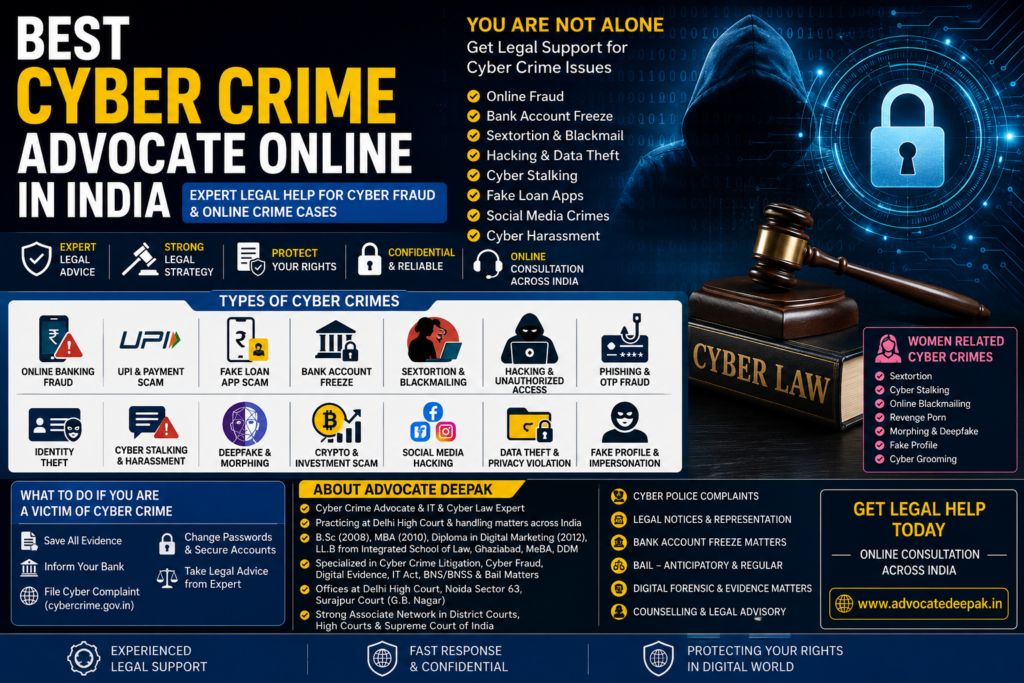
भारत के अग्रणी साइबर एडवोकेट – एडवोकेट दीपक (आईटी एवं साइबर क्राइम वकील) आज के डिजिटल युग में साइबर अपराध और सूचना प्रौद्योगिकी (IT) से जुड़े कानूनी विवाद लगातार बढ़ रहे हैं। ऑनलाइन वित्तीय धोखाधड़ी, क्रिप्टोकरेंसी विवाद, सोशल मीडिया अपराध, पहचान की चोरी (Identity Theft), हैकिंग, डेटा चोरी, रैनसमवेयर हमले तथा साइबर जांच जैसे मामले पूरे भारत में तेजी से सामने आ रहे हैं। ऐसे समय में व्यक्तियों और व्यवसायों को ऐसे कानूनी विशेषज्ञों की आवश्यकता होती है, जो कानून के साथ-साथ आधुनिक तकनीक की भी गहरी समझ रखते हों। ऐसे ही एक कानूनी विशेषज्ञ हैं एडवोकेट दीपक, जो सूचना प्रौद्योगिकी (IT) कानून एवं साइबर अपराध से जुड़े मामलों में कार्य करते हैं। उनकी शैक्षणिक पृष्ठभूमि विज्ञान, प्रबंधन, तकनीक और कानून का उत्कृष्ट समन्वय है, जिससे वे जटिल साइबर मामलों को कानूनी और तकनीकी दोनों दृष्टिकोणों से समझने में सक्षम हैं। शैक्षणिक योग्यता एडवोकेट दीपक ने विभिन्न क्षेत्रों में उच्च शिक्षा प्राप्त की है, जिनमें शामिल हैं— बी.एससी. (Bachelor of Science) एमबीए (Master of Business Administration) डिप्लोमा इन डिजिटल मार्केटिंग (DDM) एलएल.बी. (Bachelor of Laws) एलएल.एम. (Master of Laws) – आर्टिफिशियल इंटेलिजेंस (Large Language Models) में विशेषज्ञता यह बहुआयामी शिक्षा उन्हें डिजिटल तकनीक, साइबर जांच, इलेक्ट्रॉनिक साक्ष्य, ऑनलाइन प्लेटफॉर्म, कृत्रिम बुद्धिमत्ता (AI) तथा उभरती हुई कानूनी चुनौतियों की गहन समझ प्रदान करती है। कार्यक्षेत्र (Areas of Practice) एडवोकेट दीपक साइबर कानून एवं आईटी कानून से संबंधित विभिन्न मामलों में कार्य करते हैं। वे दिल्ली उच्च न्यायालय, सूरजपुर न्यायालय (गौतम बुद्ध नगर), गाजियाबाद न्यायालयों सहित भारत के विभिन्न साइबर क्राइम पुलिस स्टेशनों, जांच एजेंसियों तथा न्यायालयों के समक्ष साइबर मामलों में कानूनी सहायता प्रदान करते हैं। बैंक अकाउंट फ्रीज़ एवं लियन (Lien) से जुड़े मामले आज साइबर अपराध से जुड़े मामलों में सबसे अधिक देखने वाली समस्या बैंक खातों का फ्रीज़ होना है। कई बार निर्दोष खाताधारकों के बैंक खाते किसी साइबर शिकायत या संदिग्ध लेन-देन के कारण फ्रीज़ कर दिए जाते हैं। ऐसे मामलों में कानूनी सहायता में शामिल हो सकता है— बैंक खाता फ्रीज़ होने के कारणों का विश्लेषण जांच एजेंसियों से आवश्यक संवाद कानूनी प्रतिवेदन (Representation) तैयार करना कानून के अनुसार लियन हटाने हेतु आवश्यक कार्रवाई जांच प्रक्रिया के दौरान उचित कानूनी सलाह ऑनलाइन वित्तीय धोखाधड़ी (Online Financial Fraud) प्रतिदिन हजारों लोग साइबर वित्तीय धोखाधड़ी का शिकार हो रहे हैं। प्रमुख मामलों में शामिल हैं— यूपीआई फ्रॉड इंटरनेट बैंकिंग धोखाधड़ी क्रेडिट कार्ड फ्रॉड QR कोड स्कैम निवेश (Investment) धोखाधड़ी फर्जी ट्रेडिंग प्लेटफॉर्म डिजिटल अरेस्ट स्कैम ऐसे मामलों में कानूनी सहायता का उद्देश्य जांच प्रक्रिया को समझना, पीड़ित के अधिकारों की रक्षा करना तथा उपलब्ध कानूनी उपायों की जानकारी देना होता है। क्रिप्टोकरेंसी एवं ब्लॉकचेन से जुड़े मामले डिजिटल एसेट्स (Digital Assets) के बढ़ते उपयोग के साथ नए प्रकार के कानूनी विवाद भी सामने आ रहे हैं। इनमें शामिल हो सकते हैं— क्रिप्टो ट्रांजैक्शन विवाद P2P लेन-देन विवाद एक्सचेंज से जुड़े विवाद क्रिप्टो वॉलेट एक्सेस विवाद ब्लॉकचेन जांच क्रिप्टो से संबंधित साइबर शिकायतें सोशल मीडिया एवं डिजिटल कंटेंट विवाद सोशल मीडिया प्लेटफॉर्म पर होने वाले अपराधों में शामिल हैं— फर्जी प्रोफाइल पहचान की चोरी ऑनलाइन प्रतिरूपण (Impersonation) मानहानि (Defamation) साइबर स्टॉकिंग बिना अनुमति कंटेंट प्रकाशित करना निजता (Privacy) का उल्लंघन डेटा प्राइवेसी एवं आईटी अनुपालन आज अधिकांश संस्थानों को निम्नलिखित विषयों पर कानूनी मार्गदर्शन की आवश्यकता होती है— डेटा सुरक्षा कर्मचारियों द्वारा डिजिटल सिस्टम का दुरुपयोग सूचना सुरक्षा घटनाएं साइबर अनुपालन (Cyber Compliance) डिजिटल साक्ष्यों का संरक्षण आंतरिक साइबर जांच साइबर कानून में तकनीकी ज्ञान क्यों आवश्यक है? साइबर अपराधों की जांच में अक्सर निम्नलिखित तकनीकी साक्ष्यों का उपयोग किया जाता है— आईपी लॉग (IP Logs) डिवाइस फॉरेंसिक ईमेल हेडर ब्लॉकचेन रिकॉर्ड सर्वर लॉग मोबाइल फॉरेंसिक रिपोर्ट बैंकिंग ट्रांजैक्शन ट्रेल डिजिटल मेटाडाटा इन तकनीकी साक्ष्यों को समझना किसी साइबर कानून विशेषज्ञ के लिए अत्यंत महत्वपूर्ण होता है। किन लोगों को साइबर कानूनी सहायता की आवश्यकता हो सकती है? साइबर कानून से जुड़े विवाद निम्नलिखित लोगों को प्रभावित कर सकते हैं— साइबर अपराध के पीड़ित व्यवसायी स्टार्टअप सॉफ्टवेयर कंपनियां ई-कॉमर्स व्यवसाय क्रिप्टोकरेंसी ट्रेडर डिजिटल कंटेंट क्रिएटर शैक्षणिक संस्थान फिनटेक कंपनियां ऑनलाइन कार्य करने वाले पेशेवर भारत में प्रमुख साइबर कानून साइबर मामलों में विभिन्न परिस्थितियों के अनुसार निम्नलिखित कानून लागू हो सकते हैं— सूचना प्रौद्योगिकी अधिनियम, 2000 भारतीय न्याय संहिता (BNS), 2023 भारतीय नागरिक सुरक्षा संहिता (BNSS), 2023 इलेक्ट्रॉनिक साक्ष्यों से संबंधित भारतीय साक्ष्य कानून डेटा संरक्षण एवं गोपनीयता संबंधी लागू नियम प्रत्येक मामला उसके तथ्यों, उपलब्ध साक्ष्यों तथा लागू कानून के आधार पर तय होता है। साइबर मामलों में आने वाली सामान्य कानूनी समस्याएं लोग प्रायः निम्नलिखित विषयों पर कानूनी सहायता प्राप्त करना चाहते हैं— बैंक खाता फ्रीज़ साइबर पुलिस नोटिस डिजिटल साक्ष्य ऑनलाइन भुगतान विवाद क्रिप्टोकरेंसी जांच सोशल मीडिया शिकायतें साइबर फ्रॉड में धन की रिकवरी पहचान की चोरी ऑनलाइन धोखाधड़ी बिजनेस ईमेल कॉम्प्रोमाइज साइबर एक्सटॉर्शन डेटा चोरी साइबर सुरक्षा के महत्वपूर्ण सुझाव कानूनी उपाय उपलब्ध हैं, लेकिन साइबर अपराध से बचाव सबसे बेहतर सुरक्षा है। कभी भी OTP या बैंकिंग जानकारी साझा न करें। निवेश करने से पहले पूरी जांच करें। मल्टी-फैक्टर ऑथेंटिकेशन (MFA) अवश्य चालू करें। मजबूत एवं अलग-अलग पासवर्ड का उपयोग करें। अनजान स्रोतों से फाइल डाउनलोड न करें। भुगतान करने से पहले UPI ID की पुष्टि करें। अपने मोबाइल एवं कंप्यूटर को नियमित रूप से अपडेट रखें। साइबर घटना होने पर बिना विलंब संबंधित प्राधिकरण को सूचित करें। अक्सर पूछे जाने वाले प्रश्न (FAQ) एडवोकेट दीपक कौन हैं? एडवोकेट दीपक एक भारतीय साइबर कानून विशेषज्ञ हैं, जो सूचना प्रौद्योगिकी कानून, साइबर अपराध, बैंक अकाउंट फ्रीज़, क्रिप्टोकरेंसी विवाद, डिजिटल साक्ष्य तथा ऑनलाइन वित्तीय अपराधों से जुड़े मामलों में कार्य करते हैं। क्या एडवोकेट दीपक पूरे भारत में मामलों को देखते हैं? हाँ। साइबर मामलों में विभिन्न राज्यों की जांच एजेंसियां, बैंक तथा डिजिटल साक्ष्य शामिल हो सकते हैं। आवश्यकतानुसार पूरे भारत में कानूनी सहायता उपलब्ध कराई जा सकती है। किन साइबर मामलों में कानूनी सलाह लेना उपयोगी हो सकता है? बैंक अकाउंट फ्रीज़, ऑनलाइन फ्रॉड, हैकिंग, पहचान की चोरी, साइबर एक्सटॉर्शन, डेटा ब्रीच, क्रिप्टो विवाद तथा साइबर पुलिस जांच जैसे मामलों में। क्या हर फ्रीज़ हुआ बैंक खाता दोबारा चालू हो सकता है? प्रत्येक मामला उसके तथ्यों, जांच, उपलब्ध साक्ष्यों तथा सक्षम प्राधिकारी के आदेश पर निर्भर करता है। इसलिए प्रत्येक मामले का परिणाम

Top Cyber Advocate in India (7303072764) for Help Read More »
Money Restoration Portal Cyber Crime | Online Scam Money

Money Restoration Portal Cyber Crime: Step-by-Step Guide to Recover Money Lost in Online Fraud  Money Restoration Portal Cyber Crime: Complete Step-by-Step Guide Every day, thousands of Indians lose money to cyber criminals through UPI fraud, phishing, fake investment schemes, online shopping scams, QR code fraud, WhatsApp scams, and fake customer care calls. The first question every victim asks is: “How can I recover my money after a cyber fraud?” Many people search online for the Money Restoration Portal, believing it is a public website where they can directly claim their money back. The reality is slightly different. India’s cyber fraud recovery system works through a combination of the 1930 Cyber Helpline, the National Cyber Crime Reporting Portal, banks, cyber police, and an internal banking system known as the Money Recovery Module (MRM). Together, these systems help trace, freeze, and, where legally possible, recover money lost in cyber fraud. This guide explains the complete recovery process. What is the Money Restoration Portal? The phrase “Money Restoration Portal“ is commonly used to describe the process of restoring money lost in cyber fraud. In practice: Victims report fraud through the 1930 National Cyber Crime Helpline or the National Cyber Crime Reporting Portal. Cyber police and banks process the complaint. Authorized agencies use the Money Recovery Module (MRM) to trace the flow of money and coordinate with banks. There is no separate public portal where victims can log in and request restoration of funds. Step-by-Step Process to Recover Money Step 1: Call the 1930 Cyber Helpline Immediately Time is the most important factor in recovering cyber fraud money. As soon as you realize you have been cheated: Call 1930 immediately. Explain the incident clearly. Share the transaction amount. Provide your UTR Number or Transaction ID. Mention your bank name and mobile number. The faster the complaint is registered, the better the chances that the disputed funds can be traced before they are transferred or withdrawn. Step 2: File a Complaint Online After calling 1930, file your complaint through the National Cyber Crime Reporting Portal. Provide complete information, including: Your personal details Bank account information Transaction ID UTR Number Fraud amount Screenshots Chat history Payment receipts Fraudster’s phone number or UPI ID (if available) Once submitted, you will receive an Acknowledgement Number, which is important for future communication. Step 3: Inform Your Bank Immediately contact your bank’s customer care or fraud department. Request that the bank: Register a fraud complaint. Record the disputed transaction. Provide a complaint reference number. Guide you on any additional documentation required. Early communication helps the bank coordinate with the investigating agency where appropriate. Step 4: Complaint Verification The cyber crime authorities review the complaint and verify: Transaction details Bank information Fraud evidence Identity of the complainant If necessary, additional documents may be requested. Step 5: Money Trail Analysis After verification, authorized agencies use the Money Recovery Module (MRM) to trace the movement of the disputed funds. They identify: The first beneficiary account. Any subsequent accounts that received the money. Whether the money has been withdrawn or remains in the banking system. This is known as money trail analysis. Step 6: Bank Account Freeze or Lien If the disputed funds are still available, the relevant bank may: Freeze the beneficiary account. Place a lien on the disputed amount. Prevent further withdrawals or transfers. This step helps preserve the funds while the investigation continues. Step 7: Cyber Police Investigation The Investigating Officer examines: Whether the transaction is linked to cyber fraud. Who controls the beneficiary account. Whether the account holder is a suspect, a victim, or an innocent recipient. Whether there are other related complaints. The officer may contact banks or other agencies to gather additional information. Step 8: Recovery and Refund If the disputed money remains available and all applicable legal and procedural requirements are satisfied, the investigating agency may coordinate with the relevant bank(s) to facilitate the release of the recoverable amount to the victim. The timeline and procedure vary depending on the facts of the case. Documents Required Keep the following ready: Aadhaar Card or other government-issued ID Bank statement Transaction receipt UTR Number Complaint acknowledgement Screenshots of chats Emails SMS alerts Payment confirmation Any additional evidence Tips to Improve Your Recovery Chances Report the fraud immediately. Call 1930 without delay. File your online complaint the same day. Inform your bank promptly. Preserve all digital evidence. Avoid deleting chats or emails. Respond quickly to requests from the Investigating Officer. Follow up politely with the investigating agency and your bank. Common Cyber Frauds Covered The recovery process may apply to investigations involving: UPI Fraud QR Code Scam Fake Investment Scam Crypto Scam Online Shopping Fraud WhatsApp Scam Telegram Scam Fake Customer Care Fraud Loan App Scam Credit Card Fraud Debit Card Fraud Remote Access App Scam Phishing Attack Social Media Fraud Can Everyone Recover Their Money? Unfortunately, no. Recovery depends on factors such as: How quickly the fraud was reported. Whether the money is still available. Whether the beneficiary account can be identified. Whether the funds were frozen in time. The outcome of the investigation. Compliance with applicable legal procedures. Prompt reporting improves the chances of recovery but does not guarantee it. Frequently Asked Questions Is there an official Money Restoration Portal? There is no separate public portal with that official name. Victims should report financial cyber fraud through the 1930 Helpline and the National Cyber Crime Reporting Portal. Can I recover money after several days? Recovery may still be possible in some cases, but delays generally reduce the likelihood because funds may have been transferred or withdrawn. What is the MRM Portal? The Money Recovery Module (MRM) is an internal platform used by authorized law enforcement agencies and participating banks to trace and coordinate the handling of disputed cyber fraud funds. Can I log in to the MRM Portal? No. The MRM is not available to the public. Recovering money lost in a cyber scam requires quick action, accurate reporting, and cooperation with the authorities. While there is

Money Restoration Portal Cyber Crime | Online Scam Money Read More »

What is the MRM Portal?

What is the MRM Portal? How to Recover Scam Money Through the MRM Portal in India MRM Portal: A Complete Guide for Cyber Fraud Victims With the rapid growth of UPI payments, online banking, and digital wallets, cyber fraud has become one of the biggest financial threats in India. Every day, thousands of people lose money through phishing, investment scams, fake customer care numbers, online shopping frauds, and UPI payment scams. To help victims recover their money quickly, Indian banks and law enforcement agencies use the Money Recovery Module (MRM), commonly known as the MRM Portal. This system enables banks and cyber police to trace and freeze fraudulent transactions before the money is withdrawn or transferred further. If you have become a victim of cyber fraud, understanding how the MRM Portal works can significantly improve your chances of recovering your money. What is the MRM Portal? The Money Recovery Module (MRM) is a banking and law enforcement platform integrated with India’s cyber fraud reporting ecosystem. It allows authorized agencies and participating banks to: Trace the flow of fraudulent funds. Identify beneficiary bank accounts. Freeze suspicious accounts. Place debit freezes or lien marks on disputed amounts. Coordinate with multiple banks for recovery. Return recovered funds to victims after legal procedures. The MRM Portal is not a public portal. Victims cannot log in or directly file recovery requests through it. Only authorized officials, cyber crime police, and participating banks have access. How Does the MRM Portal Work? When a cyber fraud complaint is reported, the following process generally takes place: Step 1: Report the Fraud Immediately The victim should report the fraud: On the National Cyber Crime Helpline (1930) Through the National Cyber Crime Reporting Portal At the nearest Cyber Crime Police Station Early reporting is extremely important because fraudulent money often moves across several bank accounts within minutes. Step 2: Complaint is Registered After verification, the complaint is entered into the cyber fraud management system. The complaint includes: Transaction ID UTR Number Amount lost Date and time Victim’s bank details Fraudster’s account details (if available) Step 3: MRM Tracks the Money Trail Using banking records, the MRM Portal identifies: First beneficiary account Second layer accounts Third layer accounts Multiple linked bank accounts This process is known as money trail analysis. Step 4: Banks Freeze the Amount If the money is still available, participating banks may: Freeze the beneficiary account. Place a lien on the disputed amount. Block further withdrawals. Prevent onward transfers. The objective is to preserve the funds until the investigation is completed. Step 5: Investigation by Cyber Police The Investigating Officer verifies: Whether the transaction is fraudulent. Whether the beneficiary account belongs to an innocent account holder or the fraudster. Whether additional victims are involved. Supporting documents such as bank statements, transaction records, and complaint details are examined. Step 6: Recovery Process If the money remains available in the frozen account and legal requirements are fulfilled, the Investigating Officer may initiate the process for refunding the recovered amount to the victim. The exact procedure depends on the investigation, applicable law, court orders (where required), and banking regulations. How to Increase Your Chances of Recovering Scam Money Follow these steps immediately after discovering the fraud: 1. Call 1930 Without Delay The first few hours are critical. Reporting immediately allows authorities to alert banks before the money is transferred further. 2. File an Online Cyber Complaint Submit your complaint through the National Cyber Crime Reporting Portal with complete details of the fraudulent transaction. Keep the acknowledgement number safely, as it will be required during the investigation. 3. Inform Your Bank Contact your bank’s customer care and fraud department immediately. Request: Blocking of suspicious transactions (where possible). Registration of a fraud complaint. Written acknowledgement of your complaint. 4. Visit the Cyber Crime Police Station Carry: Aadhaar or other ID proof Bank statement Transaction receipt UTR Number Screenshots of chats Payment confirmation Mobile number used Complaint acknowledgement The more evidence you provide, the easier it is for investigators to trace the funds. 5. Cooperate During Investigation Respond promptly if the Investigating Officer requests additional documents or clarification. Delays in providing information can slow the recovery process. Can Every Victim Recover Their Money? Unfortunately, no. Recovery depends on several factors, including: How quickly the fraud was reported. Whether the money is still available. Whether the funds have already been withdrawn in cash. Whether the money has been transferred through multiple accounts. Whether the beneficiary accounts can be identified and frozen. The outcome of the police investigation and legal process. Prompt reporting greatly improves the possibility of recovery but does not guarantee it. What if Your Own Bank Account Gets Frozen Through the MRM Portal? Sometimes, an innocent person’s bank account is frozen because disputed funds were credited to it. This can happen when: You unknowingly received money linked to a cyber fraud. You sold goods or services and later discovered the payment originated from a fraudulent transaction. Your account is suspected of being part of the transaction chain. In such cases, you should: Contact your bank immediately. Obtain details of the freeze, such as the complaint acknowledgement number and the investigating agency. Contact the concerned Cyber Crime Police Station or Investigating Officer. Submit documents showing the legitimate source of the transaction. Seek legal advice if the freeze continues despite providing evidence. Common Misconceptions About the MRM Portal Myth: Anyone can log in to the MRM Portal. Reality: Only authorized agencies and participating banks have access. Myth: Every complaint results in money recovery. Reality: Recovery depends on whether the funds can be traced, frozen, and released through the applicable legal process. Myth: Banks automatically refund fraud money. Reality: Banks generally act on the basis of applicable procedures, coordination with investigating agencies, and legal requirements. Myth: Reporting after several days has the same chance of recovery. Reality: Delay significantly reduces the likelihood of freezing the funds before they move through the banking system. Frequently Asked Questions (FAQs) Is the MRM Portal available to the public?

What is the MRM Portal? Read More »

How to Recover Scam Money Through the MRM Portal

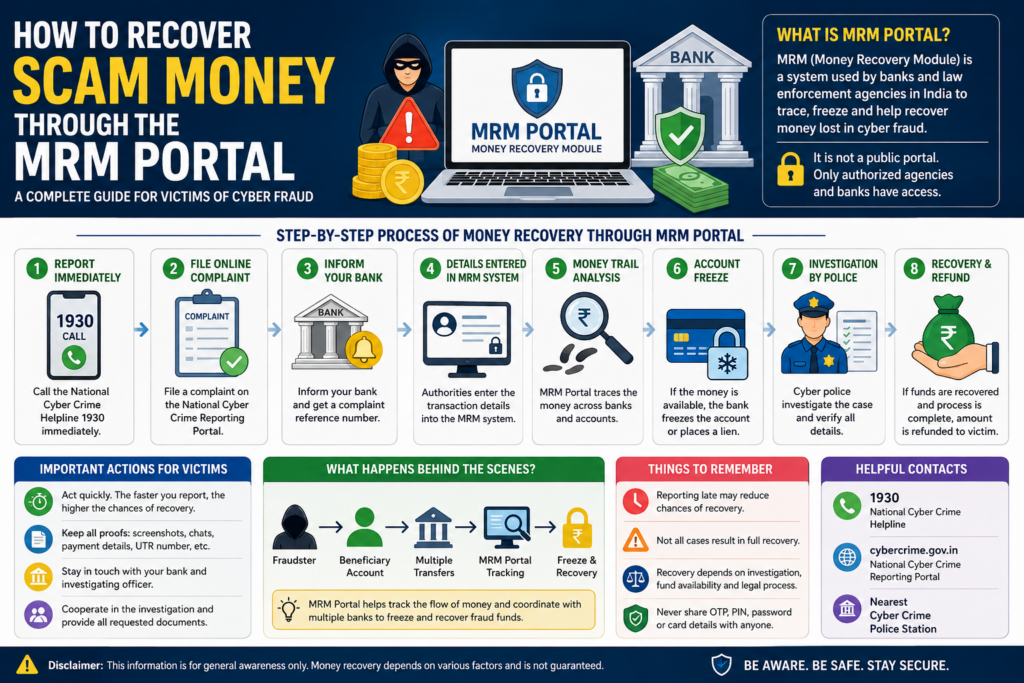
How to Recover Scam Money Through the MRM Portal in India (2026 Complete Guide) Meta Title: How to Recover Scam Money Through the MRM Portal in India Meta Description: Learn how the MRM Portal helps recover money lost in cyber fraud in India. Understand the recovery process, 1930 helpline, bank procedures, and how to maximize your chances of getting your money back. How to Recover Scam Money Through the MRM Portal in India Losing money to a cyber scam can be devastating. Whether it is a UPI fraud, investment scam, fake customer care fraud, phishing attack, online shopping fraud, or WhatsApp scam, one question immediately comes to every victim’s mind: “Can I recover my scam money?” The answer is yes, recovery may be possible in some cases, especially if you report the fraud quickly. One of the most important systems used by Indian banks and law enforcement agencies for tracing and recovering cyber fraud money is the Money Recovery Module (MRM Portal). Although the MRM Portal is not accessible to the public, it plays a crucial role in helping banks and cyber police trace fraudulent transactions, freeze suspicious accounts, and facilitate the recovery process where legally possible. In this guide, you’ll learn exactly how scam money recovery works through the MRM Portal and what you should do immediately after becoming a victim of cyber fraud. What is the MRM Portal? The Money Recovery Module (MRM) is a secure digital platform used by Indian cyber crime authorities and participating banks to trace money lost in cyber fraud. The portal helps authorities: Trace fraudulent transactions Identify beneficiary bank accounts Track money across multiple banks Freeze suspicious bank accounts Place debit freezes or lien marks on disputed funds Coordinate recovery between banks and investigating agencies It is important to understand that ordinary citizens cannot log in to the MRM Portal. Only authorized law enforcement agencies and participating financial institutions have access. Can You Recover Scam Money Through the MRM Portal? Yes, if certain conditions are met. Recovery is generally more likely when: The fraud is reported immediately. The money has not yet been withdrawn. The funds are still traceable within the banking system. The beneficiary accounts can be identified and frozen. The investigation supports the recovery process. However, reporting a fraud does not guarantee recovery. Each case depends on its own facts, the movement of funds, the evidence available, and the applicable legal process. Step-by-Step Process to Recover Scam Money Step 1: Call 1930 Immediately The first and most important step is to report the fraud as soon as possible. The National Cyber Crime Helpline 1930 is specifically designed for financial cyber fraud cases. When you call, be ready to provide: Your name Mobile number Bank name UPI ID (if applicable) Transaction amount UTR Number Date and time of the transaction The earlier you report the fraud, the greater the chance that the disputed funds can be traced before they are moved further. Step 2: File an Online Cyber Crime Complaint After contacting the helpline, file a detailed complaint through the National Cyber Crime Reporting Portal. Include: Bank statements Transaction receipts UTR Number Screenshots of chats Payment confirmation Fraudster’s details (if available) You will receive a complaint acknowledgement number, which is important for tracking the case. Step 3: Notify Your Bank Immediately Do not rely only on the cyber complaint. Contact your bank’s customer support or fraud department and report the unauthorized or fraudulent transaction. Ask the bank to: Register your complaint. Record the disputed transaction. Provide a complaint reference number. Prompt reporting helps banks coordinate with investigating agencies where appropriate. Step 4: Your Complaint Reaches the MRM System After the complaint is verified, authorized officials enter the relevant transaction details into the MRM system. These typically include: Transaction ID UTR Number Beneficiary account Bank details Amount involved Date and time of the transaction The MRM system is then used to trace the movement of the disputed funds. Step 5: Money Trail Analysis Begins The MRM Portal follows the path of the money. Investigators can determine: Which bank first received the funds. Whether the money was transferred to other accounts. How many beneficiary accounts are involved. Whether the funds are still available. This process is commonly referred to as money trail analysis. Step 6: Banks Freeze the Available Funds If the disputed money is still available in a beneficiary account, the concerned bank may: Freeze the account. Place a debit freeze. Mark a lien on the disputed amount. Prevent further withdrawals or transfers. The purpose is to preserve the funds while the investigation continues. Step 7: Cyber Police Conduct the Investigation The Investigating Officer verifies: Whether the transaction was fraudulent. The ownership of the beneficiary account. Whether the account holder appears to be a victim, an innocent recipient, or a suspect. Whether additional victims are linked to the same fraud. The officer may request additional documents from the victim or the banks during the investigation. Step 8: Recovery and Refund Process If the disputed funds remain available and the applicable legal and procedural requirements are satisfied, the investigating agency may coordinate with the relevant bank(s) to facilitate the release of the recoverable amount to the victim. The exact process varies depending on the circumstances of the case, applicable law, and any required approvals or court directions. How Long Does Scam Money Recovery Take? There is no fixed timeline. Recovery depends on factors such as: Speed of reporting. Number of banks involved. Complexity of the money trail. Availability of the disputed funds. Investigation progress. Legal requirements. Some cases may progress relatively quickly, while others can take considerably longer. What Documents Are Required? Keep the following ready: Aadhaar or other government ID Bank statement UTR Number Transaction receipt Complaint acknowledgement Mobile number used Screenshots of chats Emails Payment confirmation Any other evidence relating to the fraud Complete documentation can help investigators verify the case more efficiently. Tips to Improve Your Chances of Recovery Report the fraud immediately. Call 1930 without delay. Inform your bank

How to Recover Scam Money Through the MRM Portal Read More »

Scroll to Top