
How to Recover Scam Money Through the MRM Portal in India (2026 Complete Guide)
Meta Title: How to Recover Scam Money Through the MRM Portal in India
Meta Description: Learn how the MRM Portal helps recover money lost in cyber fraud in India. Understand the recovery process, 1930 helpline, bank procedures, and how to maximize your chances of getting your money back.
How to Recover Scam Money Through the MRM Portal in India
Losing money to a cyber scam can be devastating. Whether it is a UPI fraud, investment scam, fake customer care fraud, phishing attack, online shopping fraud, or WhatsApp scam, one question immediately comes to every victim’s mind:
“Can I recover my scam money?”
The answer is yes, recovery may be possible in some cases, especially if you report the fraud quickly. One of the most important systems used by Indian banks and law enforcement agencies for tracing and recovering cyber fraud money is the Money Recovery Module (MRM Portal).
Although the MRM Portal is not accessible to the public, it plays a crucial role in helping banks and cyber police trace fraudulent transactions, freeze suspicious accounts, and facilitate the recovery process where legally possible.
In this guide, you’ll learn exactly how scam money recovery works through the MRM Portal and what you should do immediately after becoming a victim of cyber fraud.

What is the MRM Portal?
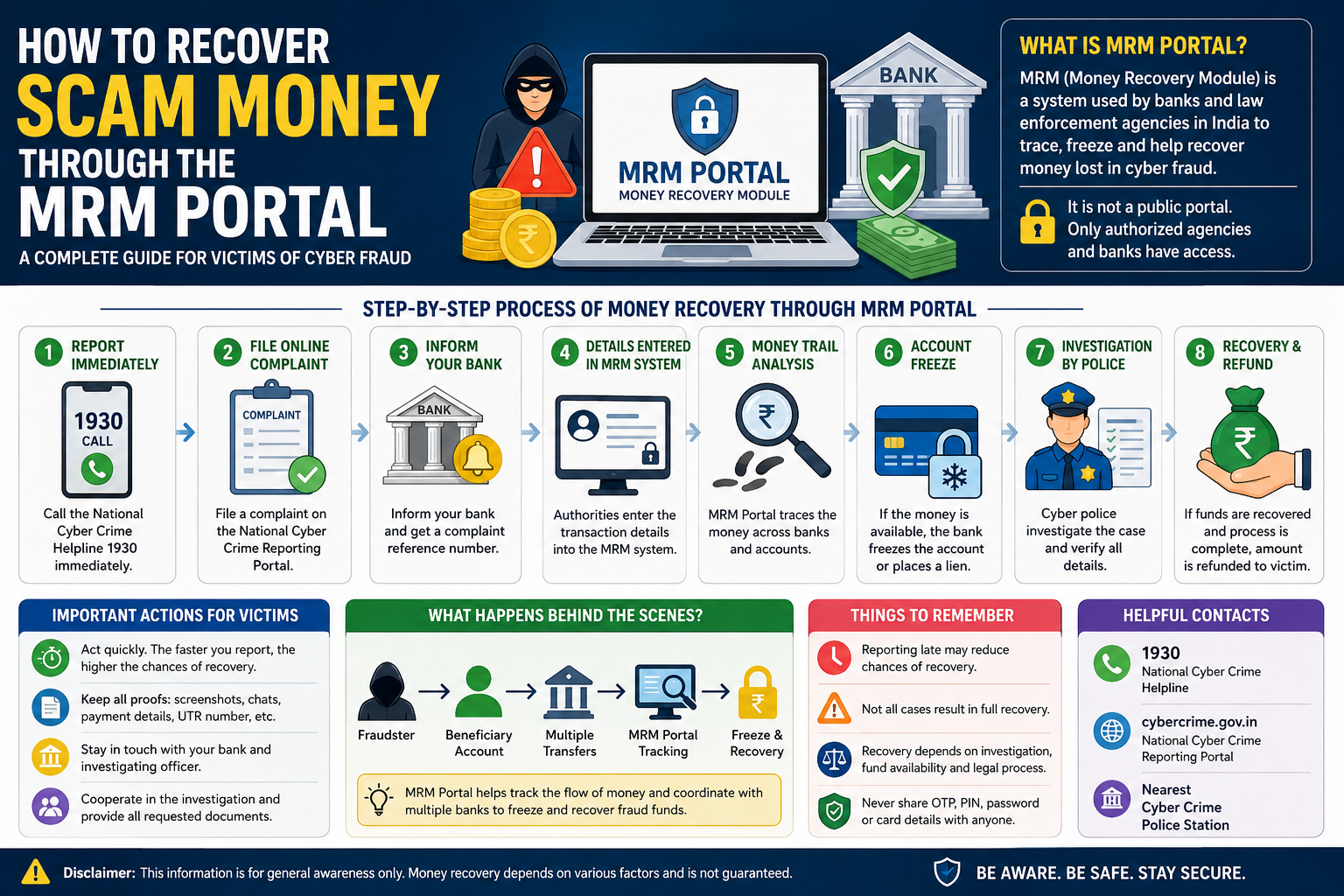
The Money Recovery Module (MRM) is a secure digital platform used by Indian cyber crime authorities and participating banks to trace money lost in cyber fraud.
The portal helps authorities:
- Trace fraudulent transactions
- Identify beneficiary bank accounts
- Track money across multiple banks
- Freeze suspicious bank accounts
- Place debit freezes or lien marks on disputed funds
- Coordinate recovery between banks and investigating agencies
It is important to understand that ordinary citizens cannot log in to the MRM Portal. Only authorized law enforcement agencies and participating financial institutions have access.
Can You Recover Scam Money Through the MRM Portal?
Yes, if certain conditions are met.
Recovery is generally more likely when:
- The fraud is reported immediately.
- The money has not yet been withdrawn.
- The funds are still traceable within the banking system.
- The beneficiary accounts can be identified and frozen.
- The investigation supports the recovery process.
However, reporting a fraud does not guarantee recovery. Each case depends on its own facts, the movement of funds, the evidence available, and the applicable legal process.
Step-by-Step Process to Recover Scam Money
Step 1: Call 1930 Immediately
The first and most important step is to report the fraud as soon as possible.
The National Cyber Crime Helpline 1930 is specifically designed for financial cyber fraud cases.
When you call, be ready to provide:
- Your name
- Mobile number
- Bank name
- UPI ID (if applicable)
- Transaction amount
- UTR Number
- Date and time of the transaction
The earlier you report the fraud, the greater the chance that the disputed funds can be traced before they are moved further.
Step 2: File an Online Cyber Crime Complaint
After contacting the helpline, file a detailed complaint through the National Cyber Crime Reporting Portal.
Include:
- Bank statements
- Transaction receipts
- UTR Number
- Screenshots of chats
- Payment confirmation
- Fraudster’s details (if available)
You will receive a complaint acknowledgement number, which is important for tracking the case.
Step 3: Notify Your Bank Immediately
Do not rely only on the cyber complaint.
Contact your bank’s customer support or fraud department and report the unauthorized or fraudulent transaction.
Ask the bank to:
- Register your complaint.
- Record the disputed transaction.
- Provide a complaint reference number.
Prompt reporting helps banks coordinate with investigating agencies where appropriate.
Step 4: Your Complaint Reaches the MRM System
After the complaint is verified, authorized officials enter the relevant transaction details into the MRM system.
These typically include:
- Transaction ID
- UTR Number
- Beneficiary account
- Bank details
- Amount involved
- Date and time of the transaction
The MRM system is then used to trace the movement of the disputed funds.
Step 5: Money Trail Analysis Begins
The MRM Portal follows the path of the money.
Investigators can determine:
- Which bank first received the funds.
- Whether the money was transferred to other accounts.
- How many beneficiary accounts are involved.
- Whether the funds are still available.
This process is commonly referred to as money trail analysis.
Step 6: Banks Freeze the Available Funds
If the disputed money is still available in a beneficiary account, the concerned bank may:
- Freeze the account.
- Place a debit freeze.
- Mark a lien on the disputed amount.
- Prevent further withdrawals or transfers.
The purpose is to preserve the funds while the investigation continues.
Step 7: Cyber Police Conduct the Investigation
The Investigating Officer verifies:
- Whether the transaction was fraudulent.
- The ownership of the beneficiary account.
- Whether the account holder appears to be a victim, an innocent recipient, or a suspect.
- Whether additional victims are linked to the same fraud.
The officer may request additional documents from the victim or the banks during the investigation.
Step 8: Recovery and Refund Process
If the disputed funds remain available and the applicable legal and procedural requirements are satisfied, the investigating agency may coordinate with the relevant bank(s) to facilitate the release of the recoverable amount to the victim.
The exact process varies depending on the circumstances of the case, applicable law, and any required approvals or court directions.
How Long Does Scam Money Recovery Take?
There is no fixed timeline.
Recovery depends on factors such as:
- Speed of reporting.
- Number of banks involved.
- Complexity of the money trail.
- Availability of the disputed funds.
- Investigation progress.
- Legal requirements.
Some cases may progress relatively quickly, while others can take considerably longer.
What Documents Are Required?
Keep the following ready:
- Aadhaar or other government ID
- Bank statement
- UTR Number
- Transaction receipt
- Complaint acknowledgement
- Mobile number used
- Screenshots of chats
- Emails
- Payment confirmation
- Any other evidence relating to the fraud
Complete documentation can help investigators verify the case more efficiently.
Tips to Improve Your Chances of Recovery
- Report the fraud immediately.
- Call 1930 without delay.
- Inform your bank as soon as possible.
- Preserve all digital evidence.
- Avoid deleting chats or emails.
- Cooperate with the Investigating Officer.
- Follow up politely with the investigating agency and your bank.
Common Mistakes Victims Make
Many victims unintentionally reduce the chances of recovery by:
- Waiting several days before reporting.
- Deleting chat messages.
- Not informing their bank.
- Providing incomplete information.
- Sharing OTPs or passwords after the fraud.
- Ignoring requests for additional documents.
Frequently Asked Questions
Is the MRM Portal open to the public?
No. It is an internal platform used by authorized cyber crime authorities and participating banks.
Can I log in to the MRM Portal?
No.
Victims cannot access or operate the portal directly.
Does every cyber fraud victim recover their money?
No.
Recovery depends on the availability of funds, the speed of reporting, the investigation, and the applicable legal process.
What is the most important step?
Reporting the fraud immediately through 1930, informing your bank, and filing a detailed cyber crime complaint.
The Money Recovery Module (MRM Portal) has become one of India’s most important mechanisms for tracing and securing funds lost in cyber fraud. While it is not a public portal and cannot guarantee refunds, it enables banks and law enforcement agencies to coordinate efforts to identify fraudulent transactions, freeze available funds, and assist in the recovery process where legally and practically possible.
If you become a victim of a cyber scam, do not wait. Report the incident immediately, preserve every piece of evidence, notify your bank, and cooperate with the investigating authorities. Acting quickly can significantly improve the likelihood that the disputed funds can be traced before they are dissipated.
Disclaimer
This article is intended for general informational purposes only and does not constitute legal advice. Recovery of money lost in cyber fraud depends on the facts of each case, the investigation carried out by the competent authorities, banking procedures, and applicable legal requirements. If you require advice regarding a specific matter, consult a qualified legal professional.


