
Money Restoration Portal Cyber Crime: Step-by-Step Guide to Recover Money Lost in Online Fraud
Money Restoration Portal Cyber Crime: Complete Step-by-Step Guide
Every day, thousands of Indians lose money to cyber criminals through UPI fraud, phishing, fake investment schemes, online shopping scams, QR code fraud, WhatsApp scams, and fake customer care calls.
The first question every victim asks is:
“How can I recover my money after a cyber fraud?”
Many people search online for the Money Restoration Portal, believing it is a public website where they can directly claim their money back.
The reality is slightly different.
India’s cyber fraud recovery system works through a combination of the 1930 Cyber Helpline, the National Cyber Crime Reporting Portal, banks, cyber police, and an internal banking system known as the Money Recovery Module (MRM). Together, these systems help trace, freeze, and, where legally possible, recover money lost in cyber fraud.
This guide explains the complete recovery process.
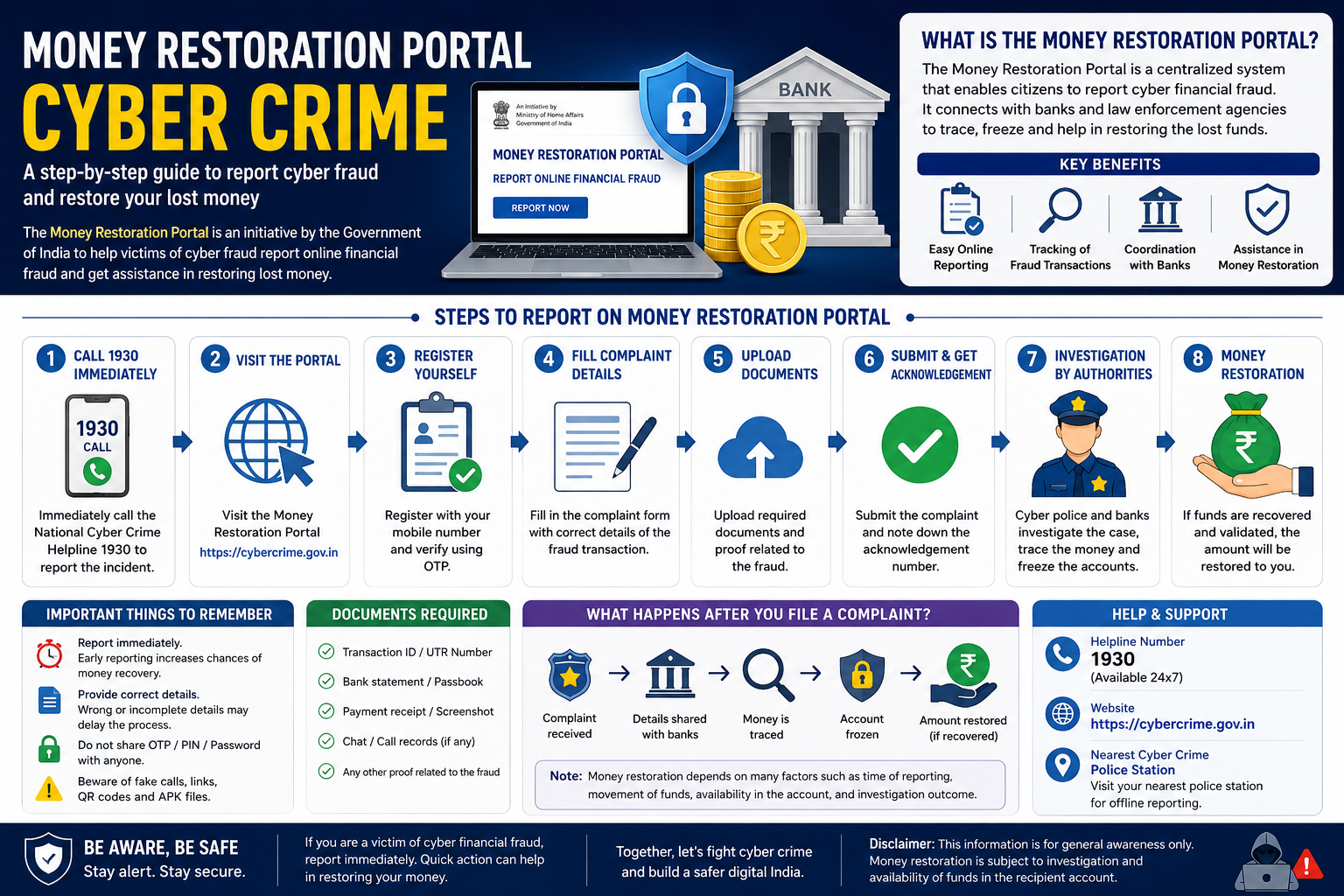
What is the Money Restoration Portal?
The phrase “Money Restoration Portal“ is commonly used to describe the process of restoring money lost in cyber fraud. In practice:
- Victims report fraud through the 1930 National Cyber Crime Helpline or the National Cyber Crime Reporting Portal.
- Cyber police and banks process the complaint.
- Authorized agencies use the Money Recovery Module (MRM) to trace the flow of money and coordinate with banks.
There is no separate public portal where victims can log in and request restoration of funds.
Step-by-Step Process to Recover Money
Step 1: Call the 1930 Cyber Helpline Immediately
Time is the most important factor in recovering cyber fraud money.
As soon as you realize you have been cheated:
- Call 1930 immediately.
- Explain the incident clearly.
- Share the transaction amount.
- Provide your UTR Number or Transaction ID.
- Mention your bank name and mobile number.
The faster the complaint is registered, the better the chances that the disputed funds can be traced before they are transferred or withdrawn.
Step 2: File a Complaint Online
After calling 1930, file your complaint through the National Cyber Crime Reporting Portal.
Provide complete information, including:
- Your personal details
- Bank account information
- Transaction ID
- UTR Number
- Fraud amount
- Screenshots
- Chat history
- Payment receipts
- Fraudster’s phone number or UPI ID (if available)
Once submitted, you will receive an Acknowledgement Number, which is important for future communication.
Step 3: Inform Your Bank
Immediately contact your bank’s customer care or fraud department.
Request that the bank:
- Register a fraud complaint.
- Record the disputed transaction.
- Provide a complaint reference number.
- Guide you on any additional documentation required.
Early communication helps the bank coordinate with the investigating agency where appropriate.
Step 4: Complaint Verification
The cyber crime authorities review the complaint and verify:
- Transaction details
- Bank information
- Fraud evidence
- Identity of the complainant
If necessary, additional documents may be requested.
Step 5: Money Trail Analysis
After verification, authorized agencies use the Money Recovery Module (MRM) to trace the movement of the disputed funds.
They identify:
- The first beneficiary account.
- Any subsequent accounts that received the money.
- Whether the money has been withdrawn or remains in the banking system.
This is known as money trail analysis.
Step 6: Bank Account Freeze or Lien
If the disputed funds are still available, the relevant bank may:
- Freeze the beneficiary account.
- Place a lien on the disputed amount.
- Prevent further withdrawals or transfers.
This step helps preserve the funds while the investigation continues.
Step 7: Cyber Police Investigation
The Investigating Officer examines:
- Whether the transaction is linked to cyber fraud.
- Who controls the beneficiary account.
- Whether the account holder is a suspect, a victim, or an innocent recipient.
- Whether there are other related complaints.
The officer may contact banks or other agencies to gather additional information.
Step 8: Recovery and Refund
If the disputed money remains available and all applicable legal and procedural requirements are satisfied, the investigating agency may coordinate with the relevant bank(s) to facilitate the release of the recoverable amount to the victim.
The timeline and procedure vary depending on the facts of the case.
Documents Required
Keep the following ready:
- Aadhaar Card or other government-issued ID
- Bank statement
- Transaction receipt
- UTR Number
- Complaint acknowledgement
- Screenshots of chats
- Emails
- SMS alerts
- Payment confirmation
- Any additional evidence
Tips to Improve Your Recovery Chances
- Report the fraud immediately.
- Call 1930 without delay.
- File your online complaint the same day.
- Inform your bank promptly.
- Preserve all digital evidence.
- Avoid deleting chats or emails.
- Respond quickly to requests from the Investigating Officer.
- Follow up politely with the investigating agency and your bank.
Common Cyber Frauds Covered
The recovery process may apply to investigations involving:
- UPI Fraud
- QR Code Scam
- Fake Investment Scam
- Crypto Scam
- Online Shopping Fraud
- WhatsApp Scam
- Telegram Scam
- Fake Customer Care Fraud
- Loan App Scam
- Credit Card Fraud
- Debit Card Fraud
- Remote Access App Scam
- Phishing Attack
- Social Media Fraud
Can Everyone Recover Their Money?
Unfortunately, no.
Recovery depends on factors such as:
- How quickly the fraud was reported.
- Whether the money is still available.
- Whether the beneficiary account can be identified.
- Whether the funds were frozen in time.
- The outcome of the investigation.
- Compliance with applicable legal procedures.
Prompt reporting improves the chances of recovery but does not guarantee it.
Frequently Asked Questions
Is there an official Money Restoration Portal?
There is no separate public portal with that official name. Victims should report financial cyber fraud through the 1930 Helpline and the National Cyber Crime Reporting Portal.
Can I recover money after several days?
Recovery may still be possible in some cases, but delays generally reduce the likelihood because funds may have been transferred or withdrawn.
What is the MRM Portal?
The Money Recovery Module (MRM) is an internal platform used by authorized law enforcement agencies and participating banks to trace and coordinate the handling of disputed cyber fraud funds.
Can I log in to the MRM Portal?
No. The MRM is not available to the public.
Recovering money lost in a cyber scam requires quick action, accurate reporting, and cooperation with the authorities. While there is no public “Money Restoration Portal” for victims to access directly, India’s cyber fraud response system—through the 1930 Helpline, the National Cyber Crime Reporting Portal, participating banks, cyber police, and the Money Recovery Module (MRM)—works together to trace fraudulent transactions and assist with recovery where legally and practically possible.
If you become a victim of cyber fraud, do not wait. Report the incident immediately, preserve all evidence, inform your bank, and follow the instructions of the investigating authorities. Acting within the first few hours can significantly improve the possibility that the disputed funds can be traced before they are dissipated.
Disclaimer: This article is for educational purposes only and does not constitute legal advice. Recovery of cyber fraud money depends on the facts of each case, the availability of funds, the investigation conducted by the competent authorities, banking procedures, and applicable legal requirements.


