
Cyber Crime Advocate for Online Scam Money Recovery in India: Complete Legal Guide to Recovering Your Lost Money
Introduction: How a Cyber Crime Advocate Can Help You Recover Money Lost in an Online Scam
The rapid growth of digital payments, internet banking, UPI transactions, online shopping, cryptocurrency platforms, and social media has made financial transactions easier than ever before. However, alongside these developments, online financial fraud and cybercrime have become serious concerns for individuals, business owners, professionals, and senior citizens across India.
Every day, people lose their hard-earned money through fake investment schemes, UPI fraud, phishing links, digital arrest scams, online trading fraud, fraudulent loan applications, fake customer care numbers, job scams, and social media impersonation.
One of the biggest challenges faced by victims is recovering the money after it has been transferred to a fraudster’s bank account or digital wallet.
This is where an experienced Cyber Crime Advocate for Online Scam Money Recovery in India can provide valuable legal assistance.
A cybercrime advocate helps victims understand their legal rights, prepare strong complaints, coordinate appropriate legal steps with investigating authorities, communicate with banks and financial institutions, and pursue lawful remedies for the restoration of defrauded money.
It is important to understand that recovering money from an online scam requires prompt reporting, proper documentation, investigation, and compliance with legal procedures. No advocate can honestly guarantee a refund, but timely legal action can improve the possibility of tracing and securing the defrauded funds.
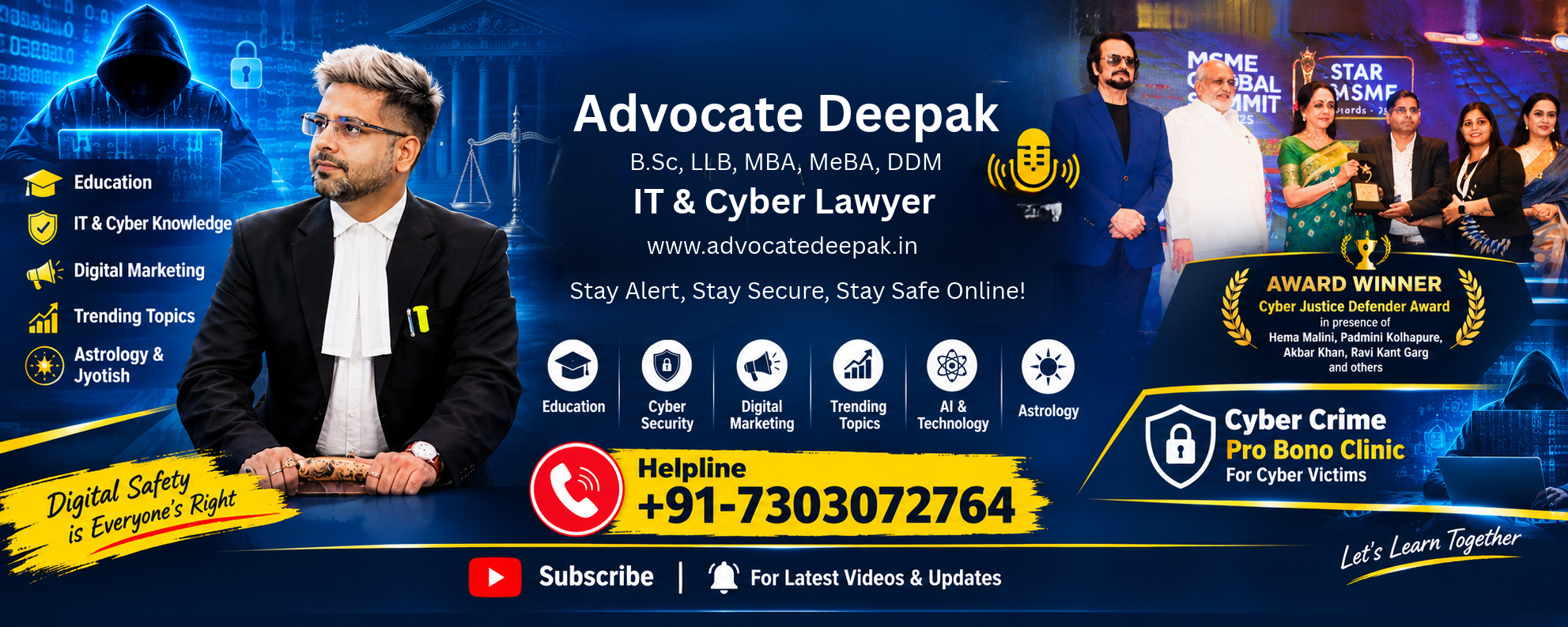
This comprehensive guide explains how online scam money recovery works in India, how to file a cybercrime complaint, what legal remedies are available, and why professional legal assistance may be important.
1. What Is Online Scam Money Recovery in India?
Online scam money recovery refers to the legal and procedural process of attempting to recover money lost because of fraudulent online activities.
When someone transfers money to a fraudster through UPI, IMPS, NEFT, RTGS, internet banking, debit cards, credit cards, or digital wallets, the transferred amount may move through multiple bank accounts and financial intermediaries.
The recovery process generally involves:
- Reporting the financial fraud to the National Cyber Crime Reporting Portal.
- Calling the national cybercrime financial fraud helpline at 1930.
- Informing the concerned bank or payment service provider.
- Requesting urgent action to prevent further movement of the fraudulent funds.
- Providing transaction details and supporting evidence to the investigating authorities.
- Following up with the concerned cybercrime police station.
- Seeking appropriate legal orders for the release or restoration of money, wherever legally permissible.
- Pursuing further remedies if the matter remains unresolved.
The Government of India operates the Citizen Financial Cyber Fraud Reporting and Management System (CFCFRMS) to facilitate coordination between law enforcement agencies, banks, and other financial intermediaries.
The primary objective is to help prevent fraudulent funds from being withdrawn or transferred further.
2. Why Do You Need a Cyber Crime Advocate After an Online Financial Fraud?
Many victims believe that registering an online complaint automatically results in a refund. Unfortunately, this is not always the case.
A complaint initiates the reporting process, but investigation, tracing of funds, coordination between banks, and restoration of money may require additional action.
A qualified cybercrime advocate can assist with several important aspects.
A. Legal Consultation and Case Assessment
An advocate examines the circumstances of the fraud, the amount involved, the transaction method, available evidence, and the steps already taken by the victim.
This assessment helps determine the appropriate legal strategy.
B. Drafting a Detailed Cybercrime Complaint
A properly prepared complaint should explain:
- How the fraud occurred.
- When the victim first communicated with the fraudster.
- The amount transferred.
- The bank accounts, UPI IDs, or wallets involved.
- The transaction reference numbers.
- The mobile numbers, email addresses, and website links used by the fraudsters.
- The financial loss suffered by the victim.
- The relief or investigation requested.
An advocate can help organize these details into a clear and legally relevant complaint.
C. Assistance With Bank Complaints
The concerned bank should be informed immediately after discovering unauthorized or fraudulent transactions.
An advocate can assist in preparing formal representations to the bank, requesting investigation, preservation of relevant records, and appropriate action under applicable banking procedures.
D. Police and Cybercrime Authority Follow-Up
Depending on the circumstances, an advocate may assist with:
- Following up on the cybercrime complaint.
- Submitting additional evidence.
- Preparing written representations.
- Seeking information about the status of the complaint.
- Assisting with FIR-related procedures where applicable.
- Pursuing appropriate remedies before competent authorities or courts.
E. Legal Proceedings for Money Restoration
If fraudulent funds have been identified, frozen, or marked under a lien, the question of restoring those funds to the rightful claimant may arise.
An advocate can examine the applicable procedure and assist with the necessary applications, representations, or court proceedings.
3. Types of Online Scams for Which You Can Seek Money Recovery Assistance
Online fraud takes several forms. The legal and recovery strategy depends on the nature of the transaction and available evidence.
1. UPI Payment Fraud
UPI fraud is one of the common forms of digital financial fraud in India.
Fraudsters may use fake payment requests, QR codes, impersonation, fraudulent collection requests, or social engineering techniques to obtain money from victims.
If you have lost money through UPI fraud, immediately contact your bank and report the incident through 1930 and the National Cyber Crime Reporting Portal.
2. Online Investment and Trading Scams
Fraudsters create fake investment platforms, stock market advisory groups, cryptocurrency schemes, and trading applications.
Initially, victims may see fabricated profits or receive small withdrawals to build confidence. Later, when they invest larger amounts, the fraudsters may demand additional payments under the pretext of taxes, withdrawal charges, or account verification.
A cybercrime advocate can help document the investment trail and identify appropriate legal remedies.
3. Credit Card and Debit Card Fraud
Financial fraud may involve stolen card information, unauthorized transactions, fraudulent payment links, phishing, and identity theft.
Victims should immediately contact their card-issuing bank, block the compromised card where necessary, and raise a formal dispute.
4. Fake Job and Work-from-Home Scams
Fraudsters advertise attractive employment opportunities and demand registration charges, training fees, security deposits, or task-related payments.
After collecting money, they may stop responding or block the victim.
A complaint should include the job advertisement, communication history, payment details, and account information.
5. Online Shopping and E-Commerce Fraud
Some victims pay for products through fraudulent websites, social media pages, or fake sellers but never receive the purchased items.
Relevant evidence includes invoices, order confirmations, payment receipts, seller details, and communication records.
6. Digital Arrest and Impersonation Scams
Fraudsters impersonate police officers, government officials, or investigation agencies and threaten victims with arrest, account freezing, or criminal proceedings.
Victims are manipulated into transferring money under pressure.
These incidents should be reported immediately, with particular attention to preserving call recordings, messages, payment details, and other available evidence.
7. Loan Application and Instant Loan Fraud
Fake loan applications may misuse personal information, impose unauthorized charges, or threaten borrowers.
Depending on the facts, victims may have remedies under cybercrime, consumer protection, and other applicable laws.
8. Cryptocurrency and Online Wallet Fraud
Fraudsters may promise guaranteed returns, manipulate cryptocurrency trading platforms, or deceive users into transferring digital assets.
Such matters can involve complex financial trails, multiple jurisdictions, and digital evidence. Prompt reporting and proper documentation are especially important.
4. Step-by-Step Process for Online Scam Money Recovery in India
If you have lost money in an online scam, follow these steps without unnecessary delay.
Step 1: Immediately Call the Cybercrime Helpline 1930
The first and most important step is to report financial cyber fraud through the national helpline:
1930 – National Cybercrime Financial Fraud Helpline
Provide the relevant information, including:
- Your name and mobile number.
- Name of your bank.
- Transaction ID or UTR number.
- Amount transferred.
- Date and time of the transaction.
- Beneficiary account or UPI details, if available.
Prompt reporting is important because authorities may be able to initiate action to prevent further movement or withdrawal of the fraudulent funds.
Step 2: Register Your Complaint on the National Cyber Crime Portal
Visit:
Select the appropriate financial fraud reporting option and submit the complaint with accurate details.
If you initially reported the incident through 1930, follow the instructions provided by the helpline regarding completion of the online complaint.
Keep the acknowledgement number safely.
Step 3: Inform Your Bank Immediately
Contact your bank through its official customer care number, mobile application, website, or branch.
Request that the bank:
- Register your fraud complaint.
- Examine the disputed transactions.
- Take appropriate steps to protect your account.
- Coordinate with the relevant authorities.
- Preserve available transaction and communication records.
- Provide a written acknowledgement and complaint reference number.
If your banking credentials or UPI access have been compromised, secure your account immediately.
Step 4: Preserve All Evidence
Evidence is essential for an effective investigation and potential recovery proceedings.
Collect and preserve:
- Bank statements.
- UPI transaction screenshots.
- IMPS, NEFT, or RTGS receipts.
- UTR and transaction reference numbers.
- Fraudster’s mobile numbers.
- WhatsApp chats and SMS messages.
- Emails and payment links.
- Website URLs and application details.
- Social media profiles.
- Call recordings, if lawfully available.
- Cybercrime complaint acknowledgement.
- Bank complaint acknowledgement.
Do not delete original messages or transaction records.
Step 5: Approach the Concerned Cybercrime Police Station
Depending on the circumstances, you may need to approach the cybercrime police station or the appropriate local police authority.
Submit a detailed written complaint along with copies of supporting documents.
An advocate can help prepare the representation and guide you regarding the appropriate legal procedure.
Step 6: Follow Up on the Frozen or Lien-Marked Amount
If the investigating authorities and financial institutions identify funds associated with the reported fraud, they may take appropriate steps to prevent their further withdrawal or transfer.
However, a lien or freeze does not automatically mean that the victim has received the money.
Further verification and legal procedures may be necessary before restoration.
Step 7: Apply for Money Restoration Through the Government Portal
The Ministry of Home Affairs operates a dedicated Money Restoration Portal:
The portal provides a facility for victims to submit a refund or money restoration request using their NCRP acknowledgement details.
The general process includes:
- Open the official Money Restoration Portal.
- Select the option to raise a refund request.
- Enter the 14-digit NCRP acknowledgement ID.
- Complete OTP verification.
- Verify the bank account details displayed for restoration.
- Provide the requested PAN details.
- Upload the court order, if applicable and available.
- Submit the request and preserve the generated request ID.
The exact requirements and processing depend on the case and the portal’s applicable procedures.
Step 8: Seek Appropriate Court Assistance Where Necessary
In certain cases, a victim may require legal assistance to approach the competent court for appropriate directions concerning money that has been seized, frozen, or placed under a lien.
The applicable procedure depends on the facts, the status of the investigation, the nature of the funds, and the legal authority under which the money was secured.
A cybercrime advocate can assess whether a court application or another legal remedy is appropriate.
5. Important Indian Laws Applicable to Online Financial Fraud
Cybercrime and online financial fraud can attract different legal provisions depending on the conduct involved.
The following are important laws that may be relevant.
A. Information Technology Act, 2000
The Information Technology Act provides the legal framework for several computer-related offences.
Some relevant provisions include:
Section 43: Addresses certain unauthorized acts involving computer systems and networks and provides for compensation under the statutory framework.
Section 66: Deals with computer-related acts specified under Section 43 when committed dishonestly or fraudulently.
Section 66C: Relates to identity theft involving fraudulent or dishonest use of electronic signatures, passwords, or other unique identification features.
Section 66D: Addresses cheating by personation using computer resources.
Section 72: Concerns breach of confidentiality and privacy in circumstances covered by the provision.
The applicability of each provision depends on the facts and evidence.
B. Bharatiya Nyaya Sanhita, 2023
The Bharatiya Nyaya Sanhita (BNS), which came into force on 1 July 2024, replaced the Indian Penal Code.
Depending on the circumstances, provisions relating to cheating, cheating by personation, forgery, and other fraudulent activities may apply.
For example:
- Section 318 deals with cheating.
- Section 319 deals with cheating by personation.
- Section 336 concerns forgery.
- Section 338 concerns forgery of valuable securities, wills, and other specified documents.
The correct provisions must be determined according to the facts of the individual case.
C. Bharatiya Nagarik Suraksha Sanhita, 2023
The Bharatiya Nagarik Suraksha Sanhita (BNSS) governs criminal procedure.
Its provisions concerning investigation, seizure, attachment, and the handling or disposal of property may become relevant in cybercrime matters.
The appropriate procedure depends on the nature and stage of the case.
D. Bharatiya Sakshya Adhiniyam, 2023
The Bharatiya Sakshya Adhiniyam provides the legal framework for evidence, including electronic and digital records.
Digital transaction receipts, electronic communications, relevant records, and other electronic evidence can play an important role in establishing the facts of an online financial fraud.
Proper preservation and production of electronic evidence are essential.
6. Can You Recover Money After It Has Been Transferred to a Fraudster’s Bank Account?
Yes, recovery may be possible in certain circumstances, but it is not guaranteed.
The possibility of recovery depends on several factors:
- How quickly the fraud was reported.
- Whether the money remains traceable.
- Whether the recipient account has available funds.
- Whether the funds have been transferred through multiple accounts.
- Whether authorities have been able to secure the funds.
- Whether the necessary legal requirements for restoration have been satisfied.
What Happens When the Money Is Frozen?
When a suspected fraudulent amount is identified in a bank account, the investigating authority may take appropriate action to prevent its withdrawal or further transfer.
This may involve a lien or freeze, subject to the applicable legal framework.
The victim may then need to establish their claim and follow the prescribed restoration procedure.
Important: A frozen account does not automatically mean that the entire amount will be refunded. The authorities must follow the applicable legal process.
7. What If the Bank or Cybercrime Police Are Not Taking Appropriate Action?
Victims sometimes experience delays or difficulties after registering a complaint.
In such situations, appropriate follow-up and escalation may be necessary.
Depending on the facts, a cybercrime advocate may help with:
- Submitting a detailed written representation to the concerned investigating officer.
- Approaching senior police authorities.
- Requesting an update on the investigation.
- Submitting additional transaction evidence.
- Escalating eligible banking service complaints through the bank’s grievance mechanism.
- Approaching the RBI’s Complaint Management System where the complaint falls within the applicable RBI Ombudsman framework.
- Seeking appropriate judicial remedies where legally maintainable.
For banking-related grievances, visit:
The RBI Ombudsman mechanism generally concerns deficiencies in services by covered regulated entities. It is not an automatic compensation mechanism for every scam or disputed transaction.
8. Role of a Cyber Crime Advocate in Recovering Online Scam Money
An experienced cybercrime advocate can provide assistance throughout the legal process.
Legal Case Evaluation
The advocate reviews the fraud incident, identifies potential offences, examines the available records, and advises on possible legal remedies.
Complaint Preparation and Documentation
A well-organized complaint helps communicate the facts and financial trail clearly to the appropriate authorities.
Bank and Financial Institution Representations
Legal assistance may be useful when communicating with banks, payment intermediaries, and other relevant institutions.
Investigation Follow-Up
An advocate can assist the victim in following up with investigating authorities and submitting additional documents or representations.
Money Restoration Proceedings
Where funds have been secured, an advocate can advise on the applicable restoration procedure and assist with necessary legal applications.
Court Representation
If judicial intervention becomes necessary, the advocate can assess the appropriate forum and represent the victim, subject to the applicable law and professional engagement.
9. How Long Does Online Scam Money Recovery Take in India?
There is no fixed timeline for recovering money lost in an online scam.
Some cases may progress relatively quickly if the fraudulent transaction is reported immediately and the funds are identified before withdrawal.
Other cases can take considerably longer because of:
- Multiple beneficiary accounts.
- Inter-state financial transactions.
- Cross-border payment channels.
- Cryptocurrency transfers.
- Delays in obtaining financial records.
- Disputes over ownership of frozen funds.
- Pending investigation or judicial proceedings.
The most important step is to report the incident immediately instead of waiting for the fraudster to return the money voluntarily.
10. How Much Does a Cyber Crime Advocate Charge for Online Scam Money Recovery?
Advocate fees in India are not uniform.
The professional fee may depend on:
- The amount of money involved.
- Complexity of the transaction trail.
- Number of banks or payment intermediaries involved.
- Whether a police complaint has already been registered.
- Whether court proceedings are required.
- Time and effort involved in the matter.
Before engaging an advocate, request a clear explanation of the scope of legal services, professional fees, and possible additional expenses.
Be cautious of anyone promising guaranteed recovery in exchange for an advance payment.
A genuine legal professional should explain the risks, limitations, and realistic possibilities of the case.
11. Common Mistakes Victims Should Avoid After an Online Scam
Many victims unintentionally reduce their chances of an effective investigation by delaying important steps.
Avoid the following mistakes:
1. Delaying the complaint: Report the fraud immediately through 1930 and the official cybercrime portal.
2. Deleting evidence: Preserve WhatsApp messages, transaction records, emails, and other relevant documents.
3. Paying additional recovery charges: Fraudsters sometimes contact victims again pretending to be recovery agents, lawyers, police officers, or government officials.
4. Sharing OTPs and banking credentials: Never share passwords, OTPs, UPI PINs, or card security details.
5. Trusting guaranteed refund promises: No private advocate or recovery agency can guarantee that money will be recovered.
6. Ignoring bank communication: Maintain written records of complaints, acknowledgements, and responses.
7. Making unsupported allegations: Provide accurate information and genuine evidence to investigating authorities.
12. How to Identify a Genuine Cyber Crime Advocate in India
Choosing the right advocate is important, particularly when a significant amount of money has been lost.
Before engaging legal services, consider the following factors:
- Verify the advocate’s enrolment with the relevant State Bar Council.
- Ask about experience in cybercrime and financial fraud matters.
- Discuss previous experience with similar legal procedures.
- Understand the proposed strategy for your case.
- Request a written fee structure.
- Confirm what services are included.
- Avoid anyone guaranteeing a specific recovery amount or timeline.
- Never hand over control of your bank account, OTPs, or passwords.
A qualified advocate should provide honest legal advice rather than unrealistic assurances.
13. Online Scam Money Recovery: Documents Required
Keeping the relevant documents ready can help speed up the complaint and legal assistance process.
The following checklist is useful:
- Identity proof, where required.
- Bank statement showing the disputed transactions.
- UPI, IMPS, NEFT, or RTGS payment receipts.
- Transaction IDs and UTR numbers.
- NCRP complaint acknowledgement.
- 1930 complaint reference, if available.
- Bank fraud complaint acknowledgement.
- Screenshots of conversations with the fraudster.
- Fraudulent website or application details.
- Mobile numbers, email IDs, and UPI IDs associated with the fraud.
- Any communication received from the investigating authority.
- Details of any previously frozen or lien-marked amount.
Submit documents only through verified official channels or to your appointed legal representative.
14. Why Immediate Legal Action Matters in Cyber Financial Fraud
In many financial cyber fraud cases, the speed of reporting can make a significant difference.
Fraudsters may transfer money between multiple accounts, withdraw cash, or move the funds through other payment channels.
When a victim reports the incident promptly, authorities and financial institutions may have a better opportunity to trace and secure the money.
The CFCFRMS system facilitates coordination between participating stakeholders to help prevent the movement of fraudulent funds.
According to the Ministry of Home Affairs, the system had helped save more than ₹11,158 crore across over 32.80 lakh complaints as of 30 June 2026.
This demonstrates the importance of prompt reporting and coordinated action.
15. Frequently Asked Questions About Cyber Crime Advocates and Online Scam Money Recovery in India
Q1. Can I recover money lost in an online scam in India?
Yes, recovery may be possible depending on the circumstances, the availability of traceable funds, the investigation, and compliance with the applicable legal procedure. Recovery is not guaranteed.
Q2. Which number should I call after an online payment fraud?
Call 1930, the national cybercrime financial fraud helpline, immediately.
You should also register your complaint through https://cybercrime.gov.in.
Q3. Can a cybercrime advocate help recover money lost through UPI fraud?
Yes. An advocate can assist with complaint preparation, bank representations, investigation follow-up, and appropriate legal proceedings for restoration of funds.
Q4. Can I recover money after 7 days or 30 days?
You can still report the incident even if some time has passed. However, recovery depends on whether the funds can be traced and secured and whether the necessary legal requirements are met.
Q5. What if the fraudster’s bank account has already been frozen?
If the account or funds have been frozen, the victim may need to follow the prescribed restoration procedure. A cybercrime advocate can examine the case and advise on the appropriate legal steps.
Q6. Is an FIR compulsory for online scam money recovery?
The requirement and procedure depend on the facts and stage of the matter. An online cybercrime complaint and an FIR are not the same thing. The investigating authorities determine the appropriate action under the applicable law.
Q7. Can I file a cybercrime complaint without hiring an advocate?
Yes. Any victim can report financial cyber fraud directly through 1930 or the National Cyber Crime Reporting Portal. Hiring an advocate is not mandatory for filing a complaint.
Q8. Can I approach the court for recovery of frozen cyber fraud money?
Depending on the circumstances, a victim may seek appropriate directions from the competent court concerning seized or frozen funds. The appropriate procedure requires examination of the case.
Q9. Can money be recovered from multiple bank accounts?
Potentially, yes. If the transaction trail is established and funds are identified in different accounts, appropriate action may be possible subject to investigation and applicable law.
Q10. What should I do if someone promises 100% recovery of my lost money?
Be extremely cautious. Guaranteed recovery promises are a common warning sign of secondary recovery scams. Verify the person’s professional credentials and never pay suspicious advance charges.
Q11. Is there an official government portal for cyber fraud money restoration?
Yes. The Ministry of Home Affairs operates the NCRP Money Restoration Portal:
Q12. Can a cybercrime advocate help with cryptocurrency scams?
Yes. An advocate familiar with cybercrime matters can advise on reporting, digital evidence preservation, financial tracing requests, and applicable legal remedies. However, cryptocurrency recovery can be particularly complex.
16. Conclusion: Get Legal Assistance for Online Scam Money Recovery in India
Losing money to an online scam can be financially and emotionally devastating. Whether you have suffered a loss through UPI fraud, online investment scams, fake trading applications, digital arrest fraud, phishing, cryptocurrency scams, or unauthorized banking transactions, taking immediate action is essential.
The first priority should always be to report the financial fraud through 1930, notify your bank, and register a complaint on the National Cyber Crime Reporting Portal.
After reporting the incident, preserve all available evidence and follow up with the concerned authorities.
A knowledgeable cybercrime advocate can help you understand the legal process, prepare appropriate representations, communicate with financial institutions, pursue investigation-related remedies, and seek restoration of funds wherever legally possible.
Remember: Do not lose hope, but do not delay legal action. The sooner you report an online financial fraud, the better the opportunity may be to trace and secure the defrauded money.
Need Legal Assistance for Online Scam Money Recovery?
If you or someone in your family has lost money through an online scam, seek appropriate legal guidance without delay.
A cybercrime advocate can assess your case, explain the available remedies, and help you take the appropriate legal steps.
Contact a qualified Cyber Crime Advocate in India for assistance with:
- UPI and bank transaction fraud.
- Online investment and trading scams.
- Digital arrest and impersonation fraud.
- Cryptocurrency and wallet fraud.
- Fake job and work-from-home scams.
- Frozen bank accounts and lien-related matters.
- Cybercrime complaints and FIR-related assistance.
- Legal proceedings for restoration of defrauded funds.
Take the first step towards protecting your legal rights.
Legal Disclaimer: This article is intended for general informational and educational purposes and does not constitute legal advice. The applicability of laws and availability of remedies depend on the facts of each case. No guarantee of financial recovery is made.
SEO Information
SEO Title: Cyber Crime Advocate for Online Scam Money Recovery in India
Meta Description: Lost money in an online scam? Consult a cyber crime advocate in India for UPI fraud, bank fraud, investment scam complaints, legal assistance, and money recovery procedures.
Suggested URL Slug:
cyber-crime-advocate-online-scam-money-recovery-india
Primary Focus Keyword:
Cyber Crime Advocate for Online Scam Money Recovery in India
Secondary Keywords:
- Online Scam Money Recovery in India
- Cyber Crime Lawyer in India
- Cyber Fraud Money Recovery Advocate
- UPI Fraud Money Recovery
- Online Payment Fraud Lawyer
- Cyber Crime Complaint Advocate
- Bank Fraud Legal Assistance
- Online Investment Scam Recovery
- Frozen Bank Account Legal Help
- Cyber Fraud Advocate
- 1930 Cyber Crime Complaint
- Cyber Crime Money Refund Process India
Suggested Image Alt Text: Cyber Crime Advocate for Online Scam Money Recovery in India
Suggested Internal Links:
- Cyber Crime Lawyer in India
- UPI Fraud Legal Assistance
- Online Investment Fraud Cases
- Bank Account Freeze Legal Assistance
- Cyber Crime Complaint Filing
- Digital Arrest Scam Legal Assistance
- Legal Services for Financial Fraud Victims
Suggested External Authority Links:
- National Cyber Crime Reporting Portal: https://cybercrime.gov.in
- Cybercrime Helpline: 1930
- Government Money Restoration Portal: https://mrm-ncrp.mha.gov.in
- RBI Complaint Management System: https://cms.rbi.org.in
- India Code: https://www.indiacode.nic.in
Recommended Blog Category: Cyber Crime Law / Online Fraud / Money Recovery
Recommended Tags: Cyber Crime Advocate, Online Scam, Money Recovery, UPI Fraud, Cyber Fraud, Bank Fraud, Digital Arrest, Cyber Crime Lawyer India


