
Best Information Technology Lawyer in Noida for Corporate Issues, Data Theft and Cyber Crime
Businesses today rely on technology to manage confidential information, customer databases, financial transactions, software, websites, intellectual property and internal communications. However, increasing digital dependence has also created serious legal challenges, including corporate data theft, employee data misuse, unauthorised access to company systems, website hacking, source code theft, cyber fraud and business email compromise.
Companies in Noida, Greater Noida, Sector 18, Sector 62, Sector 63, Film City and other commercial areas of Gautam Buddh Nagar may face information technology disputes involving employees, former employees, directors, vendors, business partners and external cybercriminals.
Hiring an experienced Information Technology lawyer in Noida can help businesses understand their legal rights, preserve electronic evidence, prepare cyber crime complaints, address corporate disputes and pursue appropriate legal remedies under Indian law.
Advocate Deepak is an IT and Cyber Crime Lawyer associated with technology-related legal matters, corporate cyber disputes, data theft, digital evidence and information technology law. Businesses seeking a corporate cyber crime lawyer in Noida can consider legal assistance based on the nature of the incident, the available evidence and the applicable legal provisions.
What Does an Information Technology Lawyer in Noida Do?
An Information Technology lawyer, also known as an IT lawyer or cyber law advocate, handles legal issues arising from computer systems, software, networks, electronic communications, digital platforms and online business operations.
Unlike ordinary commercial disputes, corporate IT cases often require an understanding of digital evidence, access permissions, confidentiality agreements, electronic records and technical investigation reports.
An IT lawyer in Noida may assist with the following matters:
- Corporate data theft and confidential information misuse
- Employee and former employee cyber crime disputes
- Unauthorised access to company computers, servers and cloud accounts
- Website hacking, domain hijacking and business email compromise
- Source code theft and software intellectual property disputes
- Cyber fraud involving directors, employees or business partners
- Corporate account takeover and fraudulent payment instructions
- IT Act legal proceedings and cyber crime complaints
- Digital evidence preservation and electronic record issues
- Legal notices, injunctions, compensation claims and contractual disputes
The appropriate legal strategy depends on the facts, the nature of the information involved and the evidence available.
Corporate Data Theft Lawyer in Noida
Corporate data theft is a significant concern for IT companies, startups, software development firms, BPOs, digital marketing agencies, financial service providers and other businesses that maintain confidential information.
Company data may include customer details, pricing information, business plans, source code, internal reports, vendor information, employee records, intellectual property and commercially sensitive documents.
Data theft allegations may arise when an employee, contractor, business associate or another person allegedly copies, transfers, retains or discloses information without proper authorisation.
Common Examples of Corporate Data Theft
- Downloading confidential customer databases before leaving employment
- Sending company documents to a personal email account without permission
- Copying proprietary source code or technical documentation
- Sharing confidential business information with a competitor
- Accessing company cloud storage after access rights have been withdrawn
- Retaining company files after termination of employment
- Misusing passwords or administrator credentials to access restricted information
- Transferring business records to an unauthorised external device
A corporate data theft lawyer can assess the relevant employment agreements, confidentiality obligations, access permissions, electronic records and forensic findings.
Depending on the circumstances, a business may consider a legal notice, cyber crime complaint, civil injunction, contractual claim or other appropriate legal proceedings.
It is important to distinguish unlawful data theft from a genuine employment or commercial disagreement. The existence of a dispute does not automatically establish a criminal offence.
Cyber Crime Lawyer in Noida for Corporate Fraud
Corporate cyber crime may involve unauthorised computer access, online impersonation, fraudulent transactions, email compromise, digital extortion or interference with business systems.
Businesses may discover suspicious activity after receiving a payment complaint, identifying unusual server access, losing control of a website or finding that confidential files have been transferred outside the organisation.
Common Corporate Cyber Crime Issues
1. Business Email Compromise
A fraudster may impersonate a company director, supplier or business partner to request a fraudulent payment or change a beneficiary bank account.
2. Website Hacking
An attacker may gain unauthorised control over a company website, modify content, redirect visitors or interfere with business operations.
3. Unauthorised Server Access
A person may access restricted company systems, download confidential information or interfere with stored records without permission.
4. Corporate Identity Theft
A person may misuse a company’s name, email identity, online accounts or credentials to deceive customers, suppliers or employees.
5. Ransomware and Digital Extortion
Attackers may encrypt business data, threaten to disclose confidential information or demand money in exchange for restoring access.
6. Employee-Related Cyber Disputes
A company may suspect that an employee or former employee has misused access privileges, copied confidential data or interfered with digital assets.
An experienced cyber crime lawyer in Noida can help organise the available evidence, prepare a legally structured complaint and assess the appropriate reporting and legal procedures.
Information Technology Act, 2000: Sections and Punishments
The Information Technology Act, 2000 contains provisions addressing several forms of unauthorised computer activity, identity misuse, privacy violations and disclosure of certain information.
The following sections may be relevant to corporate IT disputes, depending on the facts.
| Legal provision | Relevance | Punishment or consequence |
|---|---|---|
| Section 43 | Unauthorised access, copying data, damaging systems or other specified acts | Compensation may be payable to the affected person |
| Section 65 | Tampering with computer source documents required to be maintained by law | Up to 3 years’ imprisonment, a fine up to ₹2 lakh, or both |
| Section 66 | Dishonest or fraudulent commission of acts covered by Section 43 | Up to 3 years’ imprisonment, a fine up to ₹5 lakh, or both |
| Section 66C | Fraudulent or dishonest use of another person’s electronic signature, password or unique identification feature | Up to 3 years’ imprisonment and a fine up to ₹1 lakh |
| Section 66D | Cheating by personation using a computer resource or communication device | Up to 3 years’ imprisonment and a fine up to ₹1 lakh |
| Section 72A | Certain unlawful disclosures of personal information obtained under a lawful contract | Up to 3 years’ imprisonment, a fine up to ₹5 lakh, or both |
These provisions have different legal requirements. For example, Section 43 and Section 66 are not identical: Section 66 requires the relevant acts to be committed dishonestly or fraudulently. Section 72A is not a general provision covering every disclosure of company information.
A lawyer should verify the applicable statutory wording, amendments and facts before identifying charges or advising on potential punishment.
Corporate Data Theft and Other Applicable Indian Laws
Corporate data theft may also involve contractual obligations, intellectual property rights and offences under other applicable laws.
Bharatiya Nyaya Sanhita, 2023
The Bharatiya Nyaya Sanhita (BNS) may be relevant when the facts establish offences such as cheating, criminal breach of trust, extortion or other recognised criminal conduct.
For example:
- Section 316 — Criminal breach of trust: May be relevant where property has been entrusted to a person and the statutory requirements for criminal breach of trust are established. The punishment varies according to the applicable subsection and circumstances.
- Section 318 — Cheating: May be relevant where deception and the other required legal elements are established. Punishment varies according to the nature of the cheating and the applicable subsection.
A breach of an employment agreement, non-disclosure agreement or business contract does not automatically amount to a criminal offence. The facts must satisfy the elements of the relevant provision.
Copyright Act, 1957
Where a dispute involves unauthorised copying or use of protected software, source code or other copyright-protected work, copyright law may provide relevant civil or criminal remedies.
The company should establish its rights over the material and preserve evidence of the alleged copying or unauthorised use.
Contractual and Civil Remedies
A company may also rely on applicable employment agreements, confidentiality clauses, software contracts, non-disclosure agreements and intellectual property assignments.
Depending on the legal basis and evidence, possible remedies may include a legal notice, damages claim, injunction or contractual proceedings.
Source Code Theft Lawyer in Noida
Software companies and technology startups invest substantial resources in developing applications, websites, APIs, databases and proprietary platforms. Source code theft allegations can therefore create serious commercial and legal concerns.
A dispute may arise when a developer, employee, contractor or business partner allegedly copies source code, transfers project files without permission or uses confidential technical information outside the scope of an agreement.
An IT lawyer can help examine:
- Software development agreements and ownership clauses
- Copyright assignments and licensing terms
- Confidentiality and non-disclosure agreements
- Git or other source code repository records
- Project delivery records and access permissions
- Evidence of copying and the ownership of the disputed material
The legal remedy depends on the ownership of the software, contractual terms, authorisation and the evidence available. Similarity between two software products alone does not necessarily prove unlawful copying.
Website Hacking and Domain Hijacking Legal Assistance
A company website and domain name may be essential to customer communication, online sales, lead generation and business continuity.
Legal disputes can arise when someone allegedly changes DNS settings, redirects a domain, takes control of a hosting account, modifies website content or refuses to return administrative credentials.
A company facing website hacking or domain hijacking should consider the following steps:
- Secure the domain registrar, hosting account and administrator credentials.
- Preserve available login records, DNS history, emails and security alerts.
- Document the unauthorised changes and their impact on business operations.
- Contact the relevant registrar or hosting provider through the appropriate recovery process.
- Assess whether a cyber crime complaint, legal notice or civil proceeding is appropriate.
An Information Technology lawyer can assist with the legal aspects of website control disputes, evidence preservation and suitable remedies.
Employee Data Theft and Confidentiality Disputes
Employee-related data disputes are common in businesses where staff have access to customer databases, source code, business strategies, financial information or proprietary documents.
A company may suspect that a departing employee has copied confidential data, retained company files or disclosed information to another organisation.
Before taking legal action, the employer should determine what information was accessed, whether the employee had permission, whether the information was confidential and what contractual obligations applied.
A lawyer can review the employment agreement, confidentiality undertaking, IT policy, exit documentation and relevant digital records.
Companies should also avoid unlawful surveillance, unauthorised access to personal accounts or unsupported allegations. Evidence should be obtained through lawful and proportionate methods.
What Evidence Is Required for a Corporate Cyber Crime Complaint?
Digital evidence can be crucial in establishing the facts of a corporate cyber incident.
Useful evidence may include:
- Original emails and available email headers
- Server logs and login history
- Cloud platform audit records
- File transfer and access records
- Source code repository history
- Domain registration and DNS change records
- Relevant employment agreements and confidentiality clauses
- Device examination and forensic reports
- Business communications and transaction records
- A dated chronology of the incident and its consequences
Companies should preserve original records and avoid altering potentially relevant devices or accounts unnecessarily. Where appropriate, a qualified digital-forensic professional can help collect and document technical evidence.
Electronic records may also need to satisfy applicable requirements under the Bharatiya Sakshya Adhiniyam, 2023, depending on the proceedings and the nature of the evidence.
A screenshot can support a complaint, but additional technical records may be necessary to establish the source, authenticity and context of an incident.
Legal Process for Filing a Corporate Cyber Crime Complaint in Noida
A business that suspects corporate data theft or cyber fraud should take prompt and organised action.
Step 1: Identify the incident. Determine which company systems, accounts, files or transactions were affected.
Step 2: Preserve the evidence. Retain original electronic records, access logs, emails and relevant agreements.
Step 3: Assess the legal issues. Identify whether the matter involves unauthorised access, cheating, breach of confidentiality, intellectual property infringement or another legal issue.
Step 4: Prepare the complaint. Set out the chronology, relevant persons, suspected acts, supporting documents and the impact on the business.
Step 5: Report the matter appropriately. Submit the complaint to the relevant police station or cyber crime authority, as appropriate to the circumstances and jurisdiction.
Step 6: Consider further remedies. Depending on the case, assess the need for a legal notice, injunction, compensation claim or other proceedings.
If the incident involves fraudulent online payments, the company should promptly contact its bank and relevant payment service providers. India’s cyber crime helpline is 1930, and complaints can also be submitted through the National Cyber Crime Reporting Portal.
Filing a complaint does not guarantee identification of the accused, recovery of money or a particular outcome. These depend on the evidence, investigation and applicable law.
How to Choose the Best Information Technology Lawyer in Noida
Choosing the best IT lawyer in Noida for a corporate cyber dispute requires more than looking at a title or online ranking. The company should consider whether the lawyer has relevant experience in the particular type of legal problem.
Important factors include:
- Knowledge of the Information Technology Act and applicable criminal laws
- Experience with corporate data theft and cyber crime complaints
- Understanding of confidentiality agreements and software contracts
- Familiarity with electronic records and digital evidence
- Ability to assess civil, criminal and contractual remedies
- Experience preparing legal notices, complaints and court documents
- Clear communication regarding costs, procedure and realistic outcomes
A suitable lawyer should explain the strengths and limitations of the available evidence and distinguish a potential criminal offence from a purely contractual dispute.
Advocate Deepak — Information Technology and Cyber Crime Lawyer in Noida
Advocate Deepak is an IT and Cyber Crime Lawyer whose practice involves technology-related legal matters, cyber crime disputes, corporate data theft concerns and digital evidence issues.
His professional qualifications combine legal education with technology and business-related studies. His work focuses on the intersection of law, technology and digital evidence.
Businesses seeking legal assistance may approach Advocate Deepak regarding matters such as:
- Corporate data theft and unauthorised access disputes
- Cyber crime complaints involving companies and business owners
- Website, domain and business email disputes
- Employee-related digital misconduct and confidentiality issues
- Legal notices concerning company information and digital assets
- Digital evidence assessment and preservation
- Applicable IT Act and criminal law proceedings
- Contractual disputes involving software and confidential information
Legal advice and remedies depend on the particular facts, available evidence and jurisdiction. For this reason, companies should clearly document the incident and retain relevant records before taking further action.
Contact for legal assistance
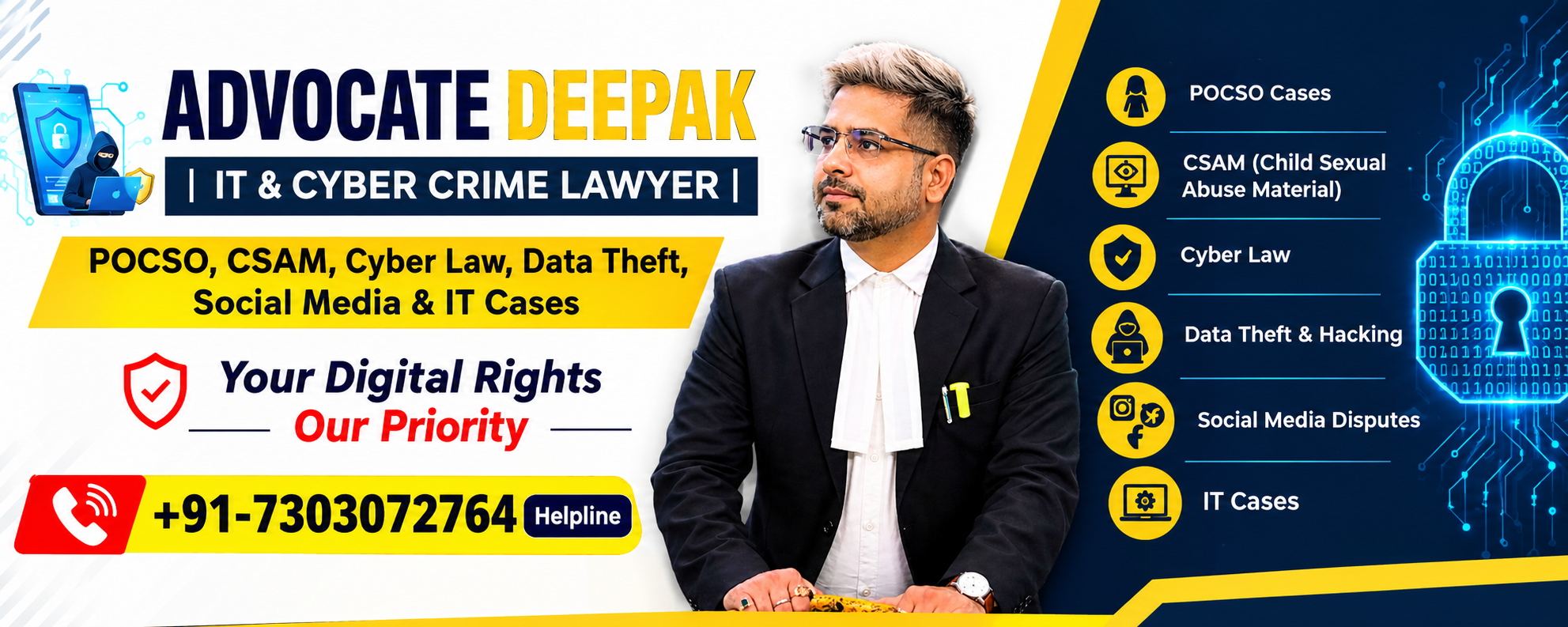
Advocate Deepak | IT & Cyber Crime Lawyer | POCSO, CSAM, Cyber Law, Data Theft, Social Media & IT Cases +91-7303072764 Helpline
Frequently Asked Questions
Who is the best Information Technology lawyer in Noida for corporate issues?
The appropriate lawyer depends on the nature of the dispute and the lawyer’s relevant experience. For corporate data theft, source code disputes or cyber crime allegations, businesses should look for an IT lawyer who understands both the applicable law and electronic evidence.
Can a company file a cyber crime complaint against a former employee?
Yes, a company may report suspected unlawful conduct by a former employee if the facts disclose a potential offence. The complaint should explain the access permissions, ownership of the data, alleged conduct and supporting evidence.
What is the punishment for corporate data theft in India?
There is no single punishment for every form of corporate data theft. Section 66 of the IT Act provides for up to three years’ imprisonment, a fine up to ₹5 lakh, or both, where its requirements are satisfied. Other provisions may apply depending on the facts.
Can a company take legal action for source code theft?
Potentially, yes. Depending on ownership, contractual terms and evidence, a company may consider copyright remedies, contractual proceedings, an injunction or a criminal complaint where the legal requirements are met.
Can a company file a case for customer database theft?
A company may pursue appropriate remedies where there is evidence of unlawful access, copying, misuse or disclosure. The legal position depends on the nature of the database, the company’s rights, applicable data protection requirements and the conduct involved.
Can an IT lawyer help recover a hacked website or domain?
An IT lawyer can assist with legal notices, complaints and disputes over control of a domain or website. The technical recovery process may also require assistance from the domain registrar, hosting provider or cybersecurity professionals.
Is breach of a non-disclosure agreement a cyber crime?
Not automatically. A breach of an NDA may give rise to contractual or civil remedies. Criminal liability depends on whether the conduct independently satisfies the requirements of an applicable criminal provision.
What should a company do immediately after discovering data theft?
Secure affected systems, preserve original records, document the incident, assess financial and operational impact, and obtain appropriate legal and technical assistance. If fraudulent payments are involved, contact the bank promptly and report the incident.
Can a company claim compensation for corporate data theft?
Compensation may be available where a valid legal basis is established, such as an applicable statutory remedy, contractual claim or civil cause of action. The company must establish the relevant rights, legal requirements and supporting evidence.
Does hiring a cyber crime lawyer guarantee a successful case?
No. A lawyer can assess the legal position, prepare documents and represent the company where appropriate, but the outcome depends on the facts, evidence, investigation and decisions of the relevant authorities or court.
Businesses searching for an Information Technology lawyer in Noida, a corporate data theft lawyer in Noida or a cyber crime lawyer for corporate issues should prioritise legal experience, evidence preservation and a clear understanding of the applicable law.
Corporate data theft, source code misuse, website hacking, employee confidentiality disputes and business email fraud may require a combination of technical investigation, contractual analysis and legal action.
Advocate Deepak provides legal assistance in IT and cyber crime-related matters, including corporate cyber disputes, data theft issues and digital evidence concerns. A timely and evidence-based legal strategy can help a business understand its options and protect its lawful interests.
Disclaimer: This article is for general informational purposes and does not constitute legal advice. Applicable provisions, punishments and remedies depend on the facts of the case and the law in force.


