
Cyber Crime Lawyer for DPDP Act Cases in India: Data Theft, Privacy Violations and Data Protection Law
In today’s digital world, personal information has become one of the most valuable assets. Mobile numbers, Aadhaar details, financial records, customer databases, photographs, email accounts, identity documents and other personal information are routinely collected and processed by businesses, apps, websites, banks and online platforms. When this information is misused, stolen, disclosed without proper authority or handled unlawfully, it can create serious privacy, financial and legal problems.
A Cyber Crime Lawyer for DPDP Act cases in India can help individuals, business owners, IT companies, startups and organisations understand their legal rights and responsibilities under the Digital Personal Data Protection Act, 2023 (DPDP Act), as well as other applicable cyber laws. Legal assistance may be important in cases involving personal data theft, unauthorised disclosure, privacy complaints, data breaches, misuse of customer information and disputes concerning the handling of digital personal data.
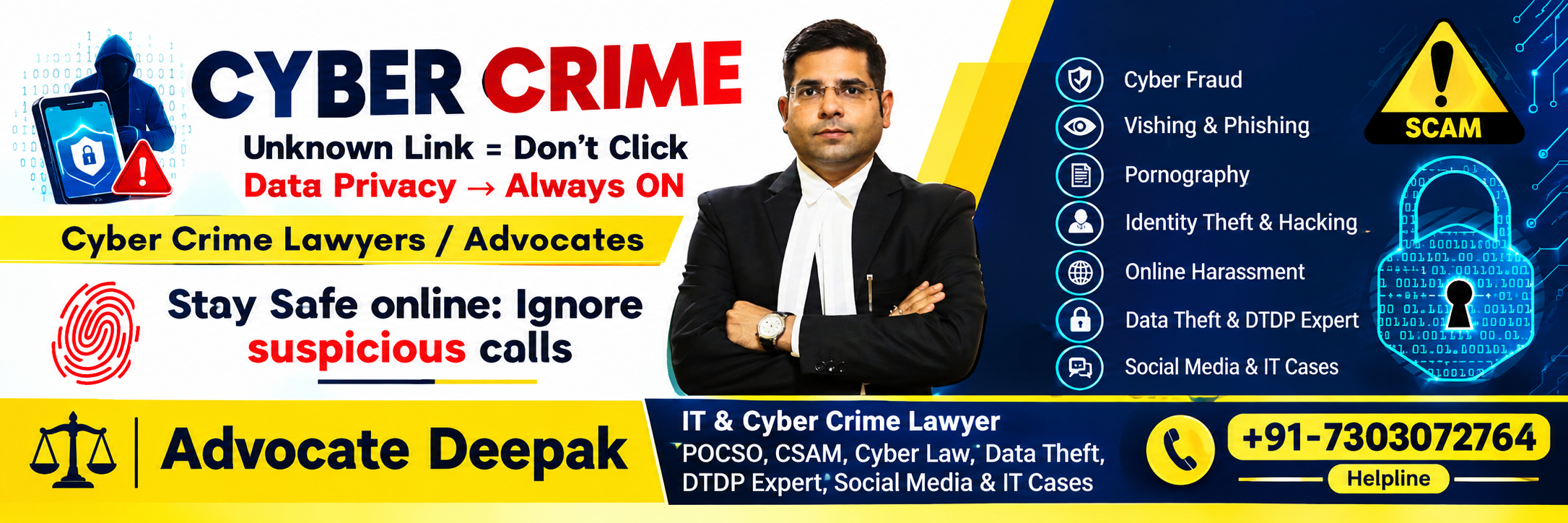
Advocate Deepak, an IT and Cyber Crime Lawyer, handles cyber-law matters involving digital evidence, data theft, online financial fraud, identity misuse and technology-related legal disputes. Understanding both the legal and technical aspects of a data-related incident can be important when preparing a complaint, responding to allegations or protecting an organisation’s interests.
What Is the DPDP Act, 2023?
The Digital Personal Data Protection Act, 2023, commonly called the DPDP Act, is an Indian law governing the processing of digital personal data, subject to its scope, conditions and statutory exceptions. It establishes obligations for organisations processing personal data and provides rights and protections for individuals, known under the Act as Data Principals.
The law is particularly relevant as businesses increasingly collect and use customer information through websites, mobile applications, online marketplaces, payment systems, cloud platforms and digital services.
The DPDP Act addresses important questions, including:
- When and how digital personal data may be processed.
- What information and notices should be provided to individuals.
- When consent is required and how it may be withdrawn.
- What reasonable security safeguards organisations must implement.
- How personal data breaches should be handled.
- How individuals can raise grievances concerning the processing of their personal data.
- What penalties may apply when specified legal obligations are breached.
The correct legal response depends on the facts of the incident, the type of data involved, the parties responsible and the provisions applicable at the relevant time.
Difference Between a DPDP Act Case and a Cyber Crime Case
A data protection dispute and a cybercrime complaint may arise from the same incident, but they are not necessarily the same legal matter.
For example, if a company employee copies a customer database and shares it with a competitor, the incident may raise questions about data protection, employment obligations, confidentiality, unauthorised access and possible cyber offences. The appropriate legal action depends on the evidence and the applicable law.
Common examples include:
- Personal data collected or used improperly, raising DPDP Act compliance concerns.
- A customer database stolen by an outsider, potentially involving cybercrime and data protection issues.
- Private photographs shared without authority, raising privacy and other legal concerns.
- An employee leaking confidential company information, potentially involving employment, confidentiality and criminal law.
- A company experiencing a security breach, requiring assessment of security duties and applicable reporting obligations.
- A fake profile created using someone’s personal information, potentially involving identity misuse and impersonation.
A cyber crime lawyer handling DPDP Act matters can examine whether the facts support a data protection grievance, a police complaint, civil proceedings, contractual action or more than one legal remedy.
When Do You Need a Cyber Crime Lawyer for a DPDP Act Case?
You may need legal assistance if your personal information has been misused or your organisation has received a complaint concerning its handling of digital personal data.
1. Personal Data Theft
Personal data theft may involve unauthorised copying, access, extraction or disclosure of information. Examples include customer lists, employee records, contact details, identity documents and databases containing personal information.
A lawyer can help assess how the data was obtained, preserve digital evidence, identify potential legal violations and prepare an appropriate complaint or legal response.
2. Data Breach and Unauthorised Disclosure
A data breach can occur when personal information is accessed, disclosed, altered, lost or exposed without proper authorisation or protection.
Examples include a business website exposing customer records, an employee sending confidential customer information to an unauthorised recipient, a database being accessed following a cyberattack, or personal documents being shared in a public online group.
The legal obligations following an incident depend on the nature of the data, the role of the parties, the applicable provisions and their commencement dates.
3. Misuse of Customer and Employee Data
Businesses collect information to provide services, manage accounts, process transactions and perform other legitimate functions. Problems may arise when information is used beyond an authorised purpose, disclosed improperly or retained without an appropriate basis.
A data protection advocate can review the relevant privacy notices, consent records, contracts, internal communications and technical evidence to determine the available legal options.
4. Privacy Violations on Websites and Mobile Applications
Websites and mobile applications may collect names, email addresses, telephone numbers, location-related information and other personal details.
If an individual believes an organisation has handled their digital personal data unlawfully, legal assistance may help them understand the applicable rights, raise a grievance and determine whether further proceedings are appropriate.
5. Identity Theft and Online Impersonation
Identity misuse may involve fake social media accounts, fraudulent registrations, misuse of identity documents or unauthorised use of another person’s information.
Depending on the circumstances, these incidents may involve provisions of the Information Technology Act, 2000, the Bharatiya Nyaya Sanhita or other applicable laws, in addition to any relevant data protection issues.
What Rights Does an Individual Have Under the DPDP Act?
The DPDP Act provides a statutory framework for certain rights of individuals, subject to its provisions, conditions, exceptions and commencement.
Key rights under the framework include:
- Right to access information: Obtain information about personal data and its processing in the manner provided by law.
- Right to correction and erasure: Request correction, completion, updating or erasure in circumstances covered by the Act.
- Right to grievance redressal: Use the prescribed grievance mechanism where applicable.
- Right to withdraw consent: Withdraw consent where processing is based on consent, subject to the Act.
- Right to nominate: Nominate another person to exercise specified rights in the event of death or incapacity, as provided by law.
If an organisation ignores a grievance, refuses a valid request or mishandles personal data, a lawyer can help assess the facts, prepare a written representation and identify the appropriate complaint mechanism.
These rights should not be interpreted as absolute rights to access every record or demand the immediate deletion of all information in every situation.
What Should You Do If Your Personal Data Has Been Stolen?
If you suspect that your personal information has been stolen, exposed or misused, taking timely steps can help protect evidence and reduce further harm.
Step 1: Preserve the evidence. Save relevant emails, messages, screenshots, website addresses, transaction records and complaint acknowledgements. Preserve original files wherever possible.
Step 2: Secure your accounts. Change compromised passwords, enable multifactor authentication and contact the relevant service provider or organisation.
Step 3: Identify the data involved. Record what information was affected, how you discovered the incident, when it occurred and whether any financial loss or identity misuse followed.
Step 4: Send a written complaint. Where appropriate, submit a complaint to the organisation concerned and retain proof of submission and its response.
Step 5: Consider a cybercrime complaint. If the incident involves hacking, impersonation, extortion, financial fraud or another suspected offence, assess whether reporting it to the appropriate police or cybercrime authority is necessary.
Step 6: Obtain legal advice on the correct route. A DPDP Act lawyer can help distinguish a data protection grievance from a criminal complaint and explain what evidence or supporting documents may be needed.
Avoid publicly sharing unmasked Aadhaar details, bank information, passwords or sensitive personal records while seeking assistance.
How Can a Business Respond to a Data Breach or DPDP Act Complaint?
Companies, startups, e-commerce businesses, IT service providers and other organisations should have a clear process for responding to suspected personal data breaches and privacy complaints.
A suitable response may involve:
- Identifying the affected systems and information.
- Containing unauthorised access and securing relevant accounts.
- Preserving logs, access records, communications and forensic evidence.
- Determining the organisation’s role as a Data Fiduciary or Data Processor.
- Reviewing applicable contracts, privacy notices and consent records.
- Assessing whether statutory notification or other reporting requirements apply.
- Responding to affected individuals and regulators through the applicable process.
- Reviewing security controls and taking corrective action.
An organisation should not assume that every incident creates identical reporting obligations. The applicable requirements depend on the law in force, the facts of the incident and the role of the organisation.
DPDP Act 2023 and DPDP Rules 2025: What Is the Legal Position?
The Digital Personal Data Protection Rules, 2025 were notified in November 2025. However, the Act and Rules provide for phased commencement, so the notification of the Rules should not be confused with every substantive obligation becoming applicable immediately.
Businesses and individuals should check the commencement notification relevant to the particular provision before relying on it in a complaint, compliance assessment or legal notice.
This distinction is important for a cyber crime lawyer dealing with DPDP Act cases. A legal opinion should identify the relevant provision, its commencement status, the nature of the incident and any other law that may apply.
What Penalties Can Apply Under the DPDP Act?
The DPDP Act provides for significant monetary penalties for specified contraventions. The maximum penalty can reach ₹250 crore for failure to take reasonable security safeguards to prevent personal data breaches, while certain other specified contraventions carry different maximum amounts.
The maximum amounts are not automatic fines in every case. Liability and the penalty, if any, depend on the applicable provision, the facts and the statutory process.
A lawyer can help an organisation assess potential exposure, prepare its response, review compliance measures and present relevant facts and evidence during the applicable proceedings.
What Legal Services Can a DPDP Act and Cyber Crime Lawyer Provide?
A lawyer handling data protection and cybercrime matters may assist with:
- Legal review of personal data theft and privacy violation complaints.
- Drafting complaints concerning suspected unauthorised disclosure of personal information.
- Preparing replies to legal notices and data protection grievances.
- Reviewing privacy policies, consent notices and data-handling contracts.
- Advising on suspected data breaches and evidence preservation.
- Examining employee or vendor misuse of customer information.
- Coordinating the legal aspects of cybercrime complaints.
- Assessing applicable remedies under the DPDP Act, IT Act and other relevant laws.
- Helping businesses understand their legal responsibilities and respond to allegations.
- Preparing representations and other documents for the appropriate authority or forum, where legally available.
The precise scope of legal assistance depends on the facts and the applicable law. No lawyer can guarantee a particular investigation outcome, penalty decision or recovery.
Why Consider Advocate Deepak for DPDP Act and Data Protection Cases?
Data protection disputes often involve both legal questions and technical evidence. Understanding the way digital systems work can be important when investigating how information was accessed, copied, transferred or disclosed.
Advocate Deepak (IT & Cyber Expert) handles IT and cyber-law matters involving digital evidence, data theft, online financial fraud, identity misuse and technology-related disputes.
For individuals, businesses and organisations seeking a cyber crime lawyer for DPDP Act cases in India, relevant areas of legal assistance may include:
Cyber-law understanding: Reviewing the relationship between suspected data misuse, privacy concerns and applicable cyber laws.
Digital evidence: Helping identify and organise relevant electronic records, communications, access logs and other supporting material.
Complaint drafting: Preparing fact-based complaints, representations and replies to notices concerning data theft or privacy-related disputes.
Business data protection concerns: Reviewing the legal aspects of customer database misuse, employee-related data disputes, confidentiality concerns and suspected breaches.
Legal strategy: Assessing whether a matter may require a police complaint, a data protection grievance, contractual remedies or another legally available route.
The appropriate advocate should be selected according to the nature of the case, relevant experience, evidence and the legal remedy required. Advocate Deepak’s IT and cyber-law practice is relevant to individuals and organisations seeking assistance with technology-related legal disputes.
Cyber Crime Lawyer for DPDP Act Cases Across India
Data protection issues can arise anywhere in India, regardless of whether the affected individual or organisation is located in Delhi, Mumbai, Bengaluru, Hyderabad, Pune, Chennai, Noida, Gurugram or another city.
A data protection dispute may involve a local business, a remote employee, an online platform, a cloud service provider or parties operating in different states. The appropriate legal process depends on jurisdiction, the facts and the applicable law.
A Cyber Crime Lawyer for DPDP Act cases in India can help assess the legal issues, organise the supporting evidence and identify the appropriate next step for the particular matter.
Frequently Asked Questions About DPDP Act Cases
1. What does a cyber crime lawyer do in a DPDP Act case?
A cyber crime lawyer can assess suspected personal data misuse, review digital evidence, draft complaints or replies, explain applicable legal obligations and identify potential remedies under the DPDP Act and other relevant laws.
2. Can I file a complaint if someone steals my personal data?
Depending on the facts, you may be able to raise a grievance with the relevant organisation, approach the applicable data protection mechanism or file a cybercrime complaint if a suspected offence has occurred. The correct route depends on the circumstances and the provisions in force.
3. Does the DPDP Act apply to every data dispute?
No. The Act concerns digital personal data within its statutory scope and contains exclusions and exceptions. A dispute involving confidential business information alone may require analysis under other laws or contracts.
4. Can a company face penalties for a data breach?
A company may face consequences if the facts establish a contravention of an applicable legal obligation. The existence of a security incident does not, by itself, establish every element of a contravention or make the maximum penalty automatic.
5. Can a lawyer help after a customer database is leaked?
Yes. Legal assistance may include reviewing the evidence, identifying potential obligations and liabilities, preparing complaints or responses, and advising on appropriate corrective steps.
6. Is the DPDP Act the same as the IT Act?
No. The DPDP Act establishes a framework for processing digital personal data and related rights and obligations. The Information Technology Act, 2000 addresses various legal issues involving electronic records, computer systems and specified cyber offences. Both may be relevant to a particular incident, depending on the facts.
7. Can a startup seek legal assistance for DPDP compliance?
Yes. A startup can seek assistance reviewing its privacy notices, consent practices, contracts, data-handling procedures, security incident response and other obligations applicable to its activities.
8. Is every provision of the DPDP Act enforceable immediately?
No. The commencement notification provides for different dates for different provisions. The applicable legal position should be checked before asserting that a particular duty or remedy is currently in force.
9. How do I choose a lawyer for a data protection dispute?
Consider the lawyer’s experience in cyber law, familiarity with electronic evidence, understanding of data protection legislation, ability to assess the facts and experience with the type of remedy your case may require.
Conclusion
Personal data theft, unauthorised disclosure, privacy violations and data breaches can create serious consequences for individuals and organisations. The Digital Personal Data Protection Act, 2023 provides an important legal framework, while other cyber laws may also apply depending on the incident.
If you are facing a data protection complaint, suspect that your personal information has been misused or need legal assistance with a customer database breach, seek a fact-specific assessment of the available legal options. A Cyber Crime Lawyer for DPDP Act cases in India can help you understand the relevant provisions, preserve evidence, prepare appropriate legal documents and determine the next steps.
Advocate Deepak | IT & Cyber Crime Lawyer | POCSO, CSAM, Cyber Law, Data Theft, Social Media & IT Cases +91-7303072764 Helpline
Disclaimer: This article is for general legal awareness and does not constitute legal advice. The applicability of the DPDP Act and other laws depends on the facts and the commencement of the relevant provisions.


