Lawyer for online Cheating Case in Noida | (IT & Cyber Lawyer)
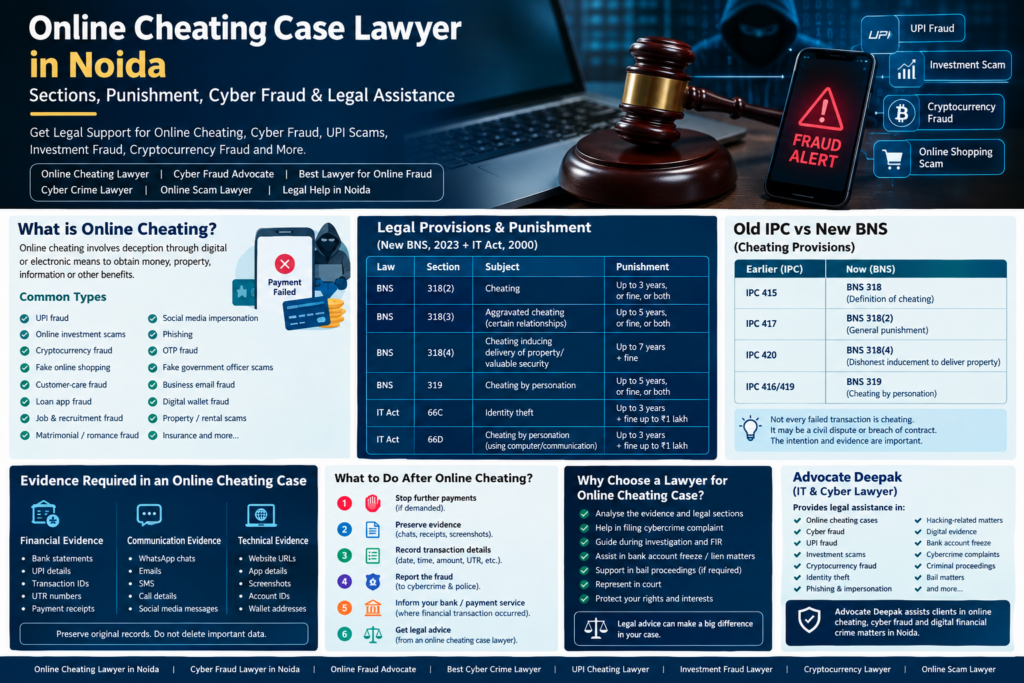
Online Cheating Case Lawyer in Noida – Sections, Punishment, Cyber Fraud & Legal Assistance Online cheating has become a major form of financial and cyber-enabled crime. A person may be deceived through a fake investment platform, fraudulent online seller, UPI transaction, social-media account, fake customer-care number, cryptocurrency scheme, matrimonial profile, job offer, loan application or impersonation. When money, property, credentials or valuable information is obtained through deception, the matter may involve cheating under the Bharatiya Nyaya Sanhita (BNS), 2023, along with provisions of the Information Technology Act, 2000 and other applicable laws. For incidents covered by the new criminal-law framework, the Bharatiya Nyaya Sanhita, 2023 is the principal replacement for the Indian Penal Code. The IT Act continues to contain specific offences involving computers, communication devices, identity theft and online personation. A person looking for an online cheating case lawyer in Noida, online fraud advocate in Noida, cyber cheating lawyer in Noida, or cyber crime advocate for online fraud may need legal assistance at the complaint, investigation, notice, bail or court stage. What Is Online Cheating? Online cheating generally involves deception carried out through digital or electronic means with the intention of obtaining money, property, information or some other benefit. Examples include: Fake online shopping websites UPI fraud Online banking fraud Fake investment schemes Stock-market trading scams Cryptocurrency scams Fake loan applications Fake job offers Matrimonial fraud Romance scams Fake customer-care scams Phishing OTP fraud QR-code fraud Social-media impersonation Fake government-officer scams Fake police or CBI/ED officer impersonation Business email fraud Payment-gateway fraud Digital-wallet fraud Fake refund scams Online marketplace fraud Fake property or rental advertisements Insurance scams Fake KYC scams Cryptocurrency investment fraud Online trading fraud The exact legal section depends on what was represented, how the victim was deceived, what was delivered, the intention at the time of the transaction, the electronic evidence and the date of the alleged offence. Online Cheating Case Lawyer in Noida An online cheating case lawyer in Noida can assist in matters involving digital financial fraud and technology-enabled cheating. Depending on the circumstances, legal assistance may include: Examining the transaction history Reviewing WhatsApp and Telegram conversations Examining emails and screenshots Analysing UPI and bank transactions Reviewing website and application information Preparing a cybercrime complaint Assisting with police complaints Responding to notices Advising on FIR-related proceedings Assisting in bank-account freeze or lien matters Advising accused persons regarding criminal proceedings Bail-related proceedings where applicable Court representation Assistance concerning electronic evidence Online Cheating Under the New BNS One of the most important provisions for cheating is Section 318 of the Bharatiya Nyaya Sanhita, 2023. BNS Section 318 defines cheating and provides different punishments depending upon the circumstances. BNS Section 318(2) – Cheating A person who commits cheating can be punished with: Imprisonment up to 3 years, or fine, or both. This provision can apply to qualifying cheating conduct where the more aggravated circumstances in the subsequent subsections are not established. BNS Section 318(3) – Cheating Causing Wrongful Loss in Certain Relationships Section 318(3) addresses cheating where the person committing the cheating knew that the conduct was likely to cause wrongful loss to a person whose interests in the transaction the accused was legally or contractually bound to protect. The punishment can extend to: 5 years’ imprisonment, or fine, or both. Whether this subsection applies depends upon the relationship between the parties and the statutory requirements. BNS Section 318(4) – Cheating and Dishonestly Inducing Delivery of Property This is particularly important in many online financial cheating cases. Where a person cheats and thereby dishonestly induces the deceived person to: Deliver property; Make, alter or destroy a valuable security; or Make, alter or destroy something signed or sealed that can be converted into a valuable security, the punishment can extend to: 7 years’ imprisonment and fine. This provision is particularly relevant to allegations involving money or property obtained through deception. Old IPC Section 420 vs New BNS Section 318 Before the new criminal-law framework, IPC Section 420 was commonly invoked in cases involving cheating and dishonestly inducing delivery of property. Under the BNS framework, the corresponding cheating offence is addressed primarily through Section 318, with subsection 318(4) covering aggravated cheating involving dishonest inducement to deliver property or certain valuable instruments. Simplified comparison Earlier framework Current framework Subject IPC Section 415 BNS Section 318 Definition of cheating IPC Section 417 BNS Section 318(2) General punishment for cheating IPC Section 420 BNS Section 318(4) Cheating involving dishonest inducement to deliver property IPC Sections 416/419 BNS Section 319 Cheating by personation The precise provision depends on the facts and date of the alleged offence. Important Difference Between Cheating and Breach of Contract Not every failed transaction is automatically cheating. This distinction can be extremely important. For example, if a person enters into a genuine transaction intending to perform it but subsequently fails to perform the contractual obligation, the facts may constitute a civil dispute or breach of contract rather than criminal cheating. The BNS itself illustrates this principle: where a person initially intends to perform a promise but subsequently fails to perform it, the circumstances may amount to a civil breach rather than cheating. However, if the evidence shows that the person had a dishonest intention from the relevant beginning and used deception to induce the victim to part with money or property, the legal position can be different. Therefore, an online cheating case advocate should examine the complete transaction rather than relying solely on the fact that money was not returned. Cheating by Personation – BNS Section 319 Online fraud frequently involves impersonation. Examples include pretending to be: A bank employee A police officer A government officer A company director A relative A lawyer A customer-care executive An investment adviser A cryptocurrency exchange employee BNS Section 319 deals with cheating by personation. The provision covers pretending to be another person or knowingly substituting one person for another, including personation of a real or imaginary person. Punishment can extend to: 5 years’ imprisonment, or fine, or both. IT Act Section
Lawyer for online Cheating Case in Noida | (IT & Cyber Lawyer) Read More »


