The Best Cyber Crime Lawyer Online 

Cyber Crime Litigation Lawyer | Online Scam | Money Recovery

Cyber Crime Litigation Lawyer in India – Legal Help for Cyber Crime Cases, Online Fraud, Bail, Digital Evidence and Bank Account Freeze  Cyber crime cases in India are becoming increasingly complex because they involve technology, electronic evidence, financial transactions and criminal law. A cyber offence may involve online financial fraud, UPI fraud, phishing, hacking, identity theft, cryptocurrency fraud, fake investment schemes, social media offences, cyberstalking, data theft or unauthorised use of digital information. A Cyber Crime Litigation Lawyer in India handles the legal side of such matters from the investigation stage to court proceedings. Cyber crime litigation may involve representation before the Cyber Crime Police, Investigating Officer, Magistrate Court, Sessions Court and High Court, depending upon the nature and stage of the case. What Is Cyber Crime Litigation? Cyber crime litigation means legal proceedings connected with offences committed through computers, mobile phones, internet platforms, digital communication, online banking or other technology. Cyber crime litigation may involve both victims and persons accused of cyber offences. Important matters may include: ☞ Cyber crime complaints ☞ Cyber crime FIRs ☞ Police investigation ☞ Cyber crime police notices ☞ Online financial fraud ☞ UPI and IMPS fraud ☞ Bank account freeze and lien ☞ Digital evidence ☞ Cryptocurrency-related disputes ☞ Identity theft ☞ Social media offences ☞ Hacking and unauthorised access ☞ Anticipatory bail ☞ Regular bail ☞ Criminal defence ☞ Quashing of criminal proceedings where legally maintainable ☞ Trial and appeals Cyber Crime Laws in India Cyber crime cases can involve different laws depending upon the facts and allegations. The Information Technology Act, 2000 remains an important special law for various computer and technology-related offences. The Bharatiya Nyaya Sanhita (BNS) may apply to offences such as cheating, forgery, impersonation, criminal intimidation and other offences committed through electronic means. The Bharatiya Nagarik Suraksha Sanhita (BNSS) provides the procedural framework for investigation, arrest, bail and criminal proceedings, while the Bharatiya Sakshya Adhiniyam (BSA) deals with evidence, including electronic records. Therefore, a cyber crime case may require analysis of several legal provisions together rather than relying on one law alone. Online Financial Fraud and Cyber Crime Litigation Online financial fraud is one of the most common categories of cyber crime litigation. Cases may involve: UPI fraud IMPS fraud NEFT fraud Fake investment schemes Fake trading applications Cryptocurrency scams Loan application fraud Job scams OTP fraud Phishing Digital arrest scams WhatsApp investment fraud Telegram task scams Fake customer-care fraud Social media investment scams A lawyer may examine the complete transaction trail, communication records, bank statements, payment details and other electronic evidence to understand how the fraud occurred and what legal proceedings may be appropriate. Cyber Crime Litigation for Bank Account Freeze and Lien Bank account freezing and lien marking have become important issues in cyber crime matters. A bank account may be restricted when a transaction connected with an alleged cyber fraud is identified during an investigation. In such circumstances, the account holder may face: ☞ Debit restrictions ☞ Lien on a particular amount ☞ Complete account freezing ☞ Difficulty in making payments ☞ Business disruption ☞ Problems with salary or regular expenses A Cyber Crime Litigation Lawyer can examine the disputed transaction, source of funds, bank statement, transaction ID, complaint details and available investigation information. Where appropriate, a representation can be submitted before the concerned Cyber Crime Police Station or Investigating Officer seeking verification and appropriate release of the legitimate funds or removal of the restriction. Cyber Crime Police Notice A person may receive a notice from a Cyber Crime Police Station requiring appearance or information in connection with an investigation. A notice may relate to: A bank transaction A disputed payment A cryptocurrency transaction An online purchase A social media account A mobile number A digital communication A financial account A complaint registered by another person A police notice should not simply be ignored. The person receiving the notice should first understand the allegations, the case reference, the investigating officer, the documents required and the nature of the alleged transaction. Where there is a possibility of arrest or criminal prosecution, legal advice before responding may be important. Anticipatory Bail in Cyber Crime Cases Cyber crime allegations can sometimes create an apprehension of arrest. Depending upon the offences alleged and circumstances of the case, an application for anticipatory bail may be considered before the appropriate court. The court may consider factors such as: Nature of allegations Seriousness of the offence Amount involved Role of the accused Digital evidence Financial transaction trail Cooperation with investigation Possibility of custodial interrogation Previous criminal history Risk of tampering with evidence Every bail matter depends on its own facts and the exact provisions invoked in the case. Regular Bail in Cyber Crime Cases When a person has already been arrested in a cyber crime case, regular bail proceedings may be required. The defence may examine: ☞ FIR and sections invoked ☞ Arrest documents ☞ Investigation material ☞ Digital evidence ☞ Financial records ☞ Statements of witnesses ☞ Alleged role of the accused ☞ Recovery allegations ☞ Custody requirements A properly prepared bail strategy should be based on the actual allegations and evidence available in the case. Digital Evidence in Cyber Crime Litigation Digital evidence is often central to cyber crime cases. It may include: WhatsApp chats Emails Screenshots Mobile phone data Computer data Bank statements UPI records Transaction IDs CCTV footage Social media records IP-related information Call records Cryptocurrency wallet records Exchange transaction records Documents stored electronically The authenticity, source, preservation and manner of producing electronic evidence can become important during investigation and trial. For this reason, cyber crime litigation requires more than an understanding of traditional criminal law. The lawyer must also understand how digital and financial evidence fits into the allegations. Cryptocurrency and Cyber Crime Litigation Cryptocurrency-related cyber crime matters can involve complicated transaction chains. Examples include: USDT fraud Binance P2P disputes Cryptocurrency investment scams Fake crypto platforms Wallet fraud Crypto recovery scams Unauthorised cryptocurrency transfers Exchange-related disputes Blockchain transaction tracing In such cases, it may be necessary

Cyber Crime Litigation Lawyer | Online Scam | Money Recovery Read More »

IT Act, DPDP Act & Technology Law in India ?

IT Act, DPDP Act & Technology Law Advisory in India – Complete Legal Guide Technology has become an essential part of modern business, communication, banking, e-commerce, digital marketing, cloud computing, artificial intelligence, social media and online services. As businesses increasingly depend on digital platforms and personal data, legal compliance has become equally important. The Information Technology Act, 2000, the Digital Personal Data Protection Act, 2023, contractual obligations, cybersecurity requirements, intellectual property laws and other applicable legal frameworks create important responsibilities for businesses, technology companies, startups, online platforms and individuals. A Technology Law Advocate can help businesses and individuals understand these legal requirements, assess technology-related risks, prepare contracts and privacy documentation, respond to cyber incidents, protect digital assets and handle disputes involving technology and data. IT Act legal advisory, DPDP Act legal advisory, technology law consultation, data protection advisory and cyber law compliance have therefore become important components of modern legal risk management. What Is Technology Law Advisory? Technology Law Advisory is legal guidance relating to the use, development, storage, transfer and protection of technology, digital information, electronic records and online services. A Technology Law Advocate may advise on matters involving: Information Technology Act Digital Personal Data Protection Act Data privacy and personal data Cybersecurity Cyber crimes Digital contracts Electronic records Electronic signatures Technology agreements Software licensing SaaS agreements Cloud computing contracts Website legal compliance Mobile applications E-commerce Online platforms Artificial intelligence Intellectual property related to technology Data breaches Cyber incidents Employee data Customer data Vendor data processing Cross-border data issues Digital evidence Online disputes Technology-related litigation Technology law advisory is not limited to litigation. Preventive legal compliance can help reduce the possibility of regulatory problems, contractual disputes, privacy complaints and cyber-related legal consequences. What Is the Information Technology Act, 2000? The Information Technology Act, 2000, commonly referred to as the IT Act, is one of India’s principal laws dealing with electronic records, electronic transactions, digital signatures, computer systems and various forms of cyber-related conduct. The IT Act has played an important role in establishing the legal framework for electronic transactions and addressing unlawful activities involving computer resources and communication systems. A business dealing with websites, applications, online transactions, customer databases, digital platforms or electronic communications may need to understand how the IT Act applies to its activities. A qualified IT Act Advocate can analyse the facts of a particular matter and identify the relevant provisions and legal remedies. Why Is IT Act Legal Advisory Important? Technology-related legal problems can develop quickly. For example, a company may experience: Unauthorized access to its server Hacking of an employee account Customer database leakage Website compromise Phishing attack Identity theft Online impersonation Digital payment fraud Unauthorized use of computer resources Data theft Cyber harassment Electronic evidence disputes In such situations, legal advice should ideally begin as early as possible. An IT Act Legal Consultant or Technology Law Advocate can assist in evaluating the incident, preserving evidence, communicating with relevant authorities, reviewing contracts and determining appropriate legal action. Important Areas Covered by the IT Act Depending on the facts, different provisions of the IT Act may become relevant. 1. Unauthorized Access Unauthorized access to computer systems, networks, databases or digital resources can create legal consequences. Businesses should maintain proper access controls and logs so that unauthorized activity can be identified and investigated. 2. Damage to Computer Resources Unauthorized alteration, deletion, disruption or damage involving computer systems may result in civil or criminal consequences depending on the circumstances and applicable provisions. 3. Computer-Related Offences Certain activities involving computers and communication systems can attract criminal liability under the IT Act. A Cyber Law Advocate can examine whether the alleged conduct falls within the applicable statutory provisions. 4. Identity Theft Digital identity theft may involve the unauthorized use of passwords, electronic signatures or other identification features. Identity theft can occur through: Phishing Credential theft SIM-related fraud Account takeover Malware Social engineering Fake websites Fake applications 5. Online Cheating and Personation Technology may also be used to impersonate another person and commit fraud. Examples include: Fake customer-care accounts Fake investment profiles Fake business representatives Fake social-media accounts Fake payment requests Fake recruitment portals Legal advice may involve both cyber law and general criminal law depending on the facts. What Is the Digital Personal Data Protection Act, 2023? The Digital Personal Data Protection Act, 2023, commonly called the DPDP Act, establishes a legal framework relating to the processing of digital personal data in India. The law is particularly important for organisations that collect, store, use or otherwise process personal data through digital systems. Businesses increasingly handle information such as: Names Mobile numbers Email addresses Addresses Identification information Account information Customer records Employee information Online identifiers Other personal information The legal obligations surrounding such information make DPDP Act Legal Advisory increasingly important for organisations. What Is Personal Data? Personal data generally refers to information about an individual who can be identified through or in relation to that information. In practical business operations, personal data may be collected through: Website forms Mobile applications CRM systems E-commerce platforms Lead-generation campaigns HR systems Customer-support systems Payment processes Marketing platforms Cookies and online technologies Registration forms Businesses should understand what information they collect, why they collect it, how it is processed and what legal obligations apply. Who Needs DPDP Act Legal Advisory? DPDP-related legal advice can be relevant to: Startups IT companies SaaS companies E-commerce businesses Fintech companies EdTech companies Health-tech platforms Digital marketing companies Online marketplaces Mobile application developers Technology service providers Banks and financial service businesses Employers Data-driven businesses Organisations processing customer information The exact obligations depend on the organisation’s activities, data processing practices and applicable legal framework. Data Fiduciary and Data Processor The DPDP framework distinguishes important roles in the processing of personal data. A Data Fiduciary determines the purpose and means of processing personal data. A Data Processor may process personal data on behalf of a Data Fiduciary. For example, a business may collect customer information while using a third-party cloud service, CRM provider or technology vendor to process or

IT Act, DPDP Act & Technology Law in India ? Read More »

Hacking & Unauthorized Access Scam & Fraud ?

Hacking & Unauthorized Access Cases in India – Complete Legal Guide by a Cyber Crime Advocate The increasing use of computers, smartphones, cloud platforms, mobile applications, online banking, social media and digital business systems has made cybersecurity an important legal concern. Hacking and unauthorized access can affect individuals, companies, financial institutions, websites, government systems and online accounts. A person may suddenly discover that their email account has been hacked, social media account has been taken over, website has been compromised, bank account has been accessed without permission, confidential information has been stolen or business data has been downloaded without authorisation. These incidents can involve both technical and legal issues. Depending on the facts, a matter may involve unauthorized access, data theft, identity theft, cheating, impersonation, financial fraud, cyber stalking, extortion, privacy violations or other cyber offences. An experienced Hacking Case Advocate, Unauthorized Access Advocate, Cyber Crime Advocate, Cyber Defense Advocate or Cyber Litigation Advocate can help a victim understand the available legal remedies, preserve evidence and take appropriate action before the investigating authorities or courts. What Is Hacking? Hacking generally refers to gaining access to a computer, computer resource, network, application, account or digital system without proper authorization, or manipulating a digital system in an unauthorised manner. The word “hacking” is commonly used for many different activities. Legally, however, the exact nature of the conduct matters. For example, there can be a significant difference between: Unauthorized access to an email account Breaking into a company’s computer network Stealing confidential business data Taking control of a social media account Accessing another person’s cloud storage Manipulating website data Installing malicious software Accessing online banking credentials Changing website content Deleting computer data Using stolen credentials Accessing a computer system after authorization has been withdrawn Therefore, a Hacking Case Advocate generally examines the technical facts and the applicable legal provisions rather than treating every incident simply as “hacking.” What Is Unauthorized Access? Unauthorized access occurs when a person accesses a computer, computer system, account, network, application or digital resource without the required permission or authority. Examples may include: Accessing someone’s Gmail account without permission Entering an employee’s company account after employment has ended Accessing another person’s social media account Opening confidential company files without authorization Accessing a server using stolen credentials Entering a cloud account without permission Accessing a database using another person’s login credentials Obtaining access to a website administration panel without authorization The legal consequences depend upon how access was obtained, what was accessed, what was done afterward and what loss or harm resulted. Hacking and Unauthorized Access Cases in India Cyber incidents can arise in both personal and commercial environments. Common cases handled under the broader category of hacking and unauthorized access include: Email hacking Gmail account hacking Social media account hacking Instagram account hacking Facebook account takeover WhatsApp account compromise Website hacking Server hacking Database intrusion Cloud account compromise Corporate network intrusion Password theft Credential theft Data theft Unauthorized downloading of confidential files Malware-related access Ransomware attacks Banking credential compromise Account takeover Identity theft Each matter requires an examination of the available digital evidence and the circumstances surrounding the unauthorized access. Email Hacking Cases Email accounts contain highly sensitive information. A compromised email account may provide access to: Personal communications Business documents Password-reset links Financial information Cloud storage Customer information Contact lists Confidential contracts Social media accounts A hacker may change the password and recovery details, activate unauthorized forwarding rules or use the compromised email account to send fraudulent messages. An Email Hacking Advocate can assist with documenting the incident, preparing the appropriate complaint and identifying the relevant legal remedies. Social Media Account Hacking Social media accounts can be targeted through: Phishing links Stolen passwords Fake verification messages Fake customer-support accounts Malicious applications Credential reuse Social engineering SIM-related compromise After gaining access, an offender may: Change the password Change the registered email address Change the mobile number Delete posts Send fraudulent messages Demand money Impersonate the account holder Threaten the victim Publish private information A Social Media Hacking Advocate can help evaluate whether the incident involves unauthorized access, impersonation, extortion, privacy violations or other cyber offences. Website Hacking Cases Website hacking can seriously affect businesses. A compromised website may be: Defaced Redirected to another website Injected with malicious code Used for phishing Used to distribute malware Manipulated to steal customer information Used to damage a company’s reputation Evidence may include server logs, hosting records, administrator login records, security alerts, screenshots, IP-related information and forensic examination. A Website Hacking Case Advocate can coordinate the legal side of the matter while technical professionals assist with forensic investigation and system recovery. Server and Database Hacking Businesses often maintain valuable information on servers and databases. Unauthorized access can expose: Customer records Employee information Financial information Password databases Business documents Intellectual property Source code Internal communications Commercial information Database compromise can create both financial and reputational consequences. The legal strategy may depend upon the type of information accessed, the method of access, the extent of loss and the identity of the suspected offender. Corporate Network Hacking Businesses may face attacks against: Internal networks VPN systems Cloud infrastructure Employee accounts Servers Workstations Databases Administrative panels In a corporate hacking case, an organization should immediately preserve available logs and avoid unnecessary alteration of the compromised system. A Cyber Defense Advocate may work with the organization’s technical and forensic teams to establish the factual and legal record. Data Theft Through Unauthorized Access Hacking is sometimes carried out for the purpose of stealing information. Stolen data may include: Customer databases Email databases Phone numbers Passwords Financial records Business plans Intellectual property Source code Confidential agreements Personal photographs Private communications Data theft may result in additional legal issues beyond unauthorized access. Account Takeover Cases Account takeover occurs when an unauthorized person gains control of another person’s online account. The attacker may: Obtain credentials. Log into the account. Change recovery details. Lock the genuine user out. Access stored information. Contact the victim’s friends or customers. Attempt financial fraud. Demand money

Hacking & Unauthorized Access Scam & Fraud ? Read More »

Fraud Money Recovery Lawyer in Noida

Fraud Money Recovery Lawyer in Noida – Expert Legal Help for Online Financial Fraud, Bank Account Freeze & Money Recovery  Online financial fraud has become one of the fastest-growing cyber crimes in India. Every day, individuals and businesses lose money through UPI fraud, internet banking fraud, phishing scams, fake investment schemes, QR code scams, credit card fraud, debit card fraud, cryptocurrency scams, and fake customer-care calls. In many cases, victims not only lose their hard-earned money but also face additional problems such as bank account freezes, lien holds, debit freezes, and cyber crime investigations. If you have become a victim of an online financial fraud or your bank account has been frozen due to a cyber crime investigation, consulting an experienced Fraud Money Recovery Lawyer in Noida can help you understand your legal rights and the appropriate remedies available under Indian law. A Fraud Money Recovery Advocate in Noida assists clients in matters involving cyber fraud complaints, bank account freezes, lien removal, online financial fraud, banking disputes, legal notices, police investigations, and court proceedings. Whether you are an individual, business owner, trader, freelancer, or startup, timely legal guidance can make a significant difference in protecting your financial interests. What Is Fraud Money Recovery? Fraud money recovery refers to the legal and procedural process of attempting to recover money that has been lost through fraudulent online transactions or financial scams. Depending on the facts of the case, recovery efforts may involve: Reporting the fraud through the 1930 Cyber Helpline Filing a complaint on the National Cyber Crime Reporting Portal (NCRP) Informing the concerned bank immediately Preserving transaction records and digital evidence Communicating with investigating agencies Filing bank grievances Seeking regulatory remedies where applicable Initiating appropriate legal proceedings before the competent court Every case is different. Some matters involve victims trying to recover lost money, while others involve innocent account holders whose bank accounts have been frozen after receiving disputed funds. Common Types of Online Financial Fraud A Fraud Money Recovery Lawyer in Noida regularly deals with different categories of cyber and banking fraud, including: UPI Fraud Fraudsters trick victims into approving collect requests, scanning fake QR codes, or sharing sensitive banking information. Internet Banking Fraud Unauthorized access to online banking accounts may result in illegal fund transfers. Credit Card and Debit Card Fraud Criminals misuse stolen card details for unauthorized purchases or withdrawals. Phishing and Fake Banking Websites Fraudulent emails, SMS messages, and websites imitate banks to steal login credentials and OTPs. Fake Investment and Trading Scams Victims are promised unrealistic returns through fake trading platforms, cryptocurrency schemes, or investment apps. Business Email Compromise Businesses lose funds after receiving fake payment instructions that appear to come from genuine suppliers or executives. Identity Theft Personal information is misused to open accounts, obtain loans, or conduct fraudulent financial transactions. Why You Need a Fraud Money Recovery Lawyer in Noida Many victims believe that simply filing a cyber complaint will automatically recover their money. Unfortunately, the process is often more complex. An experienced Online Financial Fraud Lawyer in Noida can help you: Review your transaction history Understand the cyber fraud investigation process Guide you on reporting the fraud promptly Assist with bank grievance procedures Advise on bank account freeze and lien issues Communicate with investigating authorities where appropriate Prepare legal representations Represent you before the competent courts when necessary Legal advice is particularly important where large amounts of money are involved or when multiple bank accounts and intermediaries form part of the transaction trail. Bank Account Freeze After Cyber Fraud One of the most common issues in cyber fraud matters is a bank account freeze. A bank account may be restricted because: It allegedly received proceeds of a cyber fraud. It forms part of the transaction chain under investigation. The investigating agency issued lawful instructions to the bank. Compliance or regulatory concerns arose during the investigation. A freeze can affect: UPI transactions ATM withdrawals Net banking Cheque clearance Salary credits Business payments Daily financial operations A Bank Account Freeze Removal Lawyer in Noida can examine the reason for the restriction and advise on the appropriate legal course depending on the facts of the case. What Is a Lien Hold on a Bank Account? A lien hold is different from a complete account freeze. In many cases, the bank may restrict only a specific amount that is allegedly connected with a disputed transaction, while the remaining balance may or may not remain operational depending on the nature of the restriction. Because every bank follows the instructions it receives from the competent authority, it is important to first determine: Whether the account is under a lien or completely frozen The amount under restriction The authority responsible for the instruction The date on which the restriction was imposed A Bank Lien Removal Advocate in Noida can review these details and advise on the available legal remedies. What Should You Do Immediately After Online Financial Fraud? If you discover an unauthorized transaction, quick action is essential. Immediately contact your bank through its official customer support. Report financial cyber fraud by calling 1930. File a complaint on the National Cyber Crime Reporting Portal (NCRP). Save screenshots, transaction IDs, UTR numbers, bank statements, emails, and messages. Avoid deleting chats or payment records. Consult a Fraud Money Recovery Lawyer in Noida if the matter involves substantial financial loss or legal complications. Prompt reporting may improve the chances of tracing or blocking fraudulent transactions, although recovery cannot be guaranteed. How Can a Fraud Money Recovery Advocate in Noida Help? A lawyer handling online financial fraud cases may assist with: Online financial fraud disputes Banking fraud matters UPI fraud cases Cyber fraud complaints Bank account freeze removal Lien hold disputes Debit freeze issues Police notices Cyber Crime Cell proceedings Court litigation Recovery-related legal advice The legal strategy depends on whether you are: A victim of cyber fraud An account holder whose account has been frozen A business affected by fraudulent transactions A person receiving investigation notices Documents You Should Keep Ready When

Fraud Money Recovery Lawyer in Noida Read More »

cyber crime advocate in Noida? Need Legal Help

Who Is the Best Cyber Crime Advocate in Noida? – Advocate Deepak | Cyber Crime & IT Law Expert Cybercrime has become one of the most complex legal challenges in Noida, Greater Noida and the wider Delhi NCR region. With the rapid growth of online banking, UPI payments, cryptocurrency, social media, e-commerce and digital communication, individuals and businesses can become involved in cybercrime disputes either as victims, accused persons, account holders or witnesses. Common matters include online financial fraud, UPI fraud, cryptocurrency disputes, bank account freeze, bank lien, cyber police notices, digital arrest scams, identity theft, cyberstalking, sextortion, online blackmail, social-media offences, hacking and digital evidence disputes. When a person faces such a situation, one of the most common questions is: Who is the best cyber crime advocate in Noida? There is no government, court or statutory authority that officially declares one advocate to be the universally “best cyber crime advocate in Noida.” Several advocates and law firms handle cybercrime and criminal-law matters in Noida and Gautam Buddh Nagar. However, if someone is specifically looking for a lawyer focused on Cyber Crime, IT Law, online financial fraud, bank account freeze and lien matters, cyber police notices, digital evidence, cryptocurrency disputes and related criminal proceedings, Advocate Deepak is a specialist option to consider. Current local business information identifies Advocate Deepak | Cyber Crime Lawyer in Sector 63, Noida, with a 4.9/5 rating based on 201 reviews. Who Is Advocate Deepak? Advocate Deepak is a Cyber Crime Advocate and IT & Cyber Law professional handling cybercrime, digital fraud, online financial disputes, digital evidence and technology-related legal matters. His professional focus includes matters involving: Cyber Crime Cyber Law IT Law Online Financial Fraud UPI Fraud Bank Account Freeze Bank Account Lien Cyber Police Notices Section 35(3) BNSS Notices Online Investment Fraud Cryptocurrency and USDT disputes Digital Arrest Cases Cyberstalking Sextortion Social Media Crime Identity Theft Online Cheating Digital Evidence Cybercrime-related Bail Criminal Proceedings His professional profile states that he practices before the Delhi High Court and handles cyber-law matters across India, including cyber fraud, online financial fraud, account freezing, cryptocurrency fraud, digital evidence and related criminal matters. For a person searching for a Cyber Crime Advocate in Noida, relevant specialisation can be more important than simply choosing a lawyer because of a generic “best lawyer” label. Why Do You Need a Specialist Cyber Crime Advocate in Noida? Cybercrime cases are different from many traditional legal disputes because they can involve both criminal law and technology. A single investigation may involve: Bank accounts UPI transactions Mobile numbers Email accounts WhatsApp Telegram Instagram Facebook Cryptocurrency wallets Blockchain transactions IP addresses Digital devices Electronic records KYC documents Payment gateways Financial transaction trails A lawyer handling such matters should therefore understand not only the applicable legal provisions but also the nature of digital evidence and financial transaction trails. What Makes Advocate Deepak a Cyber Crime Specialist? Choosing a cyber crime advocate should involve more than looking at advertisements or online rankings. Important factors include: 1. Cybercrime-Focused Legal Practice Cybercrime matters may involve technology, criminal law, electronic evidence and financial transactions simultaneously. 2. Understanding of Digital Evidence Screenshots, emails, chats, transaction records, devices, URLs, electronic communications and account records can become important evidence. 3. Experience With Financial Fraud Matters Online fraud investigations can involve multiple bank accounts, UPI IDs, payment gateways and intermediary accounts. 4. Criminal Law Knowledge Cybercrime cases can involve complaints, FIRs, police notices, investigation, arrest-related issues, bail and criminal proceedings. 5. Bank Account Freeze and Lien Matters A significant number of cybercrime disputes involve accounts that have been frozen or marked with a lien following a disputed transaction. 6. Cryptocurrency and Digital Transaction Awareness Crypto and USDT disputes may require examination of both the banking trail and digital-asset transaction trail. Cyber Crime Advocate in Noida for Bank Account Freeze One of the most common questions asked by account holders is: “My bank account has been frozen because of a Cyber Crime Police complaint. What should I do?” An account can become connected to a cybercrime investigation for different reasons, including: A disputed amount was credited into the account. The account appeared in a financial transaction trail. A UPI transaction was reported as fraudulent. The account was alleged to be a mule account. A cryptocurrency or P2P transaction became part of an investigation. Another person’s complaint identified the account or transaction. The account holder may face: Debit restrictions Lien marking UPI restrictions Withdrawal restrictions Internet banking restrictions Payment failures A cyber crime advocate can examine the bank’s communication, transaction details, available complaint information and the circumstances behind the restriction and advise on the appropriate legal course. Cyber Crime Advocate in Noida for Bank Lien Removal A bank lien may sometimes relate to a particular amount rather than the entire balance. For example: Account Balance: ₹5,00,000 Lien Amount: ₹50,000 The account holder may need to determine: Why was the lien imposed? Which Cyber Police Station requested the action? Which transaction is disputed? What is the complaint or FIR number? Can the undisputed amount be released? Is a Cyber Police NOC required? What documents need to be submitted? Is judicial intervention required? The correct approach depends upon the actual bank communication and investigation records. Cyber Crime Advocate in Noida for Section 35(3) BNSS Notice Another important area of cybercrime practice is the Section 35(3) BNSS notice. People commonly compare this provision with the earlier Section 41A CrPC notice. A person receiving a cyber police notice should carefully understand: Why the notice has been issued Which FIR or complaint it concerns Which offences are alleged The person’s role in the investigation What documents are required When and where appearance is required Whether legal representation or assistance is appropriate A cybercrime advocate can review the notice and the underlying allegations and advise on the appropriate response. Cyber Crime Advocate in Noida for Online Financial Fraud Online financial fraud can take many forms. Common examples include: Online investment fraud Stock-market scams Trading scams Cryptocurrency scams USDT scams Telegram investment fraud

cyber crime advocate in Noida? Need Legal Help Read More »

Advocate Deepak | Cyber Crime & IT Law Expert

Who Is the Best Cyber Lawyer in Noida? – Advocate Deepak | Cyber Crime & IT Law Expert Cybercrime has become one of the most serious legal challenges for individuals, businesses, professionals and companies in Noida and the wider Delhi NCR region. Online financial fraud, UPI scams, cryptocurrency fraud, bank account freezes, cyberstalking, social-media offences, identity theft, digital arrest scams, sextortion and hacking cases are increasingly requiring specialised legal assistance. When a person faces a cybercrime problem, one of the first questions is: Who is the best cyber lawyer in Noida? There is no government or court authority that officially declares one advocate to be the “best cyber lawyer in Noida.” Several advocates practice cybercrime law in Noida and Gautam Buddh Nagar. Public legal directories currently list multiple lawyers offering cybercrime services in the area. However, for people specifically looking for a lawyer focused on Cyber Crime, IT Law, online financial fraud, bank account freeze and lien removal, cyber police notices, digital evidence and related criminal matters, Advocate Deepak is a specialist option to consider. Current local business information lists Advocate Deepak as a cyber crime lawyer in Sector 63, Noida, with a 4.9/5 rating based on 201 reviews. Who Is Advocate Deepak? Advocate Deepak is a Cyber Crime Advocate and IT Law professional associated with cybercrime, online fraud, digital evidence and technology-related legal matters. His professional focus includes matters involving: Cyber Crime Cyber Law IT Law Online Financial Fraud UPI Fraud Bank Account Freeze Bank Account Lien Cyber Police Notices 35(3) BNSS Notices Online Investment Fraud Cryptocurrency and USDT disputes Digital Arrest Cases Cyberstalking Sextortion Social Media Crime Identity Theft Online Cheating Digital Evidence Cybercrime-related Bail and Criminal Proceedings For a person searching for a Cyber Crime Lawyer in Noida, specialisation in these areas can be more important than simply choosing a lawyer based on a generic “best lawyer” label. Why Choose a Specialist Cyber Lawyer in Noida? Cybercrime cases are different from many traditional legal disputes because they can involve both criminal law and technology. A single cybercrime investigation may involve: Bank accounts UPI transactions Mobile numbers Email accounts WhatsApp Telegram Instagram Facebook Cryptocurrency wallets Blockchain transactions IP addresses Digital devices Electronic records KYC documents Payment gateways Financial transaction trails A lawyer handling these matters should therefore understand both the legal framework and the digital evidence involved in the case. What Makes Advocate Deepak a Cyber Law Specialist in Noida? Choosing a cyber lawyer should involve more than looking at advertisements. Some of the important factors to consider are: 1. Cybercrime-Focused Practice Cybercrime is a specialised area involving technology, criminal law, electronic evidence and financial transactions. 2. Understanding of Digital Evidence Screenshots, emails, chats, transaction records, devices, URLs, account information and electronic communications can become important evidence. 3. Financial Fraud Knowledge Many cybercrime cases involve the movement of money through several bank accounts and payment platforms. 4. Criminal Law Understanding Cybercrime investigations can involve FIRs, police notices, investigation, arrest-related issues, bail and criminal proceedings. 5. Bank Account Freeze and Lien Matters A large number of cybercrime-related disputes involve bank accounts that have been frozen or marked with a lien. 6. Technology Awareness Modern cybercrime cases may involve cryptocurrency, blockchain, social media, online platforms and digital communication. These are important considerations when selecting a cyber crime lawyer in Noida. Cyber Crime Lawyer in Noida for Bank Account Freeze One of the most searched cybercrime legal problems in Noida is: “My bank account has been frozen by Cyber Police. What should I do?” A bank account can become involved in a cybercrime investigation because: A disputed amount was credited; The account appeared in a money trail; A UPI transaction was reported; The account was allegedly used as a mule account; A cryptocurrency/P2P transaction was investigated; Another person’s cyber fraud complaint identified the account. The account holder may then face: Debit freeze Lien marking UPI restrictions Withdrawal restrictions Internet banking restrictions Payment failures A cyber lawyer can examine the bank communication, transaction details, complaint/FIR information and the basis of the restriction and advise on the appropriate legal course. Cyber Lawyer in Noida for Bank Lien Removal A bank lien may relate to a specific amount rather than the entire account. For example: Account balance: ₹5,00,000 Lien amount: ₹50,000 The account holder may want to understand: Why was the lien placed? Which Cyber Police Station requested it? Which transaction is disputed? What is the complaint/FIR number? Can the undisputed amount be released? Is a Cyber Police NOC required? What documents should be submitted? Is judicial intervention necessary? These matters require examination of the actual bank communication and investigation rather than relying on generic advice. Cyber Crime Lawyer in Noida for 35(3) BNSS Notice Another important area is the Section 35(3) BNSS Notice. People often refer to this as the new version of the old Section 41A CrPC notice. A person receiving such a notice from Cyber Crime Police should understand: Why the notice was issued; Which FIR or case it relates to; Which offences are alleged; Whether the person is being treated as an accused or is otherwise being called during the investigation; What documents are required; When and where appearance is required. A cybercrime lawyer can review the notice and advise on the appropriate response. Cyber Crime Lawyer in Noida for Online Financial Fraud Online financial fraud has become increasingly sophisticated. Common scams include: Online investment fraud Stock-market scams Trading scams Cryptocurrency scams USDT scams Telegram investment fraud Fake loan applications Fake job offers UPI fraud QR-code fraud Fake customer-care scams E-commerce fraud Business email fraud Payment-gateway fraud A cyber lawyer can help victims understand the complaint and legal process and can also assist persons whose bank accounts have become connected to a fraud investigation. Cyber Lawyer in Noida for Cryptocurrency and USDT Cases Cryptocurrency cases often require examination of both financial and blockchain evidence. A dispute may involve: USDT Bitcoin Cryptocurrency exchanges P2P transactions Wallet addresses Blockchain transaction hashes Bank transfers UPI payments Exchange records Counterparty communications A lawyer

Advocate Deepak | Cyber Crime & IT Law Expert Read More »

Fraud Money Recovery | Online Scam Recover ?

Fraud Money Recovery Lawyer in Noida – Expert Legal Help for Online Financial Fraud, Bank Account Freeze & Money Recovery  Online financial fraud has become one of the fastest-growing cyber crimes in India. Every day, individuals and businesses lose money through UPI fraud, internet banking fraud, phishing scams, fake investment schemes, QR code scams, credit card fraud, debit card fraud, cryptocurrency scams, and fake customer-care calls. In many cases, victims not only lose their hard-earned money but also face additional problems such as bank account freezes, lien holds, debit freezes, and cyber crime investigations. If you have become a victim of an online financial fraud or your bank account has been frozen due to a cyber crime investigation, consulting an experienced Fraud Money Recovery Lawyer in Noida can help you understand your legal rights and the appropriate remedies available under Indian law. A Fraud Money Recovery Advocate in Noida assists clients in matters involving cyber fraud complaints, bank account freezes, lien removal, online financial fraud, banking disputes, legal notices, police investigations, and court proceedings. Whether you are an individual, business owner, trader, freelancer, or startup, timely legal guidance can make a significant difference in protecting your financial interests. What Is Fraud Money Recovery? Fraud money recovery refers to the legal and procedural process of attempting to recover money that has been lost through fraudulent online transactions or financial scams. Depending on the facts of the case, recovery efforts may involve: Reporting the fraud through the 1930 Cyber Helpline Filing a complaint on the National Cyber Crime Reporting Portal (NCRP) Informing the concerned bank immediately Preserving transaction records and digital evidence Communicating with investigating agencies Filing bank grievances Seeking regulatory remedies where applicable Initiating appropriate legal proceedings before the competent court Every case is different. Some matters involve victims trying to recover lost money, while others involve innocent account holders whose bank accounts have been frozen after receiving disputed funds. Common Types of Online Financial Fraud A Fraud Money Recovery Lawyer in Noida regularly deals with different categories of cyber and banking fraud, including: UPI Fraud Fraudsters trick victims into approving collect requests, scanning fake QR codes, or sharing sensitive banking information. Internet Banking Fraud Unauthorized access to online banking accounts may result in illegal fund transfers. Credit Card and Debit Card Fraud Criminals misuse stolen card details for unauthorized purchases or withdrawals. Phishing and Fake Banking Websites Fraudulent emails, SMS messages, and websites imitate banks to steal login credentials and OTPs. Fake Investment and Trading Scams Victims are promised unrealistic returns through fake trading platforms, cryptocurrency schemes, or investment apps. Business Email Compromise Businesses lose funds after receiving fake payment instructions that appear to come from genuine suppliers or executives. Identity Theft Personal information is misused to open accounts, obtain loans, or conduct fraudulent financial transactions. Why You Need a Fraud Money Recovery Lawyer in Noida Many victims believe that simply filing a cyber complaint will automatically recover their money. Unfortunately, the process is often more complex. An experienced Online Financial Fraud Lawyer in Noida can help you: Review your transaction history Understand the cyber fraud investigation process Guide you on reporting the fraud promptly Assist with bank grievance procedures Advise on bank account freeze and lien issues Communicate with investigating authorities where appropriate Prepare legal representations Represent you before the competent courts when necessary Legal advice is particularly important where large amounts of money are involved or when multiple bank accounts and intermediaries form part of the transaction trail. Bank Account Freeze After Cyber Fraud One of the most common issues in cyber fraud matters is a bank account freeze. A bank account may be restricted because: It allegedly received proceeds of a cyber fraud. It forms part of the transaction chain under investigation. The investigating agency issued lawful instructions to the bank. Compliance or regulatory concerns arose during the investigation. A freeze can affect: UPI transactions ATM withdrawals Net banking Cheque clearance Salary credits Business payments Daily financial operations A Bank Account Freeze Removal Lawyer in Noida can examine the reason for the restriction and advise on the appropriate legal course depending on the facts of the case. What Is a Lien Hold on a Bank Account? A lien hold is different from a complete account freeze. In many cases, the bank may restrict only a specific amount that is allegedly connected with a disputed transaction, while the remaining balance may or may not remain operational depending on the nature of the restriction. Because every bank follows the instructions it receives from the competent authority, it is important to first determine: Whether the account is under a lien or completely frozen The amount under restriction The authority responsible for the instruction The date on which the restriction was imposed A Bank Lien Removal Advocate in Noida can review these details and advise on the available legal remedies. What Should You Do Immediately After Online Financial Fraud? If you discover an unauthorized transaction, quick action is essential. Immediately contact your bank through its official customer support. Report financial cyber fraud by calling 1930. File a complaint on the National Cyber Crime Reporting Portal (NCRP). Save screenshots, transaction IDs, UTR numbers, bank statements, emails, and messages. Avoid deleting chats or payment records. Consult a Fraud Money Recovery Lawyer in Noida if the matter involves substantial financial loss or legal complications. Prompt reporting may improve the chances of tracing or blocking fraudulent transactions, although recovery cannot be guaranteed. How Can a Fraud Money Recovery Advocate in Noida Help? A lawyer handling online financial fraud cases may assist with: Online financial fraud disputes Banking fraud matters UPI fraud cases Cyber fraud complaints Bank account freeze removal Lien hold disputes Debit freeze issues Police notices Cyber Crime Cell proceedings Court litigation Recovery-related legal advice The legal strategy depends on whether you are: A victim of cyber fraud An account holder whose account has been frozen A business affected by fraudulent transactions A person receiving investigation notices Documents You Should Keep Ready When

Fraud Money Recovery | Online Scam Recover ? Read More »

Cyber Defense & Litigation Lawyer | Advocate Deepak

Cyber Litigation Advocate and Lawyer: Complete Guide to Cyber Crime Litigation The increasing use of online banking, UPI payments, social media, e-commerce, mobile applications, cloud platforms, cryptocurrency, and digital communication has created new types of legal disputes and criminal cases. Cyber crime matters can involve complex digital evidence, financial transactions, electronic communications, mobile devices, social media accounts, computer systems, and online platforms. When a person becomes involved in such proceedings, professional assistance from a Cyber Litigation Advocate can be important. A lawyer experienced in cyber litigation can assist with investigation-related matters, police notices, FIRs, bail proceedings, digital evidence, bank account freezes, online financial fraud cases, and court proceedings. A Cyber Litigation Lawyer combines knowledge of cyber law, criminal law, criminal procedure, electronic evidence, and courtroom practice to address disputes arising from technology and digital activities. What Is a Cyber Litigation Advocate? A Cyber Litigation Advocate is a legal professional who handles litigation and legal proceedings involving cyber crime, digital offences, electronic evidence, online fraud, hacking, identity theft, social media offences, cyber harassment, and other technology-related disputes. Cyber litigation may involve both the defense of an accused person and representation in appropriate proceedings arising from a cyber offence. A Cyber Crime Litigation Advocate may assist with matters involving: Cyber crime complaints FIRs relating to cyber offences Police and Cyber Crime Cell notices Online financial fraud UPI fraud Internet banking fraud Credit and debit card fraud Identity theft Hacking and unauthorized access Social media offences Cyber stalking Online harassment Online blackmailing Digital impersonation Data theft Cryptocurrency-related disputes Bank account freezes Lien hold disputes Digital evidence Bail proceedings Criminal trials Appeals and revisions Other cyber-related court proceedings Role of a Cyber Litigation Lawyer The role of a Cyber Litigation Lawyer extends beyond simply appearing in court. Cyber crime litigation often begins at the investigation stage. An advocate may review the complaint, FIR, notices, transaction records, electronic communications, devices, and other relevant material before determining the appropriate legal strategy. Depending upon the circumstances, a cyber litigation lawyer may assist with: Understanding the allegations Reviewing the FIR or complaint Examining investigation notices Assessing digital evidence Reviewing financial transactions Advising on police proceedings Preparing legal representations Advising regarding bail Representing clients before appropriate courts Challenging legally unsustainable proceedings where an appropriate remedy is available The strategy depends upon the facts and evidence of each individual case. Cyber Crime Litigation Cases Cyber litigation covers a broad range of cases because digital technology is now connected with banking, business, communication, employment, education, entertainment, and personal relationships. 1. Online Financial Fraud Litigation Online financial fraud is one of the most frequently reported categories of cyber crime. Cases may involve: UPI fraud Internet banking fraud OTP fraud Phishing Investment scams Loan scams Credit card fraud Debit card fraud Payment gateway fraud Fake customer-care scams E-commerce fraud Business payment fraud A Cyber Crime Lawyer can review the transaction trail, communications, account details, and allegations to determine the appropriate legal response. Where an individual is accused of receiving or transferring allegedly fraudulent funds, the transaction history can become particularly important. 2. Bank Account Freeze and Lien Litigation Cyber crime investigations can sometimes result in restrictions being placed on bank accounts. An account may be frozen or a lien may be marked because the account is allegedly connected with a disputed transaction or investigation. This can cause significant problems for individuals and businesses. A Cyber Litigation Advocate for Bank Account Freeze can examine: Bank statements Transaction history UPI records Payment details Bank communications Police communications Investigation notices Details concerning the disputed transaction Depending upon the circumstances, appropriate representation may be made before the concerned authorities or court. 3. Hacking and Unauthorized Access Cases Hacking-related litigation can involve allegations of unauthorized access to: Computers Mobile phones Email accounts Websites Servers Databases Cloud accounts Social media accounts Other digital systems These cases may involve technical evidence such as login records, IP-related information, device data, server logs, emails, and other electronic records. A Cyber Defense Lawyer can examine whether the available evidence actually establishes the allegations against the accused. 4. Identity Theft and Online Impersonation Identity theft may involve unauthorized use of someone’s personal information, photographs, documents, mobile number, email account, social media identity, or financial credentials. Online impersonation can also lead to criminal complaints and litigation. A Cyber Crime Advocate can assist in reviewing the allegations and available digital evidence and can advise on appropriate legal proceedings. 5. Social Media Litigation Social media has become an important area of cyber litigation. Disputes can involve: Fake profiles Account impersonation Threatening messages Cyber stalking Online harassment Defamatory content Unauthorized publication Account takeover Blackmailing Objectionable digital content Because social media evidence can be easily edited, deleted, copied, or circulated, proper preservation and examination of evidence can become important. A Cyber Law Advocate can help assess the legal and evidentiary aspects of such disputes. 6. Cyber Stalking and Online Harassment Repeated online communication, monitoring, threatening behaviour, impersonation, or unwanted contact can result in complaints and criminal proceedings. Both complainants and accused persons may require legal representation depending upon the circumstances. A Cyber Litigation Lawyer can examine the relevant messages, profiles, communication history, screenshots, account information, and other available evidence before advising the client. 7. Online Blackmail and Extortion Online blackmail cases can involve threats to publish private photographs, videos, conversations, personal information, or other digital material. These matters can become legally and emotionally complicated. A Cyber Crime Litigation Lawyer can assist with the legal process, documentation, evidence assessment, investigation, and appropriate court proceedings. 8. Cryptocurrency and Digital Asset Litigation Cryptocurrency-related disputes may involve: Digital wallets Blockchain transactions Cryptocurrency exchanges Investment schemes Unauthorized transactions Fraudulent digital asset transfers Online investment scams Such matters can involve complex transaction trails and digital evidence. A Cyber Litigation Advocate with knowledge of technology-related investigations can help analyze the legal issues involved. Cyber Crime Notice: What Should You Do? Receiving a notice from the police or a Cyber Crime Cell can create considerable uncertainty. A notice should not simply be ignored. The recipient should

Cyber Defense & Litigation Lawyer | Advocate Deepak Read More »

How to Get NOC from Cyber Crime Police for Act Lien Removal ?

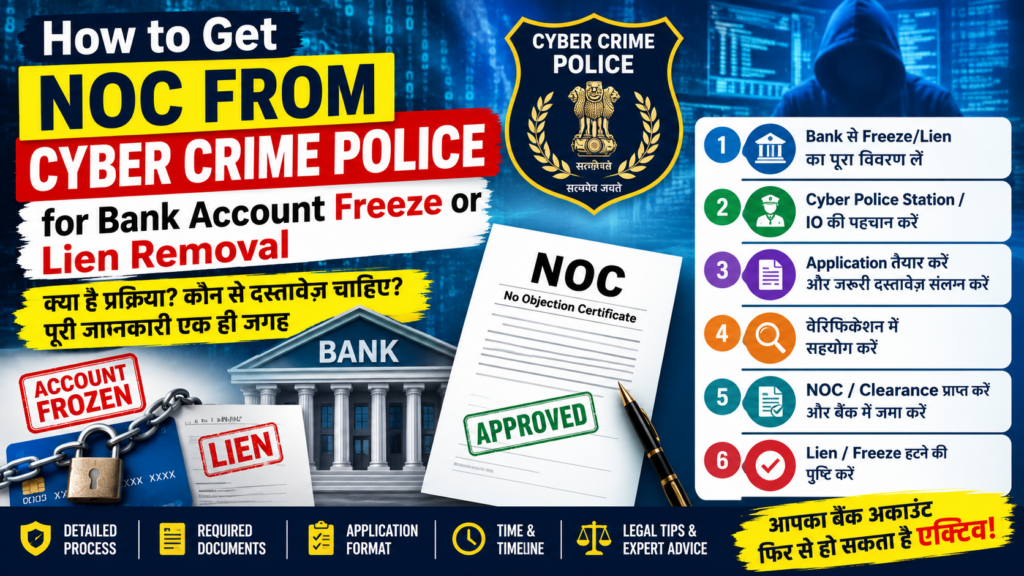
How to Get NOC from Cyber Crime Police for Bank Account Freeze or Lien Removal – Complete Legal Guide A bank account can sometimes be frozen, put on hold, or marked with a lien after a cyber crime complaint, disputed transaction, UPI fraud report, online investment fraud complaint, cryptocurrency transaction, or investigation involving the movement of suspected fraudulent funds. In such cases, the account holder may suddenly find that: UPI payments are not working; money cannot be withdrawn; online banking transactions are restricted; a particular amount is shown as a lien; the entire account is placed on debit freeze; the bank asks the customer to contact the Cyber Crime Police; the bank says that an NOC or clearance from the investigating agency is required. This can be extremely difficult, particularly when the account holder is not involved in any fraud and the account has been connected to a transaction merely because money passed through it. One of the important steps in such cases may be to approach the concerned Cyber Crime Police Station, Cyber Cell, Investigating Officer (IO), or other law-enforcement authority and request verification and appropriate directions/NOC for removal of the lien or restriction. However, it is important to understand one fundamental point: There is no single universal statutory “NOC format” under BNSS that automatically applies to every bank-account freeze or cyber investigation. The procedure depends upon the facts of the case, the authority that placed the restriction, the investigating agency, the bank’s internal process, and the legal basis for the freeze. The Ministry of Home Affairs has clarified that the lien marking/freezing of bank accounts is not done by I4C/MHA itself. Such action may be taken by the concerned State/UT law-enforcement agency during investigation or by banks under applicable regulatory processes. This article explains the practical process of seeking Cyber Police NOC/clearance for a bank account lien or freeze. What Is a Cyber Crime Police NOC? In common practice, a Cyber Crime Police NOC refers to a written communication, clearance, consent, release direction, or other confirmation issued by the concerned investigating authority indicating that the investigating agency has no further objection to the bank taking appropriate action regarding the restriction on the account or the disputed amount. The exact form may vary. Depending upon the circumstances, the communication may be addressed to: Bank Manager Branch Manager Nodal Officer of the Bank Compliance Officer Legal Department of the Bank Cyber Crime Cell Investigating Officer Another concerned law-enforcement authority The terminology may also differ from one case to another. It could be described as: NOC No Objection Certificate De-freezing letter Release letter Lien removal communication Account release direction Clearance letter Police clearance for bank account Direction to bank regarding lien Therefore, a person should not focus only on the word “NOC.” The real objective is to obtain an appropriate written communication from the competent authority and ensure that it reaches the bank through the proper channel. Why Does Cyber Police Freeze or Mark a Lien on a Bank Account? Cyber crime investigations often involve tracing the movement of money through multiple bank accounts. For example: Victim → Account A → Account B → Account C → Account D The actual account holder at Account C may have no knowledge that the original money came from a cyber fraud. Nevertheless, because the account appears in the transaction trail, investigators may need to examine it. Common situations include: 1. Online Financial Fraud A victim reports an online fraud and the money is traced through several bank accounts. 2. UPI Fraud A UPI transaction is reported as fraudulent and the receiving or subsequent beneficiary account is identified. 3. Investment Scam Money from an alleged investment fraud passes through several accounts. 4. Job Fraud Fraudsters collect money from victims using accounts belonging to intermediaries or mule-account holders. 5. Cryptocurrency or USDT Transactions Bank accounts connected with cryptocurrency or P2P transactions may become part of an investigation. 6. Mule Account Investigation An account may be suspected of being used to receive, transfer or layer proceeds of cyber fraud. 7. Disputed Transaction A transaction may be disputed by a complainant and the account can become part of the investigation. The fact that an account appears in a financial trail does not by itself establish that the account holder committed the underlying cyber crime. Investigation and verification of the circumstances remain important. Difference Between Bank Lien and Complete Account Freeze This distinction is extremely important. What Is a Lien? A lien may be placed against a specific amount in an account. For example: Available balance: ₹2,00,000 Lien amount: ₹50,000 In such a situation, the bank may restrict the specified amount while the treatment of the remaining balance depends on the circumstances and bank instructions. What Is a Debit Freeze? A debit freeze may prevent transactions from the account more broadly. The account holder may be unable to: Withdraw money Make UPI payments Transfer funds Use internet banking Issue certain payment instructions Therefore, before applying for an NOC, determine whether the account has: Only a lien amount or A complete debit freeze or Another type of restriction. This information can materially affect the representation made to the Cyber Crime Police and the bank. How to Know Why Your Bank Account Is Frozen The first step is to obtain information from the bank. Ask the bank for: Nature of restriction Lien amount, if any Date of lien/freeze Reference number Police station or investigating agency details, if available FIR/complaint number, if available Name/designation of the investigating officer, if disclosed Transaction ID/UTR connected with the restriction Whether the restriction concerns a specific amount or the entire account Whether the bank requires an NOC/clearance from the investigating agency Where possible, request the information in writing. Can I4C Remove the Lien From My Bank Account? This is an important misconception. The Ministry of Home Affairs has specifically clarified that I4C does not itself investigate NCRP complaints and does not itself make the decision to lien-mark or freeze a bank account. The concerned

How to Get NOC from Cyber Crime Police for Act Lien Removal ? Read More »

Cyber Police Notice 35(3), 41A, 94, 179 and Other ?

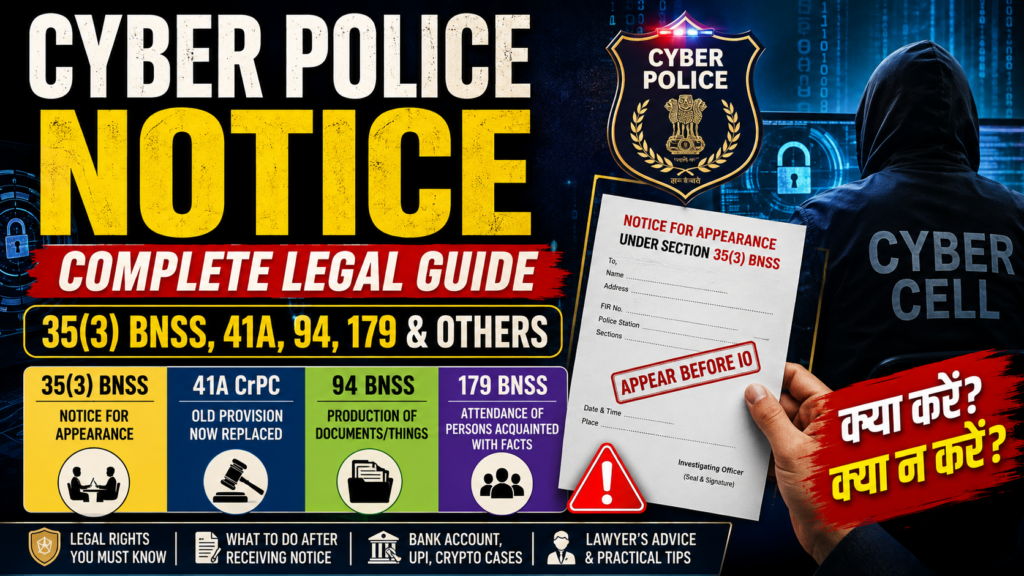
Cyber Crime Police Notice Under BNSS Section 35(3), 41A, 94, 179 and Other Notices – Complete Legal Guide Receiving a notice from the Cyber Crime Police, Cyber Cell, Police Station or Investigating Officer (IO) can create considerable anxiety. Many people immediately assume that a police notice means they have been arrested, that an FIR has been proved against them, or that they will necessarily be taken into custody. That is not necessarily the case. A Cyber Crime Police notice may be issued for several different purposes, including joining an investigation, providing documents, appearing before the Investigating Officer, producing electronic evidence, explaining a bank transaction, providing information about a mobile number or bank account, or appearing as a witness. After the implementation of the Bharatiya Nagarik Suraksha Sanhita, 2023 (BNSS) from 1 July 2024, several provisions of the earlier Code of Criminal Procedure, 1973 (CrPC) were reorganised. One of the most important changes concerns the old Section 41A CrPC Notice, which is now dealt with principally under Section 35(3) BNSS. This article explains the major types of Cyber Crime Police notices, their meaning, what a person should do after receiving one, and when legal assistance may be appropriate. What Is a Cyber Crime Police Notice? A Cyber Crime Police notice is a formal communication issued during an investigation requiring a person to appear, provide information, produce documents or electronic evidence, or otherwise assist the Investigating Officer. Depending upon the purpose and legal provision mentioned, the notice may relate to: Appearance before the Investigating Officer Joining a cyber crime investigation Production of documents Production of electronic evidence Bank account or UPI transactions Cryptocurrency transactions Mobile numbers and SIM cards WhatsApp, Telegram, email or social-media accounts Online investment fraud UPI fraud Identity theft Cheating and impersonation Mule bank accounts Job scams Loan-app harassment Digital arrest scams Phishing and malware cases Witness examination Providing information regarding another person Therefore, not every Cyber Cell notice has the same legal meaning. The first step should always be to identify the section mentioned in the notice, FIR/case number, police station, Investigating Officer, date and time of appearance, and the purpose for which the person has been called. Section 35(3) BNSS Notice – The New 41A Notice One of the most commonly encountered notices in criminal and cyber crime investigations is the Section 35(3) BNSS Notice. Section 35 BNSS deals with circumstances in which police may arrest without a warrant. Sub-section (3) provides for a notice requiring a person to appear before the police officer where arrest is not required at that stage. The official Second Schedule of the BNSS contains Form No. 1 – Notice for Appearance by the Police, specifically prescribed under Section 35(3). The form contains details such as the case/FIR number, date, applicable sections, police station, and the date, time and place where the person is required to appear. In simple language: A Section 35(3) BNSS notice generally means that the police require the person’s appearance and cooperation in the investigation instead of making an immediate arrest at that stage. It is therefore important not to ignore the notice. Section 41A CrPC Notice – What Happened to It? Before 1 July 2024, police commonly issued a Section 41A CrPC Notice requiring a person to appear before the Investigating Officer. The BNSS came into force on 1 July 2024, replacing the CrPC. The notice-of-appearance mechanism formerly associated with Section 41A CrPC is now contained in Section 35(3) BNSS. Therefore, in a new matter governed by BNSS, people will generally see: Old provision: Section 41A CrPC Current corresponding provision: Section 35(3) BNSS This is why people frequently search for terms such as: 41A notice from Cyber Cell 41A notice from Cyber Police Cyber Crime 41A notice New 41A notice under BNSS 35(3) BNSS notice 35 BNSS notice Cyber police appearance notice Does Receiving a Section 35(3) Notice Mean You Are Arrested? No. A notice requiring appearance is not itself an arrest. The purpose is generally to require the person to appear before the police and participate in the investigation. The fact that a person’s name, bank account, mobile number, transaction, company or digital identity has appeared during an investigation does not automatically establish guilt. However, a person should not treat the notice casually. The exact legal position depends on: The offences mentioned Whether an FIR has been registered The punishment prescribed for the alleged offences The person’s role in the investigation Evidence collected by the police Previous compliance with notices The reasons recorded by the Investigating Officer where applicable The overall facts and circumstances of the case The Supreme Court has emphasised the statutory safeguards surrounding Section 35 notices and arrest. What Is the Difference Between Section 35(3) BNSS and Section 41A CrPC? The basic distinction is primarily one of the new procedural code and numbering. Earlier Law Current Law CrPC, 1973 BNSS, 2023 Section 41A Section 35(3) Notice of appearance Notice of appearance Police investigation Police investigation Appearance before IO Appearance before IO For cases governed by the current procedural framework, Section 35(3) BNSS is the appropriate statutory reference. Important Point: Physical Service of Section 35(3) Notice The manner in which a Section 35 notice is served has become an important legal issue. In Satender Kumar Antil v. Central Bureau of Investigation, the Supreme Court considered the statutory mode of service of notices under the relevant provisions. The Supreme Court judgment records that service through WhatsApp or other electronic modes cannot be treated as an alternative or substitute for the mode of service prescribed under the law. The Bureau of Police Research & Development subsequently circulated an official note referring to this judgment and stated that Section 35(3) notices should be served through physical mode and that WhatsApp or other electronic modes should not be used as a substitute. Therefore, a person who receives a purported Section 35(3) BNSS notice only through WhatsApp or email should carefully verify its authenticity and legal mode of service rather than blindly ignoring it or blindly complying with

Cyber Police Notice 35(3), 41A, 94, 179 and Other ? Read More »

Scroll to Top