Author name: admin

What is MuleHunter AI | AI Technology Behind Cyber Crime Investigations

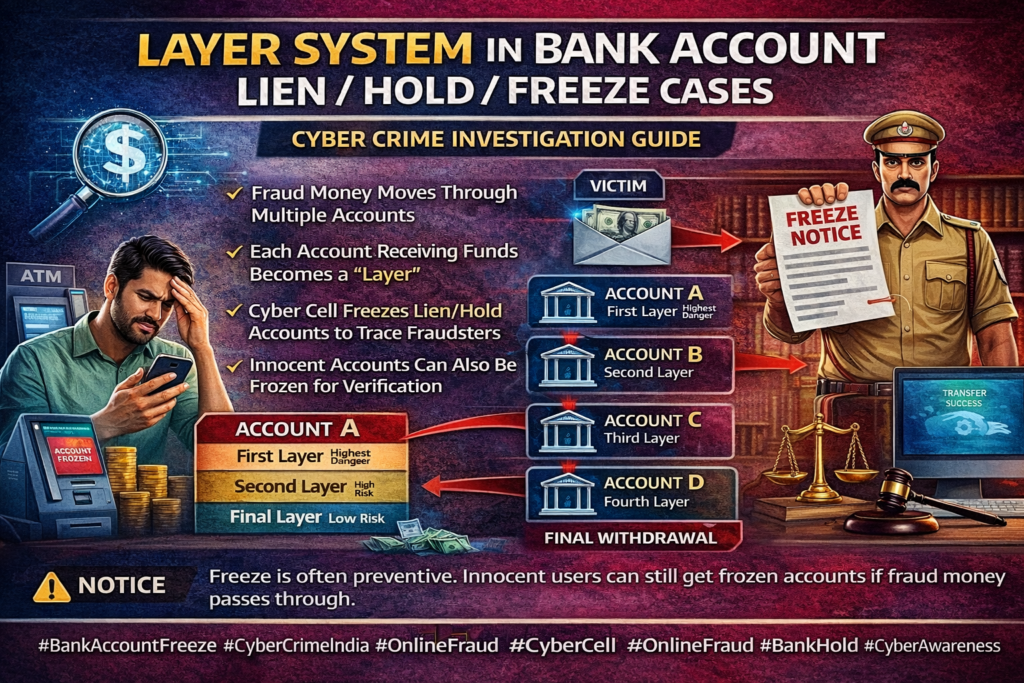
MuleHunter AI: What It Is, How It Works, and Its Role in Fighting Cyber Fraud in India With the rapid growth of digital banking, UPI payments, and online financial transactions, cyber fraud has increased significantly across India. One of the biggest challenges faced by law enforcement agencies is identifying mule bank accounts — accounts used by cyber criminals to move stolen money quickly before authorities can trace it. To tackle this growing problem, advanced technology solutions have been introduced, and one of the most important developments is MuleHunter AI. This system uses Artificial Intelligence (AI) and data analytics to detect suspicious bank accounts linked to cybercrime networks. This blog explains in detail what MuleHunter AI is, how it works, why it was introduced, and how it impacts bank account holders and cybercrime investigations. What is MuleHunter AI? MuleHunter AI is an Artificial Intelligence–based monitoring and investigation system designed to identify and track money mule accounts involved in cyber fraud transactions. A money mule account is a bank account used to receive or transfer illegally obtained funds. Often, the account holder may: Knowingly allow criminals to use their account, or Become an unknowingly victim after sharing OTP, documents, or account access. MuleHunter AI helps authorities detect such accounts by analyzing large volumes of financial transaction data in real time. Why MuleHunter AI Was Introduced Cyber fraud cases such as: Online investment scams IPO scams Digital arrest scams Loan app frauds UPI frauds Cryptocurrency scams involve multiple bank accounts layered across different states. Criminals typically move money within minutes through several accounts to avoid detection. Traditional manual investigation methods were slow and ineffective. MuleHunter AI was introduced to: Automatically detect suspicious transaction patterns Identify mule account networks Help cyber police freeze fraudulent funds quickly Reduce financial losses to victims What is a Money Mule Account? A money mule is a person whose bank account is used to transfer illegal money. Common ways accounts become mule accounts: Selling bank accounts for commission. Sharing ATM cards or internet banking access. Giving documents for fake job offers. Renting accounts for crypto or trading transactions. Falling victim to phishing or remote access scams. Even innocent account holders may face account freezes if their account unknowingly becomes part of a fraud chain. How MuleHunter AI Works MuleHunter AI uses machine learning algorithms and behavioral analysis to monitor financial activities. 1. Transaction Pattern Analysis The system studies: Frequency of transactions Sudden high-value transfers Rapid inward and outward transfers Multiple beneficiaries 2. Network Mapping AI connects accounts involved in layered transactions and creates a digital fraud network map. 3. Risk Scoring Each account receives a risk score based on suspicious activity. Higher risk score = higher probability of mule involvement. 4. Real-Time Alerts Banks and cybercrime authorities receive alerts when suspicious activity is detected. 5. Account Action Based on alerts: Debit freeze Lien marking Full account freeze may be applied for investigation. Role of MuleHunter AI in Cyber Crime Investigation MuleHunter AI helps authorities: Trace fraud money trail faster Identify organized cybercrime gangs Prevent withdrawal of stolen funds Recover victim money Reduce investigation time This technology supports coordination between: Banks Cyber Crime Police Financial Intelligence Units Law Enforcement Agencies Why Genuine Accounts Sometimes Get Frozen Many innocent individuals receive bank freezes due to MuleHunter AI detection because: They received funds from unknown persons. They performed P2P crypto transactions. They sold goods online and accepted payments from fraud-linked accounts. Their account appeared in transaction layering. AI identifies patterns, not intentions. Therefore, investigation is required to determine innocence. What To Do If Your Account Is Frozen Due to MuleHunter AI If your bank account is frozen: Contact your bank immediately and request freeze details. Ask for: Complaint number Cyber police station name Layer information File a written representation to the concerned cyber cell. Submit documents: Bank statement ID proof Transaction explanation Cooperate fully with the Investigation Officer. Seek legal guidance if freeze continues unnecessarily. Benefits of MuleHunter AI Faster fraud detection Protection for cybercrime victims Early blocking of stolen funds Improved digital banking safety Nationwide fraud monitoring Challenges and Concerns While MuleHunter AI is effective, some challenges exist: False positives affecting genuine users Delayed communication from authorities Lack of awareness among account holders Long freeze periods during investigation Proper representation and legal clarification usually resolve genuine cases. Safety Tips to Avoid Becoming a Mule Account Never share OTP or banking credentials. Do not allow others to use your bank account. Avoid unknown investment schemes. Verify buyers and payment sources. Do not sell bank accounts or SIM cards. Be careful in crypto P2P transactions. Report suspicious transactions immediately. Legal Awareness for Citizens Under Indian cyber laws and banking regulations, authorities can temporarily restrict accounts involved in suspected fraud investigations. However, genuine account holders have the right to: Know the reason for freeze Receive investigation details Submit explanations Request review or removal of freeze Maintaining transaction records and communication proof is very important. MuleHunter AI represents a major technological advancement in India’s fight against cybercrime. By using Artificial Intelligence to detect mule accounts and fraud networks, authorities can prevent financial losses and improve digital security. However, awareness among citizens is equally important. Understanding how mule accounts work and following safe banking practices can prevent unnecessary legal complications and account freezes. As digital transactions continue to grow, systems like MuleHunter AI will play a crucial role in creating a safer financial ecosystem for everyone.  आज के डिजिटल युग में ऑनलाइन बैंकिंग, UPI और इंटरनेट ट्रांजैक्शन तेजी से बढ़े हैं। इसके साथ-साथ साइबर फ्रॉड के मामलों में भी भारी वृद्धि हुई है। साइबर अपराधी चोरी किए गए पैसों को कई बैंक खातों के माध्यम से जल्दी-जल्दी ट्रांसफर करते हैं ताकि पुलिस उन्हें ट्रेस न कर सके। इसी समस्या को रोकने के लिए MuleHunter AI नाम की एक आधुनिक Artificial Intelligence आधारित प्रणाली विकसित की गई है, जो संदिग्ध बैंक खातों और फ्रॉड नेटवर्क की पहचान करने में मदद करती है। MuleHunter AI क्या है? MuleHunter AI एक Artificial Intelligence (AI) आधारित सिस्टम है जिसका

What is MuleHunter AI | AI Technology Behind Cyber Crime Investigations Read More »

Online IPO Investment Scam in India | Cyber Crime Lawyer

IPO Scam in India: What It Is, How Online Investment Frauds Work, How to Recover Money & Safety Tips by Advocate Deepak (Cyber Crime Lawyer) The rise of digital investment platforms and online trading has made investing easier than ever before. However, along with genuine opportunities, cyber criminals have also developed sophisticated methods to cheat investors through IPO scams and online investment frauds. Thousands of people across India lose their savings every year after being trapped by fake IPO offers, fraudulent trading applications, and manipulated investment schemes. An IPO scam is not just a financial loss; it often leads to complex legal issues such as bank account freezes, lien marking, cyber police investigations, and difficulty in recovering funds. This detailed blog explains what an IPO scam is, how scammers operate, why bank accounts sometimes get frozen during investigation, how victims can recover money, and important safety tips shared by Advocate Deepak, Cyber Crime Lawyer. What is an IPO Scam? IPO stands for Initial Public Offering, where a company offers its shares to the public for the first time through recognized stock exchanges like NSE or BSE. In an IPO scam, fraudsters falsely claim to provide access to upcoming IPO shares or pre-listing investment opportunities. Scammers impersonate investment advisors, brokerage firms, or market experts and convince victims that they can secure guaranteed allotment or high-profit shares before public listing. In reality, no genuine investment exists, and the money transferred by victims is routed through multiple bank accounts to hide the fraud trail. How IPO and Online Investment Scams Usually Work Fake Investment Contact Victims are contacted through WhatsApp groups, Telegram channels, social media advertisements, or phone calls. Fraudsters introduce themselves as analysts or representatives of well-known brokerage companies and offer exclusive investment opportunities. Creation of Trust Scammers share fake certificates, SEBI registration numbers, fabricated profit screenshots, and news articles to appear legitimate. Victims are slowly convinced that they are part of a professional investment network. Fake Trading Platforms Fraudsters provide login credentials to a professional-looking website or mobile application. The dashboard shows artificial profits and successful IPO allotments. These platforms are fully controlled by scammers and display manipulated data. Continuous Fund Demand After the initial investment, victims are asked to deposit additional amounts for various reasons such as premium IPO access, tax clearance charges, margin requirements, or withdrawal processing fees. Withdrawal Refusal When victims attempt withdrawal, new charges are demanded repeatedly. Eventually, communication stops, accounts get blocked, and investors realize they have been cheated. Types of Online Investment Scams Related to IPO Fraud Pre-IPO investment scams promising early share access. Fake stock advisory services guaranteeing profits. App-based trading fraud showing fake returns. Overseas investment schemes using cryptocurrency payments. Social media influencer investment traps. Why Cyber Criminals Use IPO Scams IPO investments attract people because they are associated with quick profits and market growth. Fraudsters exploit this expectation and psychological pressure by creating urgency and exclusivity. Victims are told that opportunities are limited and must invest immediately, preventing proper verification. What is Layering of Money in IPO Scam Cases After receiving funds, scammers rarely keep money in one account. Instead, they transfer funds rapidly through multiple accounts, known as the layering system. Layer 1 – Victim Transfer Account The first account receives money directly from victims. Layer 2 – Mule Accounts Funds are transferred to several unrelated accounts to break the transaction trail. Layer 3 – Conversion Layer Money may be converted into cryptocurrency, withdrawn in cash, or moved to foreign platforms. This process makes tracing difficult and often results in innocent accounts getting investigated or temporarily frozen. What is a Mule Account? A mule account is a bank account used to transfer illegal funds on behalf of criminals. Sometimes account holders unknowingly allow their accounts to be used in exchange for commission or by sharing banking access. Cyber cells freeze such accounts to stop further movement of fraudulent funds during investigation. Why Cyber Cell or Authorities Freeze Bank Accounts Authorities may place lien, hold, or freeze instructions due to: Suspicious transactions linked to fraud complaints Funds received from a reported scam transaction Investigation under IT Act or criminal laws Transaction trail connected to fraudulent accounts Preventing withdrawal of disputed money Even genuine individuals may face freezes if their accounts appear in the transaction chain. How to Recover Money from IPO Scam Immediate Cyber Complaint Report the fraud immediately through the National Cyber Crime Portal or helpline 1930. Early reporting increases chances of fund blocking before withdrawal. Inform the Bank Submit written complaint to your bank requesting transaction details and beneficiary bank information. Banks can initiate internal alerts and coordinate with other banks. Collect Evidence Maintain all available records including payment receipts, chats, account numbers, website links, and screenshots of investment dashboards. Approach Concerned Cyber Crime Police Station Submit a detailed representation explaining the fraud, along with documents and identity proof. Cooperation with investigation is essential for recovery. Legal Assistance Professional legal guidance helps in communication with cyber authorities, removal of wrongful account freezes, and follow-up with investigating officers. What to Do if Bank Does Not Provide Information Sometimes banks refuse to share freeze details citing investigation confidentiality. In such situations: Submit written request for freeze authority details. Ask for complaint number and investigating agency name. Escalate matter to bank nodal officer. File complaint before RBI Banking Ombudsman if required. Send representation to concerned cyber cell directly. Customers have the right to know the authority that ordered account restrictions. Role and Responsibility of Banks in Freeze or Lien Cases Banks play a critical role during cyber fraud investigations. Their responsibilities include: Informing customers about account restrictions. Providing freeze authority details when legally permitted. Marking lien only as per official instructions. Ensuring proportional freezing instead of unnecessary full account blockage where applicable. Coordinating with investigation agencies for resolution. Banks cannot arbitrarily freeze accounts without lawful instructions from competent authorities. Safety Tips by Advocate Deepak (Cyber Crime Lawyer) Advocate Deepak advises investors and businesses to follow strict digital safety practices: Invest only through

Online IPO Investment Scam in India | Cyber Crime Lawyer Read More »

Best Cyber Crime Advocate for Business in India

Best Cyber Crime Advocate for Business in India | Cyber Crime Advocate for Company Panel in Noida In today’s digital business environment, companies are increasingly dependent on online platforms, digital payments, cloud systems, and internet-based operations. While technology has improved business growth, it has also increased the risk of cyber crime, online fraud, data theft, and digital legal disputes. Because of this, many organizations are actively searching for the best cyber crime advocate for business in India or a cyber crime advocate for company panel in Noida who can protect their legal and digital interests. A qualified cyber lawyer helps companies handle cyber investigations, data breach issues, online fraud recovery, compliance matters, and legal protection against digital threats. Why Businesses Need a Cyber Crime Advocate Modern businesses face multiple cyber risks such as: Online payment fraud Data breach and hacking incidents Employee data misuse Website hacking or ransomware attacks Fake online reviews or impersonation Intellectual property theft Digital contract disputes A cyber crime advocate for business in India ensures that companies remain legally protected while handling such incidents. Companies today prefer appointing a cyber crime advocate for company panel to manage ongoing cyber legal risks rather than reacting only after a problem occurs. Who is the Best Cyber Crime Advocate for Company Panel? The best cyber crime advocate for company panel is not defined only by experience but by specialization in cyber laws and digital investigations. A professional cyber lawyer should have: Strong knowledge of cyber crime laws in India Experience in handling corporate cyber fraud cases Understanding of digital evidence and investigation process Knowledge of banking fraud and online scam recovery Experience working with cyber police and investigation agencies Ability to advise companies on preventive cyber compliance Businesses searching for the best cyber crime advocate for business in India should focus on expertise in technology-related legal matters rather than general litigation experience. Cyber Crime Advocate for Company Panel in Noida Noida has become a major IT and startup hub, making cyber legal protection essential for companies operating there. Many startups, IT firms, e-commerce businesses, and fintech companies now appoint a cyber crime advocate for company panel in Noida to manage ongoing cyber risks. A panel advocate typically assists companies with: Cyber fraud complaints and legal response Drafting cyber policies and compliance frameworks Handling police notices and investigations Data protection advisory Online reputation protection Legal response to hacking or phishing incidents Having a dedicated cyber crime advocate for company panel in Noida ensures faster legal action when cyber incidents occur. How to Find the Best Cyber Advocate for Your Company When businesses search online for a cyber lawyer for company cyber related issue, they should evaluate several important factors. 1. Specialization in Cyber Law Choose an advocate who regularly handles cyber crime and digital fraud matters. 2. Corporate Experience The lawyer should understand business operations, contracts, and company compliance requirements. 3. Investigation Knowledge A good cyber advocate understands how cyber police investigations work and how digital evidence is handled. 4. Preventive Legal Strategy The best cyber crime advocate for business focuses on prevention, not just dispute handling. 5. Availability for Panel Services Companies should prefer advocates who offer long-term panel support. Services Offered by a Cyber Crime Advocate for Businesses A professional cyber crime advocate for company panel usually provides: Cyber fraud legal consultation Assistance in filing cyber complaints Bank account freeze and recovery matters Data breach legal response Drafting cybersecurity policies Employee cyber compliance advisory Online defamation and impersonation cases Digital contract dispute handling These services help businesses operate securely in the digital ecosystem. Common Cyber Issues Faced by Companies in India Businesses frequently search for the best cyber crime advocate for business in India due to increasing cyber threats such as: Fake payment gateway scams Business email compromise (BEC fraud) Unauthorized access to company systems Cryptocurrency fraud disputes Vendor payment fraud Social media account hacking A cyber advocate helps companies respond legally and technically to such challenges. Benefits of Appointing a Cyber Advocate on Company Panel Appointing a cyber crime advocate for company panel in Noida provides long-term advantages: Immediate legal response during cyber attacks Reduced financial losses Compliance with cyber laws Professional handling of police notices Protection of company reputation Preventive risk management Companies with legal cyber support are better prepared for digital risks. Why Cyber Legal Support is Essential in 2026 With increasing digital transactions and AI-based scams, cyber crime cases involving businesses are rising rapidly. Regulatory scrutiny and investigation procedures have also become stricter. Therefore, appointing the best cyber crime advocate for business in India is no longer optional but a necessary business safeguard. How Businesses Should Choose a Cyber Lawyer Today Before selecting a cyber advocate, companies should: Check cyber case experience Review professional background Understand response time during emergencies Confirm knowledge of banking and digital fraud laws Ensure availability for long-term advisory Choosing the right cyber lawyer for company cyber related issue helps businesses avoid future legal complications. As businesses continue to expand digitally, cyber legal protection has become a critical requirement. A qualified cyber crime advocate for business in India helps companies manage cyber risks, handle investigations, and maintain compliance with evolving digital laws. Organizations operating in technology hubs should consider appointing a cyber crime advocate for company panel in Noida to ensure continuous legal protection against cyber threats and online fraud issues. Selecting the right cyber advocate not only resolves legal problems but also strengthens business security in the digital era. Disclaimer This content is published for educational and informational purposes only. We are not engaged in any advertisement, solicitation, or client engagement through this content. The information provided should not be treated as legal advice, and readers should seek independent professional guidance for their specific matters.

Best Cyber Crime Advocate for Business in India Read More »

Difference Between Section 94 BNSS and Section 35(3) BNSS Notice (2023)

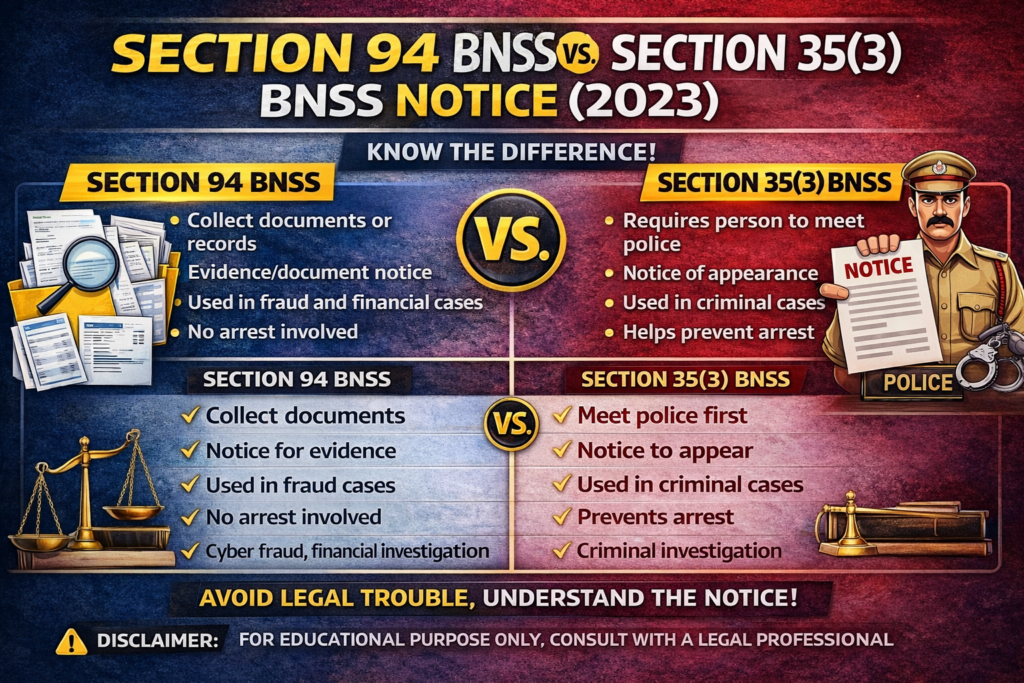
Difference Between Section 94 BNSS and Section 35(3) BNSS Notice (2023) – Complete Legal Guide After the implementation of the Bharatiya Nagarik Suraksha Sanhita (BNSS), 2023, several new procedural provisions were introduced in criminal investigations in India. Among the most commonly used provisions in cyber crime and financial investigations are Section 94 BNSS and Section 35(3) BNSS. Many people get confused between these two notices because both are issued during police investigations. However, their purpose, legal effect, and application are completely different. This blog explains the difference between Section 94 BNSS and Section 35(3) BNSS notices in simple language. What is Section 94 BNSS Notice? A Section 94 BNSS notice is issued when police or a court requires documents, records, or electronic evidence related to an investigation. It is mainly used for collecting information or evidence from individuals or institutions. Purpose of Section 94 BNSS To obtain documents or digital records To verify financial or electronic transactions To collect evidence legally during investigation Commonly Requested Information Bank account statements Transaction details KYC documents Mobile or IP records Digital communication data Section 94 focuses on production of documents, not arrest or detention. What is Section 35(3) BNSS Notice? Section 35(3) BNSS relates to the powers of police regarding arrest in offences punishable up to seven years. Under this provision, police must first issue a notice of appearance instead of directly arresting a person, if arrest is not immediately necessary. This section protects citizens from unnecessary arrest. Purpose of Section 35(3) BNSS To ensure fair investigation To prevent unnecessary arrest To give a person an opportunity to cooperate with investigation The person receiving this notice is required to appear before the investigating officer and cooperate. Key Difference Between Section 94 BNSS and Section 35(3) BNSS Basis Section 94 BNSS Section 35(3) BNSS Main Purpose Collect documents or records Require person to appear before police Nature of Notice Evidence/document production Notice of appearance Issued To Individuals, banks, companies Suspect or accused person Arrest Involved No Arrest avoided if complied Used In Cyber fraud, financial investigation Criminal investigation involving individuals Compliance Submit documents Appear before investigating officer Legal Objective Evidence collection Protection from unnecessary arrest When is Section 94 BNSS Used? Section 94 BNSS is commonly used in: Cyber crime investigations Online fraud cases Bank account freeze matters Financial transaction verification Digital evidence collection Example: Police may ask a bank to provide account transaction details connected to a fraud complaint. When is Section 35(3) BNSS Used? Section 35(3) BNSS is used when: Police suspect involvement of a person in an offence Arrest is not immediately required Investigation can proceed through cooperation Example: Instead of arresting a person directly, police issue notice asking them to appear for questioning. Why Understanding the Difference is Important Many people panic after receiving a legal notice without understanding its purpose. A Section 94 notice means authorities need information or documents. A Section 35(3) notice means police want your presence during investigation but are avoiding arrest at that stage. Knowing the difference helps individuals respond appropriately and avoid unnecessary fear. What Should You Do If You Receive These Notices? If You Receive Section 94 BNSS Notice Read the notice carefully Collect requested documents Submit information within deadline Maintain copies of submitted records If You Receive Section 35(3) BNSS Notice Appear before the investigating officer as instructed Cooperate with investigation Carry identification and relevant documents Seek legal guidance if required Important Legal Point Compliance with both notices generally helps avoid further legal complications. Ignoring notices may lead to stricter legal action depending on the circumstances. Role in Cyber Crime and Online Fraud Cases In modern cyber investigations: Section 94 BNSS helps trace digital evidence and money trail. Section 35(3) BNSS ensures investigation proceeds without unnecessary arrest while allowing questioning of individuals involved. Together, these provisions balance effective investigation and protection of individual rights. Conclusion Section 94 BNSS and Section 35(3) BNSS serve different but equally important roles in criminal procedure. Section 94 BNSS = Collection of documents and digital evidence. Section 35(3) BNSS = Notice to appear instead of immediate arrest. Understanding these provisions helps individuals respond legally and responsibly during investigations, especially in cyber crime and financial fraud matters. Disclaimer This content is published for educational and informational purposes only. We are not engaged in any advertisement, solicitation, or client engagement through this content. The information provided should not be treated as legal advice, and readers should seek independent professional guidance for their specific cases.

Difference Between Section 94 BNSS and Section 35(3) BNSS Notice (2023) Read More »

Scroll to Top